How to Use AI in Project Management: Top Tools & Use Cases
Marvin broke down AI adoption in project management, weighing Asana, ClickUp AI, and Motion across automation use cases, roadmaps, and adoption best practices.
.avif)

Your project management tool won’t help you manage your projects when you’re working across email, Slack, CRMs, and other business platforms. That’s where AI can help you. It can spot risks early, keep workloads balanced, and even draft status updates. Using practical examples, we’ll show you how to use AI in project management.
In this article, we’ll cover:
- 10 ways to use AI in project management
- Examples of AI in project management
- A roadmap to adopt AI
- Best practices to scale AI responsibly
- Challenges and how to solve them
- Compare the top 5 AI project management tools
10 practical ways to use AI in project management
AI can help you predict risks, automate tasks, and track budgets. Below are the top 10 ways:
1. Automated task creation
AI turns emails, chats, and transcripts into tasks with clear owners and due dates, cutting manual entry. Asana and ClickUp offer smart task suggestions, while Lindy sets up AI-powered workflows across inboxes and project boards.
2. Project risk prediction and delay prevention
Predictive analysis flags likely delays using historic data, so teams reassign work before deadlines slip. AI analyzes schedules and completion rates to predict risks. Wrike and Motion highlight potential delays, while Lindy uses an AI workflow builder to send alerts across tools.
3. Better resource allocation
AI balances workloads using real-time capacity and skills data. Asana surfaces availability, while ClickUp adjusts loads automatically. Lindy provides a no-code AI agent builder to connect calendars and boards. This improves fairness and avoids burnout in project teams.
4. Project status reports and executive summaries
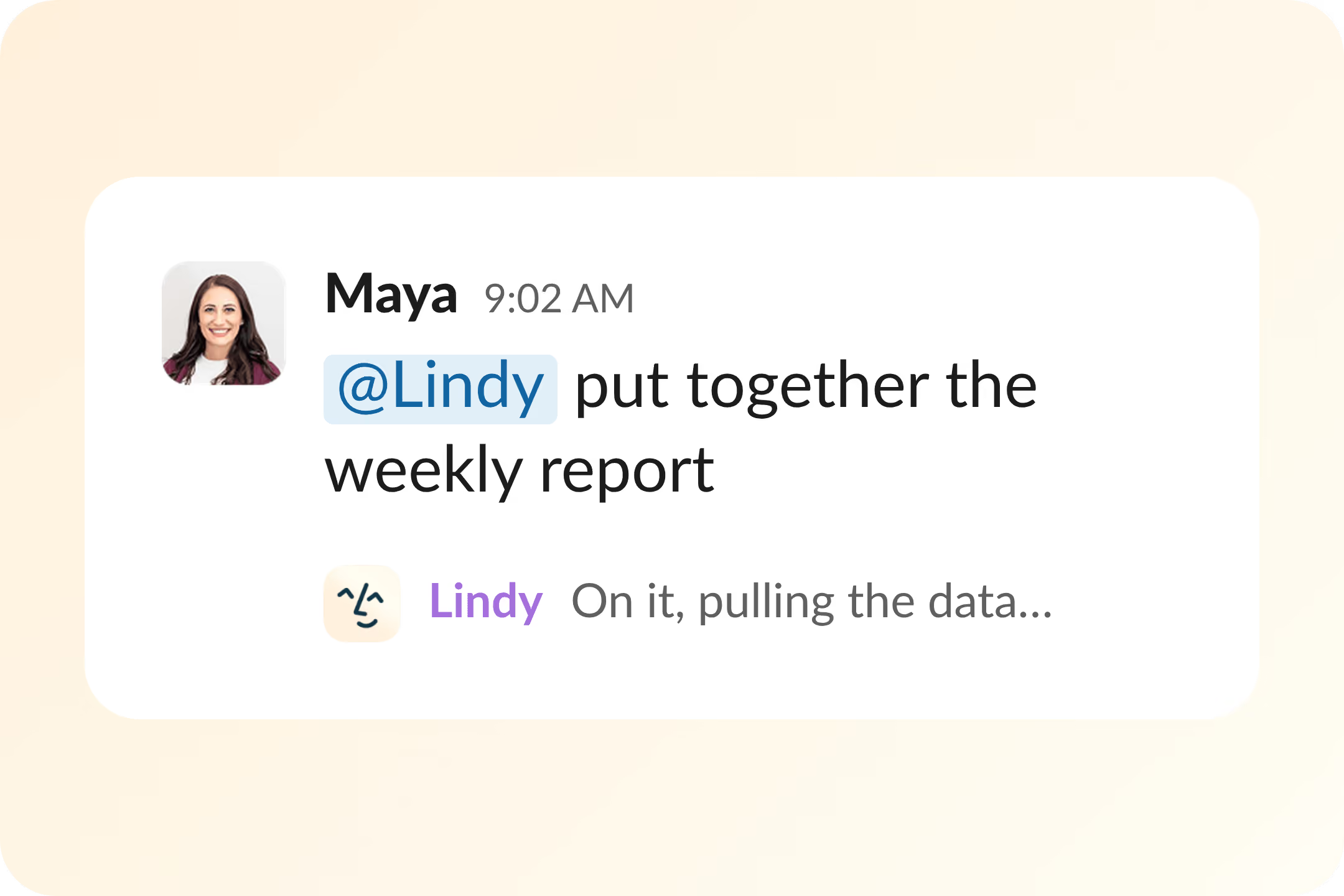
AI pulls data from meetings and tasks to create status reports automatically. Asana and ClickUp generate status summaries, while Lindy pushes cross‑tool digests to PM and CRM channels. The workflow pulls task updates from Asana and sends a status report to Slack automatically.
5. Client or stakeholder communication timelines
AI supports communication by drafting updates, reminders, and milestone emails. ClickUp posts updates in Slack, Motion aligns meetings with deadlines, and Lindy offers AI agents for small businesses that automate client updates.
6. Track budgets and detect anomalies
AI scans budgets to flag anomalies before overruns escalate. Wrike provides alerts, Motion highlights resource spikes, and Lindy uses an AI workflow builder to route these alerts to Slack or email.
7. Backlog prioritization by ROI or urgency
AI ranks backlog items by effort and impact. This approach turns prioritization into a continuous process and reduces decision churn. ClickUp Autopilot adjusts priorities automatically, while Asana Intelligence suggests orders by goals. Lindy runs AI-powered workflows to combine feedback and data.
8. Dependency schedule optimization
AI recalculates schedules and reschedules dependencies when tasks slip, saving hours and reducing conflicts. Tools like Motion can rebalance dependencies, Asana can adjust deadlines, and Lindy can link schedules into workflow management systems.
9. Compliance and approvals
AI checks if the required approvals and documents are complete. This makes compliance easier without slowing down delivery. Wrike highlights missing compliance evidence, while ClickUp drafts policy summaries. Lindy provides an AI workflow builder that automates compliance checks across email and storage.
10. Centralized knowledge for faster onboarding and handoffs
AI summarizes documents and decisions into searchable hubs. ClickUp Brain and Wrike Copilot provide Q&A, while Lindy’s no-code AI agents tie wikis, email, and tasks together. This reduces onboarding time and prevents context loss during handoffs.
Next, let’s see how teams save time and boost accuracy using AI in project management.
Examples of AI in project management
Practical examples show how teams use AI in project management to save time, reduce risk, and improve communication. Below are a few:
Faster status reporting with Asana
Asana customers like ATEED in New Zealand cut their monthly report prep from two weeks to one day after adopting AI-driven reporting and standardized workflows.
Backlog triage in ClickUp
ClickUp Autopilot Agents can answer “Who owns this task?” and automatically post summaries into Slack. Teams that adopt this workflow can potentially save 3–5 hours per week previously spent chasing updates. It keeps backlogs clean and makes decisions visible without extra meetings.
Delay prevention with Motion
Motion’s AI uses smart scheduling to automatically rearrange meetings and tasks when it detects conflicts or delays. Agencies use these features to reallocate work and avoid missed deadlines.
Cross-tool reporting with Lindy
Lindy agents can join meetings, generate notes, and compile status packets across Asana, Jira, and Slack. Teams can reduce reporting time with a Lindy agent that pushes summaries directly to leadership channels. It’s how a no-code setup can tie multiple tools into one automated reporting cycle.
Knowledge sharing with Wrike Copilot
Wrike Copilot answers project-related questions by scanning existing data. Teams use it to prepare audit reports or onboarding guides without manually searching files. It shows how AI in project management improves both compliance and pace.
Together, these AI use cases in project management save time and improve accuracy and accountability. Next, let’s explore how to implement AI in project management.
Roadmap to using AI in project management
Many teams want to use AI in project management, but hesitate because they don’t know where to start. Here’s a simple roadmap to reduce uncertainty:
- Identify one high-value use case: Pick a small but meaningful workflow, such as auto-generating status updates or converting meeting notes into tasks. These are easy to measure and quick to pilot.
- Map triggers, data, and outputs: List where the process begins, what information it requires, and where the results should go. For example: meeting notes → Jira tasks → summary to Slack.
- Choose the right tool for the job: Use project management AI tools like Asana or ClickUp for in-platform automation and Motion for scheduling. You can then use Wrike for risk alerts and Lindy for a cross-tool AI workflow builder that connects email, calendars, and task boards.
- Run a short pilot: Test in one team for 4–6 weeks. Track metrics such as reporting time saved or the number of missed tasks reduced. Share visible wins to build confidence.
- Add observability and guardrails: Set up audit logs, alerts, and approvals for decision-critical steps. This makes adoption easier for leadership and compliance teams.
- Scale gradually: Expand only to processes where you see a measurable ROI. Add more automation steps slowly, making sure each one improves outcomes without creating noise.
This roadmap lowers the barrier to adoption and gives project managers a practical way to test AI without overhauling their entire process. Let’s look at some best practices next.
Best practices for successful AI adoption
Adopting AI in project management works best when you treat it as a gradual shift rather than a one-time rollout. These best practices help teams scale responsibly:
- Start with a pilot project and iterate fast: Begin with a workflow like meeting-to-task conversion or automated status reports. Prove value quickly, then expand to more complex automations.
- Keep human oversight on critical tasks: Use AI to recommend, not decide, in areas like budget approvals, compliance checks, or scope changes. Human review protects against errors and builds trust in the system.
- Keep data clean and centralized: AI depends on accurate information. Standardize fields, enforce naming conventions, and reduce duplicate records. This makes project management AI tools more effective across every use case.
- Integrate across teams, not in silos: AI delivers more value when it connects departments. For example, linking engineering, sales, and support workflows with a no-code AI agent builder avoids fragmented adoption.
- Document wins and failures: Track how much time you save or which errors you reduce. Share results openly so adoption becomes a shared process instead of a top-down mandate.
When teams follow these practices, they reduce adoption friction and build confidence to scale AI across the organization. So, what are the challenges of AI in project management?
Challenges & overcoming them
Even when teams see the benefits of AI in project management, adoption comes with hurdles. Addressing these challenges early helps projects succeed:
- Upfront cost versus ROI timelines: Vendors tie many AI features to premium plans or add‑ons. Teams worry about spending before results appear. The fix is to start with free AI tools for project management or pilot features included in existing software. Measure time saved in weeks, not months, to justify scaling.
- Team resistance to change: Employees often hesitate to trust AI with daily tasks. Involve them early by showing real wins, such as automated reports or AI-assisted scheduling. Keeping a manual fallback option builds confidence until they trust the system.
- Privacy, security, and compliance concerns: Handling sensitive data raises valid worries. Choose platforms with clear compliance standards, audit trails, and controls. Wrike and Asana offer enterprise compliance features, while Lindy is SOC 2 and HIPAA-compliant, and provides configurable checkpoints in AI workflows so teams can insert approvals before any output goes live.
When leaders address these issues transparently, adoption moves faster. AI is most effective when teams view it as a tool they control, not a black box. Next, we explore the top 5 tools.
5 best AI tools for project management in 2025
Many project management AI tools exist, but a few stand out for distinct strengths. Here’s a snapshot of five platforms that teams are exploring in 2025:
| Tool | Best for | Starting price | Key strength |
|---|---|---|---|
| Lindy | Cross-tool automation and reporting | Free plan available, Pro $49.99/month | No‑code agent builder, multi‑step AI workflows, integrations with Asana, Jira, Slack, and HubSpot |
| Asana | Workflow standardization and smart reporting | Free, paid plans from $13.49/month, billed monthly | Work Graph + AI summaries, risk insights, and portfolio-level reporting |
| ClickUp AI | Task ownership and backlog automation | Free, paid plans from $14/month, billed monthly | Prebuilt Autopilot Agents, channel summaries, and connected search across apps |
| Wrike Work Intelligence | Risk prediction and compliance monitoring | Free, paid from $10/user/month | AI-powered risk alerts, Copilot Q&A, and advanced reporting dashboards |
| Motion | Scheduling and dependency management | From $29/user/month, billed yearly | AI Project Manager predicts delays and auto-reschedules tasks |
These platforms show how AI in project management is diversifying. Some focus on scheduling, others on reporting or cross-tool automation. For many teams, the right choice depends on whether they need depth inside one platform or flexibility across several.
So, why should you choose Lindy? Let’s answer that.
{{templates}}
Why Lindy stands out as an AI tool for project management
Lindy is different from most project management AI tools because it acts as a connector across systems. This flexibility makes it useful for teams that need more than in-platform automation. Here’s how Lindy adds value:
Keeps projects in sync across tools
You can set up an AI agent to capture meeting notes, turn action items into Jira tasks, and send a clean summary in Slack. That way, decisions made in Zoom don’t get lost before they hit the backlog.
Builds custom flows without code
A marketing team, for example, can drag-and-drop a workflow where client requests in Gmail create tasks in Asana, update the campaign budget in Sheets, and send a heads-up in Slack. No developer hours required.
Connects your project management stack, not just one app
A designer finishes a draft in Figma, AI notifies the PM in ClickUp, and the client gets a personalized update through HubSpot. Lindy integrates with 4,000+ apps, so you can stitch together the workflows that span across different apps.
Grows with your team
A startup might use a simple template to automate weekly status reports. A larger enterprise may set up human-in-the-loop checkpoints for compliance before moving budgets.
Try Lindy to automate tasks across your project management apps
Lindy connects with project management apps and helps you automate workflows. You can build custom AI agents for different tasks across your apps. Pick from the pre-built templates and 4,000+ integrations to get started.
Lindy helps with project management with features like:
- AI Meeting Note Taker: Lindy joins meetings from Google Calendar. It records the conversation, creates transcripts, and writes structured notes in Google Docs. After the meeting, Lindy can send Slack or email summaries with action items and can even trigger follow-up workflows across apps like HubSpot and Gmail.
- Drag-and-drop workflow builder for non-coders: You don’t need any technical skills to build workflows with Lindy. It offers a drag-and-drop visual workflow builder.
- Create AI agents for your use cases: You can give them instructions in everyday language and automate repetitive tasks. For instance, create an assistant to find leads from websites and sources like People Data Labs. Create another agent that sends emails to each lead and schedules meetings with members of your sales team.
- 24/7 agent availability for async teams: You can set Lindy agents to run 24/7 for round-the-clock support, perfect for async workflows or round-the-clock coverage.
- Update CRM fields without manual entry: Instead of just transcribing the meeting, you can set up Lindy to update CRM fields and fill in missing data in Salesforce and HubSpot without manual input.
- Integrates with major apps: Lindy connects with your favorite tools like Airtable and Salesforce, keeping all your training data in one place.
- Send follow-up emails and keep everyone in sync: Lindy agents can send follow-up emails, schedule meetings, and keep everyone in the loop by triggering notifications in Slack, letting you build a Slackbot.
- Cost-effective: Automate up to 40 monthly tasks with Lindy’s free version. The paid version lets you automate up to 1,500 tasks per month, which is a more affordable price per automation compared to many other platforms.
Try Lindy free and automate up to 40 tasks with your first workflow.
{{cta}}
Frequently asked questions
What is the best AI tool for project management?
Some of the best AI tools for project management include Lindy, Motion, Asana, ClickUp, and Wrike. Motion is best for scheduling, Asana for reporting, ClickUp for backlog automation, Wrike for risk, and Lindy’s AI workflow builder to automate business tasks.
How can AI help with resource allocation?
AI improves resource allocation by automatically analyzing team workloads and skill sets, then recommending balanced assignments to avoid overload. Project management AI tools like Asana, Wrike, and ClickUp provide workload views that update dynamically.
Can AI replace a human project manager?
No, AI cannot replace a human project manager. AI handles tedious tasks like reporting, document parsing, and scheduling, but project managers still lead strategy, manage stakeholders, and make trade-offs that require context and judgment.
How much does Lindy cost for project management?
Lindy’s paid plans start at $49.99 per month. Additional usage costs depend on features like phone agents.
What is the easiest AI tool to integrate with Jira?
The easiest AI tool to integrate with Jira is Lindy. Asana and ClickUp are better if your team is already locked into those platforms.
How can AI speed up project reporting?
AI speeds up project reporting by pulling updates from tasks, meetings, and risks into auto‑generated summaries. For example, Lindy can push cross-app digests, while Asana and ClickUp provide in-platform status updates.
Does AI work for both Agile and Waterfall?
Yes, AI works for both Agile and Waterfall. It improves scheduling, reporting, and backlog prioritization in both frameworks. The automation layer works regardless of the project methodology.
Can AI help with compliance tracking?
AI helps with compliance tracking by flagging missing documents and routing checks across email, storage, and PM systems.
Are there free AI tools for project management?
Yes, several AI project management tools offer free tiers. Asana has a free plan, ClickUp offers free AI trials, and Lindy includes free credits for pilots. These options make testing AI low risk.