


The 5 Best Speech-to-Text Solutions For Medical Notes


Still taking down notes like it’s 1997? No bueno! We're spilling the beans on the top 5 speech-to-text solutions that'll save you time and headaches when documenting patient visits.
In this article, we’ll cover:
- The basics of speech-to-text medical notes
- What you should look for in a note-taking app
- What are the top 5 text-to-speech medical notes apps?
Time to get started!
What are speech-to-text medical notes?
Speech-to-text medical notes refer to the transcription of spoken words into written text within the medical field.
What makes this process possible? AI and speech recognition technology, which captures and converts healthcare professionals' verbal dictations into a digital text format.
These notes can include:
- Patient consultations
- Medical histories
- Examination findings
- Cooperative reports
- Other clinical documentation
Speech recognition solutions for the exam room can save doctors boatloads of time. Instead of typing the day away, you just talk and the software types for you.
Also, some systems hook right into your EHR, automatically transcribing your golden words into perfect notes. Others work as standalone dictation tools, giving you text you can easily copy and paste.
The best part? These smart-systems actually understand medical lingo, so you can rattle off anatomy, conditions, and procedures without missing a beat.
What should you look for in speech-to-text medical notes?
So you want to ditch the keyboard and start dictating your notes? We don't blame you!
Before you get started, though, take a look at these must-haves:
- The last thing you need is a transcription full of "Tyler Knoll". Look for a solution with advanced speech recognition that's been trained in medical terminology. Precision is key, doc!
- If the interface isn't intuitive, you'll be fighting the tech instead of focusing on your patients. Find one that fits seamlessly into your workflow.
- Patient privacy should be top of mind. Choose a solution with robust data protection and HIPAA compliance. You don't want sensitive info ending up where it shouldn't!
- Every practice has different needs. Look for a solution that lets you customize templates, vocabularies, and more. The more tailored, the better.
- Why toggle between apps when you can have one that syncs directly to your EHR? Find a speech-to-text solution that integrates fully so you can save time and avoid redundancy.
What are the top 5 speech-to-text apps for medical notes?
The good news is there are a ton of speech recognition options for clinicians nowadays. The bad news? Some aren’t as helpful as they should be.
To save you the hassle of testing out duds, here are our top picks for speech-to-text medical solutions:
Lindy

Lindy takes the gold medal. It’s AI tech that listens, understands, transcribes, and perfectly streamlines every part of the note-taking workflow.
- Spot-on speech recognition: Jumps into action with a 99% success rate in picking up specialized medical vocab right from the start.
- Direct EHR feed: Smoothly funnels transcribed notes into EHRs, slashing the usual wait and redo times by smartly pulling data across the EHR for note completion.
- Plays well with others: Effortlessly meshes with leading EHR systems like Epic, and indispensable tools including email, Google, and Zoom.
- Instant charting insights: Generates on-the-fly suggestions from the dialogue and existing patient info, with the ball in your court to approve or skip.
- Adaptive learning curve: Gets sharper with each use, customizing its grasp on your dialect, medical shorthand, and field-specific lingo for tighter accuracy.
- Forward-thinking task prep: Anticipates and sets up everyday tasks in advance, simply waiting for your say-so to roll them out.
- Intuitive task alerts: Keeps you in the loop with essential follow-ups such as tests and referrals, pinpointed from the documented notes.
- Uncompromised data security: Upholds top-tier HIPAA compliance.
{{templates}}
DeepScribe

DeepScribe's 98% accurate transcription nets it a silver medal.
It understands accents, whispers, and medical jargon, learning from your edits for continuous improvement.
- 98% accurate transcription: Don’t you hate it when transcription programs garble what you say? DeepScribe captures every word with near-perfect accuracy.
- Customized notes: Adapt notes on the fly, adding, deleting, or editing as needed. DeepScribe learns from your preferences for continuous improvement.
- Real-time insights: Gain valuable understanding during patient visits with live notes and searchable transcripts. Stay on top of key elements throughout the encounter.
- Seamless EHR integration: DeepScribe helps you save hours of admin work by directly uploading finished notes to your existing EHR system.
- HIPAA compliance: DeepScribe sticks to strict HIPAA regulations to ensure data security.
- Great at understanding medical lingo: Fluent in Jargonese, DeepScribe confidently identifies and captures over 400 common medical terms for comprehensive documentation.
Suki
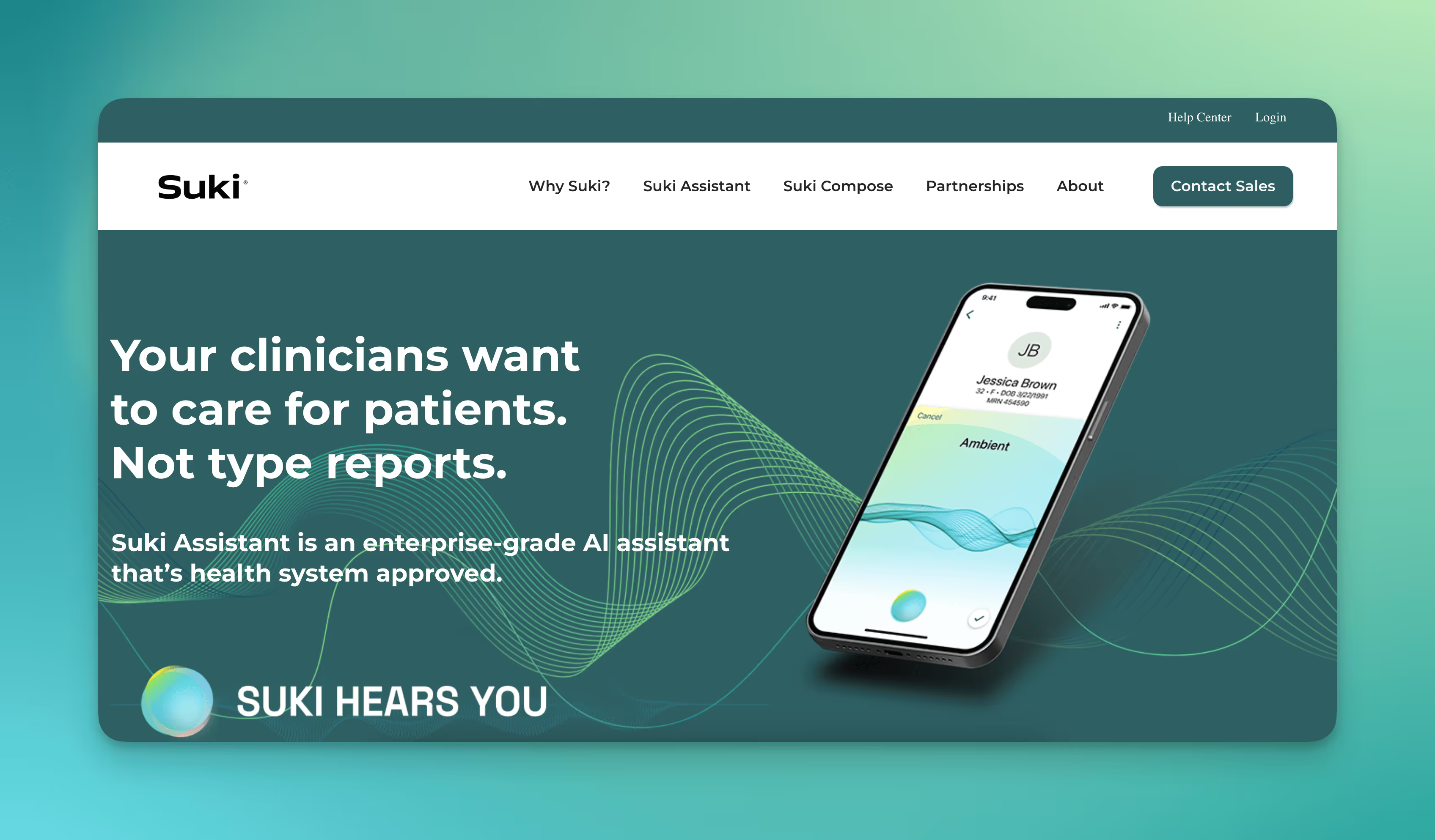
Suki accurately transcribes even the most complex medical terminology, simplifies coding, and offers real-time term suggestions for (virtually) guaranteed precision.
- Totally hands-free: Suki lets you transcribe patient interactions effortlessly.
- Jargon buster: Suki accurately transcribes even challenging conversations, including jargon and difficult speech.
- Coding made simple: Simplify the coding process with Suki's intuitive features.
- Contextual understanding: Suki's advanced understanding captures the nuances of your conversations, helping you get deeper insights from each consultation.
- Excellent precision: Suki’s accuracy with real-time medical term suggestions during conversations helps you not miss a beat.
- Personalized assistant: Suki helps you tailor your experience with customizable templates –- and the ability to ask questions for personalized support.
- Big time-saver: Save up to 72% of your time, freeing you to focus on patient care and other priorities – a huge efficacy boost.
- Secure integration: Kick back with the knowledge that you’ll have secure integration into leading EHR/EMR platforms like Epic and Cerner.
Odin

Odin's AI-powered medical documentation system provides transcription, real-time summaries, automatic SOAP note creation, and, of course, seamless EHR integration.
- Accurate medical transcription: Odin understands everything, capturing details even in complex (noisy) consultations.
- Real-time insights for clinical focus: Odin generates live summaries, flagging key elements and action items, and you don’t have to lift a finger.
- Automated SOAP note creation: Streamline documentation with automatic SOAP note generation tailored to your specific practice and preferences.
- Seamless EHR integration: Odin plays nice with your chosen EHR system for effortless note upload and data synchronization.
- HIPAA compliance: You can trust Odin to protect sensitive patient information with industry-leading security measures and strict adherence to HIPAA regulations.
- Customizable terminology recognition: Train Odin to recognize your specific medical terminology and abbreviations for personalized accuracy.
- Research & audit assistant: Quickly search transcripts for keywords or revisit specific patient encounters for insightful analysis.
- Remote patient monitoring: Transcribe and analyze telehealth consultations with the same accuracy and efficiency as in-person visits.
ScribeWell
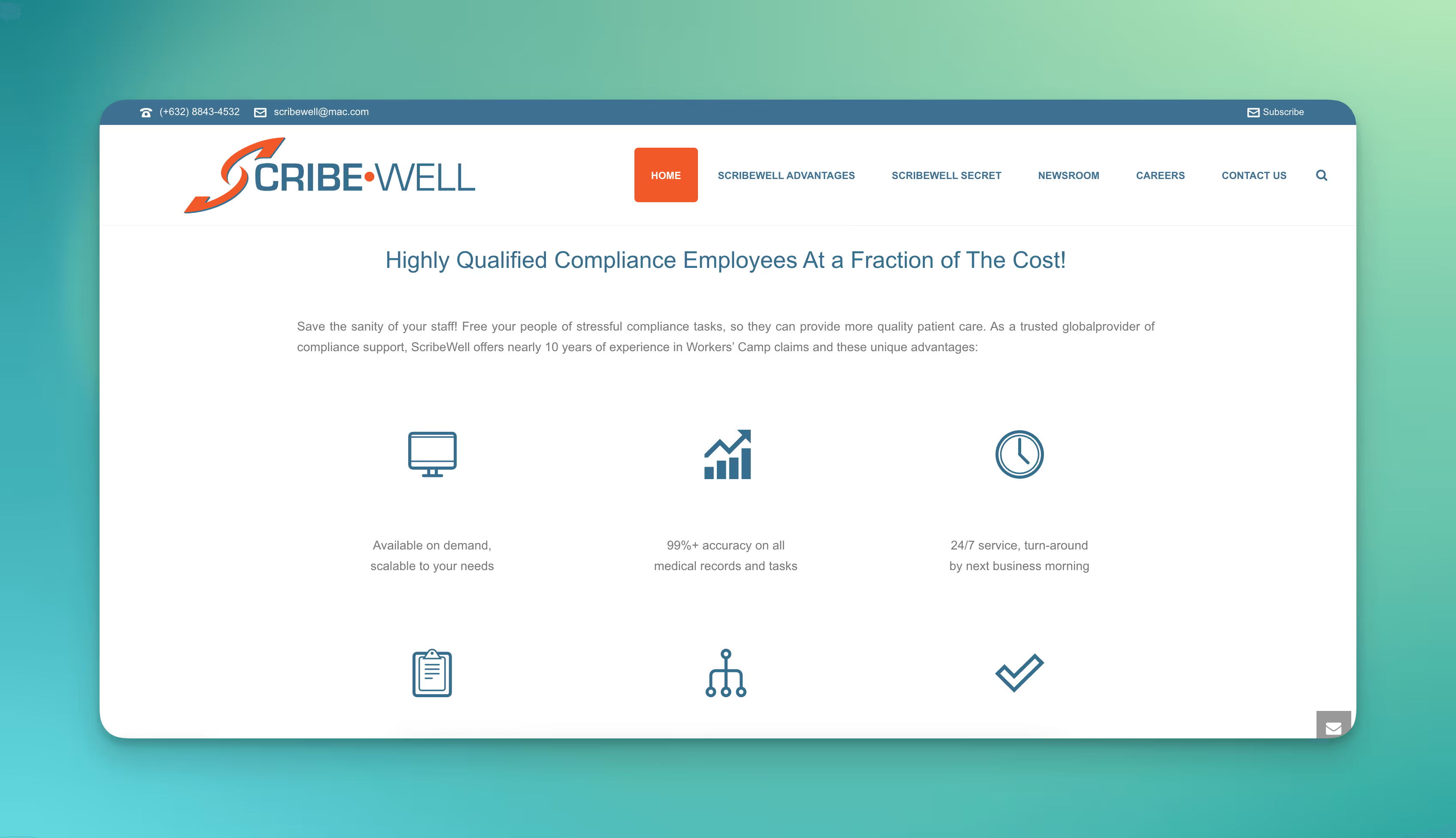
Now, for a little palate cleanser. What sets ScribeWell apart? Their 99% accuracy, provided by human medical scribes.
- Highly qualified scribes: Work with a team of expert transcriptionists who nail every detail with precision.
- Medical terminology experts: Count on their deep understanding of complex medical lingo for spot-on transcriptions.
- HIPAA compliance guaranteed: You know the drill, and they know it too.
- Get personalized support from your own account manager: Pick the ordering option that suits you, and enjoy quick turnaround times for your documents.
- Customization for your practice: Use speciality-specific templates, customize medical terms, and rely on thorough quality checks to keep your transcripts accurate.
- Benefit from detailed training, responsive customer service, and regular account optimization for continuous improvement.
- Enjoy the accuracy and consistency that come from expert reviews, power up physician efficiency by reducing admin load, and improve patient satisfaction with clear, comprehensive documentation.
{{cta}}
FAQs
Do I have to speak clearly and slowly?
Nope, these AI systems are smart enough to understand natural speech. Just talk at your normal pace and volume.
Will it understand my accent?
Speech recognition technology has gotten really good at handling different accents and dialects. As long as you’re speaking clearly in English, it should have no problem understanding your unique way of talking.
What if I stutter or stumble over my words?
No need to be self-conscious, the software won’t judge you! It’s designed to interpret human speech, stutters and all. Just correct yourself and keep going.
Do I have to use certain words or phrases?
You can speak freely using your own words and style. The system will analyze the context to determine the appropriate medical terms to include in your notes.
What if I want to edit or revise something?
No problem, you can easily review, edit, and revise the transcribed notes. The software will continue learning from any changes you make to improve over time.
Is speech-to-text technology secure enough for sensitive medical information?
Absolutely. Leading speech-to-text platforms prioritize security, employing robust encryption and compliance protocols, including HIPAA, to protect patient data and ensure confidentiality.
How does speech-to-text technology integrate with existing EHR systems?
Top-tier speech-to-text tools offer seamless integration capabilities, which lets them play well with most EHR systems, making the documentation process a breeze – and not messing up your existing workflow.
Can speech-to-text software recognize medical terminology?
Of course! High-end speech-to-text systems are specifically trained on medical vocabs, allowing them to recognize and accurately transcribe a broad spectrum of medical terms, from common jargon to super-specialized phrases.
Summing up
We just went over the 5 best speech-to-text solutions for taking medical notes. Now, it’s time to ditch the pen and paper and bring your medical practice into the 21st century.
Explore AI-powered, HIPAA-compliant Medical Dictation with Lindy.







Blog
Related Articles
.avif)
.avif)

%20(1).png)
%20(1).png)


The AI assistant that runs your work life
Lindy saves you two hours a day by proactively managing your inbox, meetings, and calendar, so you can focus on what actually matters.
