Sales Pipeline vs. Sales Funnel & How to Automate Both
Jack broke down sales pipelines vs. sales funnels, exploring how Salesforce, Pipedrive, and Gong support lead scoring, deal tracking, and forecasting.


Sales teams often use the terms sales pipeline and sales funnel like they’re the same thing.
But they’re not.
Knowing the difference helps you forecast more accurately, fix leaks faster, and build a smoother sales process. And with AI tools like Lindy, you can automate many of the repetitive tasks involved in both.
Let’s break it down.
Sales Pipeline vs. Sales Funnel
| Feature | Sales Funnel | Sales Pipeline |
|---|---|---|
| Focus | Leads and conversions | Deal status and sales activities |
| Viewpoint | The buyer's journey | Your sales team's process |
| Shape | Funnel (wide top, narrow bottom) | Straight line |
| Metrics | Lead drop-off, lead quality, marketing ROI | Deal size, close time, success rate |
| Owned By | Marketing (with sales input) | Sales (with ops help) |
| Timeframe | Longer-term, about getting new customers | Shorter-term, about current deals |
What is a Sales Pipeline?
A sales pipeline tracks individual sales opportunities, or “deals” as they move through specific sales steps. Your sales reps manage these steps.
Picture it as a straight path for your sales reps. Each step is an action a rep needs to take to get a deal closer to closing. Its main focus is how deals move forward, how sales activities are managed, and how accurately you can predict sales revenue.
Steps in a Sales Pipeline
Sales Pipeline doesn’t have a very rigid set or order of steps. This is what it generally looks like.
- Lead Qualification: Your sales rep checks if a lead fits and needs your product. This often involves an initial call.
- Initial Contact: The sales rep reaches out to the qualified lead to start a chat and understand their challenges.
- Needs Analysis/Solution Presentation: You dig deep into the prospect's problems and show how your product solves them.
- Proposal/Quotation: You prepare and give them a custom proposal or quote.
- Negotiation: You discuss prices, terms, and handle any concerns to reach an agreement.
- Closing: This is the last step where you win the deal (contract signed) or lose it.
A sales pipeline helps you answer questions like, How many deals are at each step? Which deals are stuck? How much money could we make from current deals? What's our success rate?
What is a Sales Funnel?
A sales funnel shows a customer's journey, from first hearing about your company to buying. It shows how many leads are at each step.
Think of it like a filter: You start with many potential leads at the top, and a smaller group turns into customers at the bottom. Its main focus is how well your marketing works, how good your leads are, and how many become customers.
Stages in a Sales Funnel
These steps are typically how a buyer decides to buy your product.
- Awareness: People find your brand. This could be from content, social media, or ads. The goal is to reach many.
- Interest: Leads want to learn more. They might download an e-book or sign up for your newsletter. They're looking for info.
- Consideration: Leads compare your solutions with others. They're reading reviews or looking at prices. They're narrowing choices.
- Intent: Leads show strong signs they want to buy. They might ask for a demo or start a free trial. They're very close to deciding.
- Purchase (Conversion): The lead becomes a customer by buying or signing a contract.
A sales funnel helps you answer important business questions like, How many leads do we get? How many turn into customers? Where do we lose most of them?
Sales Funnel and Pipeline Work TOGETHER
Both are important for your business:
- The Funnel Fuels the Pipeline: Your funnel brings in leads and qualifies them. Those leads feed into the pipeline as sales opportunities. A healthy funnel ensures your pipeline stays full.
- Pipeline Feedback Strengthens the Funnel: If sales reps report low-quality leads, it’s a funnel problem. Insights from your pipeline help marketing refine targeting and messaging to bring in better-fit prospects.
- Better Forecasting When Used Together: Funnels show conversion rates across lead stages. Pipelines show deal progress and value. Tracking both gives a more accurate view of future revenue.
- Improves Collaboration Across Teams: When marketing understands what leads convert, and sales understands lead intent and source, alignment becomes easier. Teams stop working in silos and start driving revenue together.
- Practical Value for Every Role:
- Sales Reps: SDRs know who’s engaged and how to prioritize outreach. AEs enter conversations with context from the lead’s funnel journey.
- Sales Managers: Can spot stuck deals, coach teams better, and predict pipeline movement with more precision.
- Marketers: Know what content drives conversions, not just traffic.
- Operations: Get complete data to optimize handoffs, processes, and reporting.
How Can AI Automation Improve Your Sales Funnel and Pipeline?

Managing a funnel and pipeline manually is time-consuming. And it’s easy to mess up, too. Leads fall through the cracks. Reps forget follow-ups. Marketing and sales lose sync.
That’s where AI automation steps in.
What Sales Funnel Automation Looks Like
- Lead Scoring & Qualification: AI agents can score leads based on behavior, source, and engagement. This ensures only the right leads move into your pipeline.
- Nurturing Prospects at Scale: AI can automatically send follow-up emails, personalized messages, or resources based on where a lead is in the funnel. No manual outreach needed.
- Funnel Drop-off Alerts: If prospects stop engaging mid-funnel, an AI agent can flag it or trigger re-engagement workflows before they go cold.
With Lindy, you can build AI Sales Agents that send timely emails, share product updates, or even book calls, based on a lead’s activity.
What Sales Pipeline Automation Looks Like
- Automated Follow-ups: AI agents can nudge reps when it’s time to follow up, or even send the first message automatically, saving time and keeping deals warm.
- Deal Tracking and Reminders: Missed updates and forgotten deals slow things down. Lindy agents can track deal status, update CRM fields, and ping reps when a deal stalls.
- Pipeline Reporting without the Busywork: Instead of manually compiling data, AI can generate real-time reports on deal health, close probability, and rep activity.
You can spin up a Pipeline Assistant with Lindy that handles reminders, pulls reports, and updates deal stages as reps progress through calls, demos, or negotiations.
{{templates}}
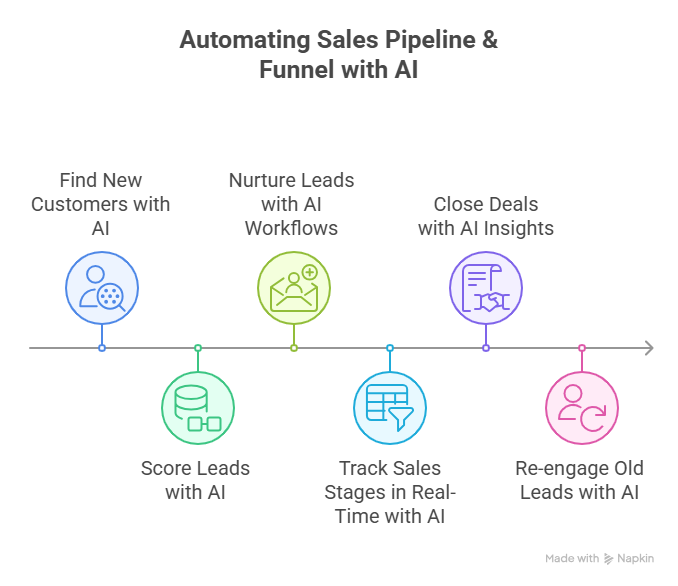
How to Automate Your Sales Pipeline & Funnel with AI
Here's how you can use AI to make your sales work easier and better:
1. Find New Customers with AI
Use AI tools to find new people who might want to buy from you. AI-driven lead generation tools act like helpers who never get tired. They find good leads and put them right into your customer list.
For example, Lindy has a Lead Management Chatbot that talks to people on your website. There are also pre-made sales agents that can engage website visitors, qualify them based on pre-set criteria, and capture their information.
You can even build your own custom lead generation agent tailored to your specific needs.
2. Score Your Leads with AI
AI helps you know which customers are most likely to buy. It gives them a score based on how they act, like visiting your website or opening your emails. This helps you focus on the best customers.
Imagine your customer list automatically scoring each person. This helps you find the most promising customers and talk to them in the best way. For example, Salesforce has tools that do this.
3. Nurture Leads with AI Workflows
Once you have leads, use AI to send them the right messages at the right time. AI acts like a guide, sending different emails or setting up calls based on what your customers do.
For example, if someone is just learning about your product, AI sends them helpful articles. If they are ready to buy, AI sends them info about demos or comparisons. Lindy even has a tool that sends automatic email replies to common questions.
4. Track Your Sales Stages in Real Time with AI
Keeping track of customers as they move through your sales steps can be hard. AI does this for you, so no one gets forgotten.
Your customer list updates automatically when a customer does something. This helps you see where deals are stuck and fix problems quickly. Tools like Lindy or Pipedrive let you set up rules that move customers to the next step automatically.
5. Close Deals with AI Insights
AI looks at your sales data and gives you smart ideas to help you close more deals. It's like having a secret weapon.
AI can guess if a deal will close and tell you the best next step. Tools like Gong or Lindy do this. They show you important deals and give you tips to win them. Lindy even has an email tool to help you write strong messages for negotiations.
6. Re-Engage Old Leads with AI
Sometimes, people stop responding. But they're not always gone for good! AI helps you get these old leads interested again with special offers and reminders.
Think of AI sending out ads or emails that remind old leads about you. By looking at what they liked before, AI sends messages that get them interested again.
The bottom line is, you need to focus on both your sales funnel and sales pipeline. Get your marketing and sales teams talking.
Find out where leads drop off in the funnel, and which deals are stuck in the pipeline. With this clear info, you can fix those issues and unlock your full sales potential.
Make Your Sales Pipeline Funnel Smarter with Lindy
Lindy is like an AI-powered sales engine that handles all the grunt work, so your team can focus on selling.
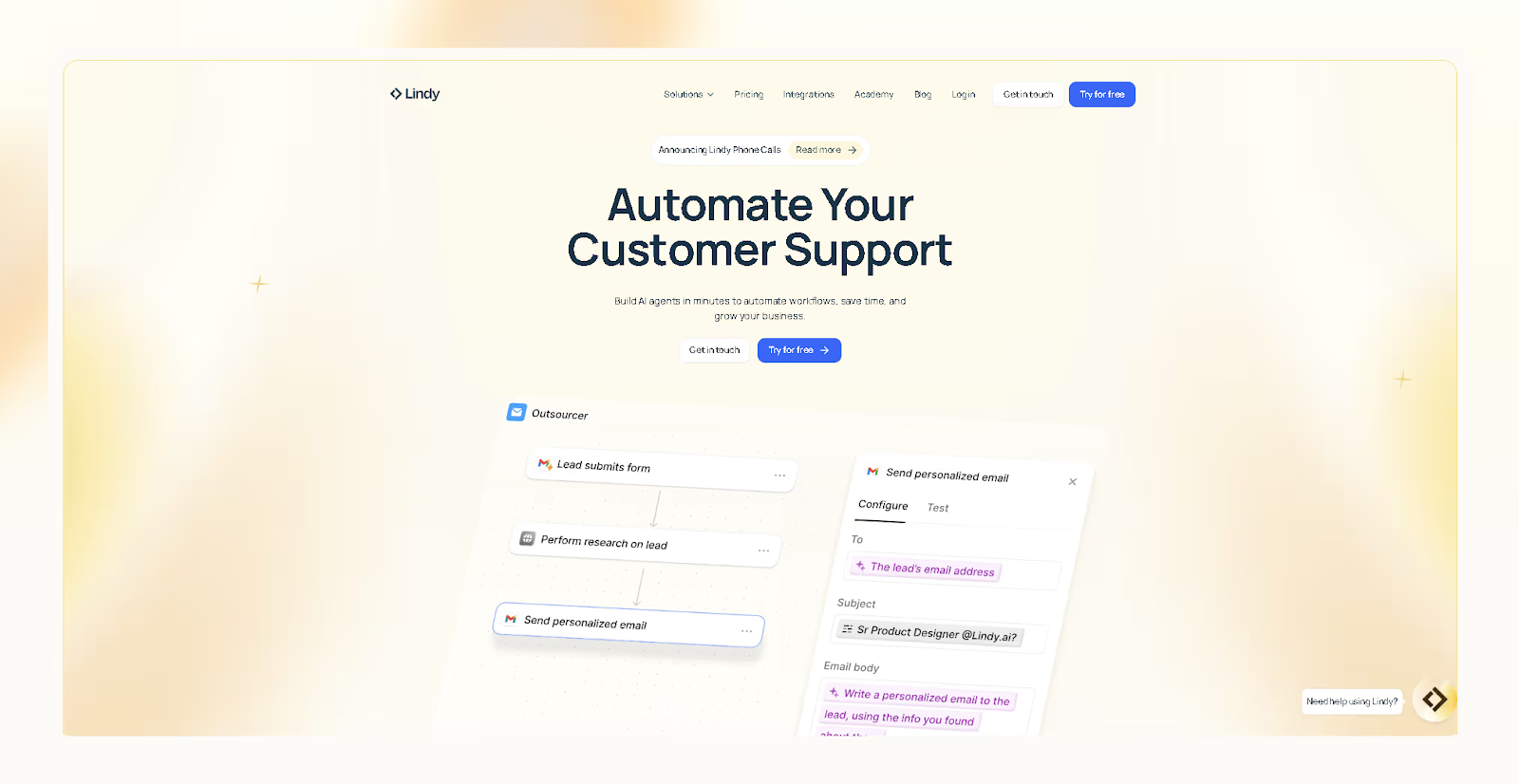
- Automate everything WITHOUT coding: Capture leads, send follow-ups, and move deals forward automatically. Set it up once, and let your AI agents handle the rest.
- Personalize every touchpoint: Deliver messages based on lead behavior, funnel stage, and timing. Stop sending generic emails. Start converting with context.
- Build smart agent networks (Societies): Assign and delegate tasks across multiple Lindy agents that work together, like trigger actions, pass data, and handle complex workflows with ease.
- Integrate with your entire stack: Sync Lindy with your CRM, email tools, and sales platforms to keep everything aligned without updating manually.
- Extend beyond sales: Automate customer support, content, and internal ops. Lindy handles it all, and you stay in control. When in doubt, check out Lindy Academy to learn more.
Ready to integrate AI into your sales strategy?
Get Lindy with a free trial and start transforming your pipeline funnel today.
{{cta}}
Frequently Asked Questions
1. Why should I integrate a sales funnel with a pipeline?
Because integrating your sales funnel and pipeline gives you a 360-degree view of your sales process. In turn, this integrated approach helps you eventually improve conversion rates and close more deals.
2. What is the difference between a sales funnel and a lead funnel?
A sales funnel focuses on the customer journey from awareness to purchase, while a lead funnel focuses specifically on the steps involved in generating and qualifying leads.
3. What are the 5 stages of the sales funnel?
While there are various models of sales funnels, one common framework includes the following stages.
- Awareness: The prospect becomes aware of your product or service.
- Interest: The prospect expresses interest in learning more.
- Consideration: The prospect evaluates your offering against competitors.
- Intent: The prospect shows a strong intention to purchase.
- Purchase: The prospect makes a purchase and becomes a customer.
4. How do I know if my sales funnel or pipeline is broken?
Look for common symptoms: too many unqualified leads in the funnel, low conversion rates, deals stalling mid-pipeline, or missed follow-ups. Review drop-off points, pipeline stages, and lead feedback. Then use AI tools like Lindy to automate the parts where things tend to break.
5. Who should own the sales funnel and pipeline in my team?
Marketing typically owns the funnel, and sales owns the pipeline, but both need to stay aligned. Use shared dashboards and automation tools (like Lindy) to make sure both teams see the same data and stay in sync.
6. How do I get started with automating my funnel and pipeline?
Start with one repetitive task, like follow-ups, lead capture, or email replies. Use a no-code tool like Lindy to create your first AI agent. From there, gradually add agents for scoring, nurturing, pipeline updates, and reporting.
7. Can I use Lindy if I already have a CRM and marketing tools?
Yes. Lindy integrates with most CRMs, email tools, and sales platforms. You can plug Lindy into your existing stack to enhance automation without replacing anything.
8. What if I don’t have a clearly defined funnel or pipeline yet?
Start simple. Map out the basic steps a lead takes before buying (funnel) and the actions your sales team takes to close deals (pipeline). Then use automation to build structure around those steps using Lindy or similar tools.
9. What KPIs should I track to measure success?
For funnels: lead-to-MQL conversion, drop-off rate, and content engagement. For pipelines: win rate, deal velocity, and stage progression. Lindy can automatically track and report on these, giving you real-time visibility.
10. How can AI improve collaboration between marketing and sales?
AI agents can centralize data, automate handoffs, and provide context across teams. For example, Lindy can notify sales when a lead crosses a scoring threshold or alert marketing when a deal is lost, so messaging can improve.
11. How do I test if my automation is working?
Set clear baseline metrics before you start (e.g., lead response time, deal close rate). Then track changes after automating each step. Lindy provides built-in reports to monitor agent performance and ROI.