What Is Quote-to-Cash Software? A Complete Guide
Jack broke down quote-to-cash software, covering configuration, contract management, billing, and renewal workflows across platforms like Salesforce and DealHub.


Most sales teams spend hours moving deals forward and then lose just as much time chasing signatures, sending invoices, and tracking payments. That’s where quote-to-cash software helps. It links quoting, billing, and renewals to prevent post-close issues.
In this article, we’ll cover:
- What the quote-to-cash process includes
- Key features to look for in modern Q2C tools
- How Lindy augments quote-to-cash software with AI agents
- The top quote-to-cash platforms to consider in 2025
- When you need CPQ vs. full Q2C
Let’s first define quote-to-cash software.
What is quote-to-cash software?
Quote-to-cash software is a tool that manages quoting, payment collection, and renewals in one connected system by connecting sales, legal, finance, and billing. It brings quoting, approval, billing, and collections into a single workflow.
Most companies manage these steps using a patchwork of tools. Quote-to-cash software brings them into one connected flow. It usually covers:
- Product or service configuration
- Pricing logic and quote generation
- Contract management and eSignatures
- Invoicing and payment collection
- Renewal and expansion workflows
This process involves teams from sales, legal, finance, and customer success. Quote-to-cash tools integrate with your CRM, CPQ, billing platforms, and contract systems. They ensure that all components work together without manual handoffs.
B2B and SaaS teams rely on connected stacks to avoid delays. Without it, legal reviews delay deals, reps send quotes with outdated pricing, and teams miss renewal reminders.
Effective quote-to-cash software automates billing and minimizes manual steps, helping teams process more deals efficiently.
Before we understand Q2C in detail, let’s see how it compares to CPQ software, since the two often get lumped together.
Quote-to-cash vs CPQ: What’s the difference?
CPQ software creates quotes for complex products while quote-to-cash (Q2C) software manages the full process from quote creation through contracts, billing, and renewals.
CPQ handles the start of the process while Q2C continues it through payment and renewals. Here’s how they compare:
Most B2B teams start with CPQ when quoting gets too complex for Google Docs. But as volumes increase, teams must feed quotes directly into contracts, billing, and finance. Quote-to-cash automation supports this process.
In other words, CPQ creates the quote. Q2C makes sure that the quote turns into money in the bank, and keeps coming back at renewal time.
This distinction helps us understand why modern sales stacks often combine both. Next, we’ll map out the full quote-to-cash process, from configuration to renewal.
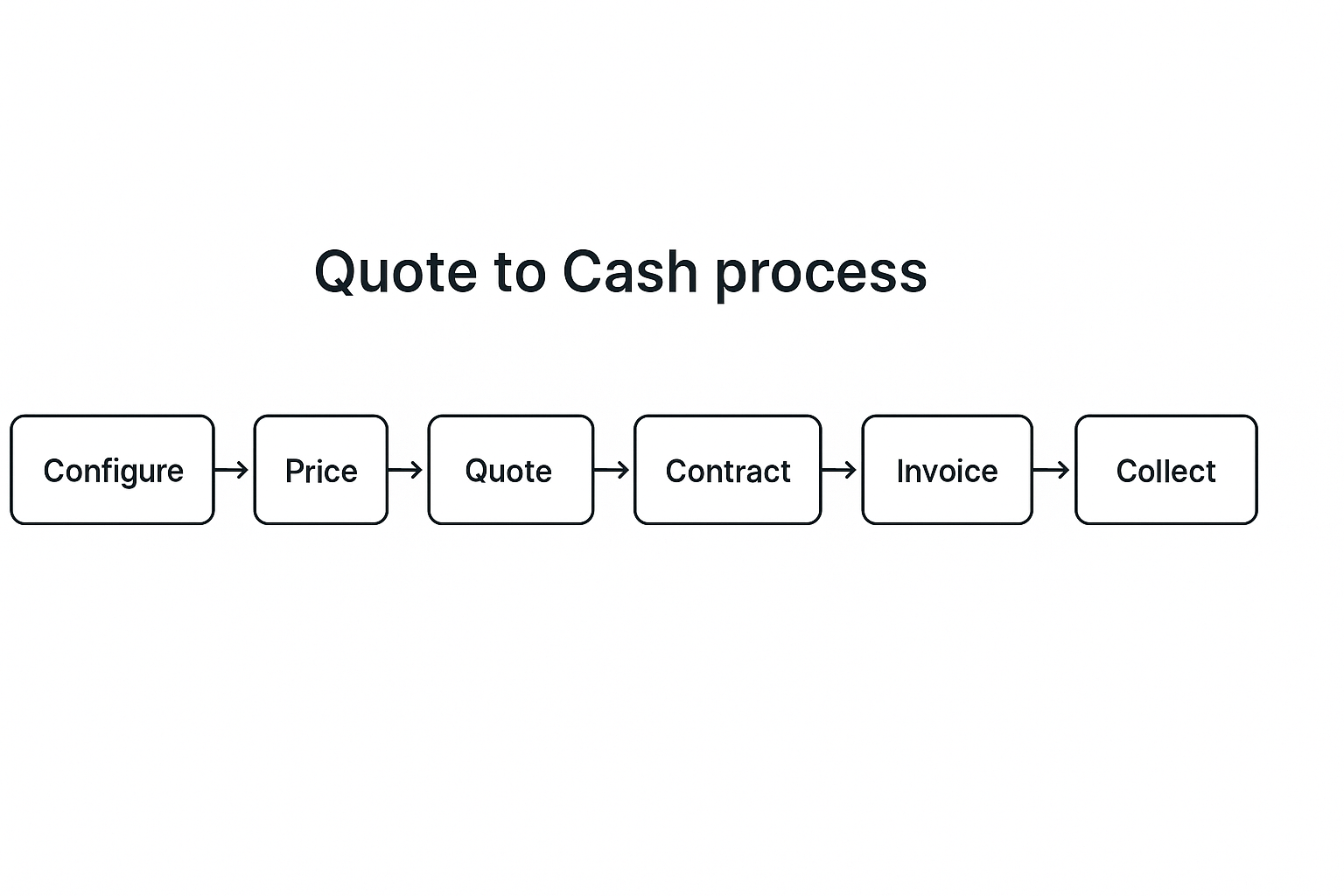
The quote-to-cash process: A visual overview
The quote-to-cash process is the full journey from building a quote to renewing a contract. It links sales, legal, finance, and customer success in a single process.
Here’s a breakdown of the seven core stages:
- Configure – Sales teams select the right products, services, and customizations for the deal.
- Price – Automated pricing logic applies rules, discounts, and tiers based on account or region.
- Quote – A formal quote is generated and sent to the buyer, often using a CPQ tool.
- Contract – Legal reviews the quote, final terms are approved, and the contract is signed.
- Invoice – Based on the contract, an invoice is generated and sent through a billing system.
- Collect – Payments are tracked, and finance ensures the funds are received.
- Renew – When the contract nears its end, renewal workflows are triggered—sometimes with upsell recommendations.
Each stage sounds straightforward. But in practice, this process breaks down fast without tight system handoffs. Common blockers include:
- Manual quote edits that never get synced to contracts
- Approval delays that stall deals
- Invoice errors due to inconsistent data
- Missed renewals from lack of centralized tracking
This is where Q2C tools reduce handoffs, keep systems in sync, and surface issues before they turn into lost revenue.
Now that we’ve outlined the full process, let’s look at the best quote-to-cash features in CPQ software.
{{templates}}
What are the best quote-to-cash features in CPQ software?
The best quote-to-cash features in CPQ make configuration easier and reduce errors in quotes, contracts, and approvals. These tools speed up quote generation, reduce errors, enforce policies, and help close deals.
Here are the features that matter most:
- Guided selling: Reps use it to select the right products or bundles based on deal type, region, or past purchases. It’s especially useful for new reps or large catalogs.
- Dynamic pricing rules: Supports things like volume-based discounts, special contract pricing, or tiered pricing based on account size. Allow teams to apply discounts automatically, so reps stay focused on selling.
- Contract versioning & approvals: Contracts often go through legal back-and-forth. Good CPQ software tracks versions, flags changes, and routes approvals without juggling email threads.
- eSignature & legal workflows: Reps can send quotes and contracts directly from the tool. Built-in eSignature speeds up closing and keeps the process legally valid.
- Billing & collections tracking: Many Q2C tools include billing and collections, even if CPQ systems don’t. It ensures payment status is visible to sales, not just finance.
- Analytics dashboards: Gives leadership visibility into quote velocity, close rates, contract delays, and stuck deals, so you can see where the real friction is.
Many modern platforms combine these with AI to make quoting even smarter. Some let you auto-populate quotes based on past deal history or CRM context. Tools like Lindy add an extra layer of automation by triggering follow-ups or reminders when quotes go cold.
Next, let’s talk about how Lindy supports quote-to-cash, not by replacing CPQ, but by enhancing what’s already in your stack.
Where does Lindy fit into the quote-to-cash ecosystem?
Lindy is a no-code AI agent builder for small business teams that want to offload manual quote-to-cash work without extra hiring. It lets you create agents that handle follow-ups and sync deal updates across CRM, CPQ, and billing tools without writing code.
In most teams, quote tracking, follow-ups, and CRM updates still depend on reps remembering to do them. That’s where things fall apart, especially when deal volume increases.
Lindy acts as an AI layer across the quote-to-cash cycle. You can choose from ready-to-use templates for sales, lead intake, and contract workflows. It connects with tools like CRM, email, and chat to handle routine admin tasks and help your team stay focused on closing deals.
What that looks like in practice:
- Email agents that follow up when quotes go stale
- Slack alerts when contracts sit unsigned
- Daily digests summarizing deal progress for leadership
- Agents that auto-update CRM fields or spreadsheets
- Triggers that start invoicing workflows when a deal closes
Lindy doesn’t replace Q2C systems. Instead, it connects CPQ, CRM, and billing tools to cover gaps. For teams that already use platforms like Salesforce or HubSpot, Lindy’s CRM sync ensures updates flow through without needing another rep check-in.
It integrates with more than 7,000 tools, so you can add it to your stack without replacing anything.
Let’s look at specific ways teams are using Lindy to automate parts of the quote-to-cash cycle, and where it fits best.
Lindy use cases for Q2C automation
Lindy automates real use cases that reduce delays, cut manual work, and keep deals moving. Here’s how teams are using Lindy to fill gaps in their quote-to-cash process:
- Quote follow-ups: Email agents detect stale quotes and send follow-up nudges automatically.
- Contract status alerts: Slack agents flag quotes that haven’t been signed yet, so reps and legal can follow up before deals die.
- Internal Q2C syncs: Lindy sends automated summaries of rep activity and deal movement to managers or RevOps daily or weekly.
- Deal context enrichment: AI agents can pull CRM fields, meeting notes, and email threads to prefill quote templates, so reps don't miss the context.
- Invoicing triggers: Lindy kicks off workflows like creating invoices in Stripe or NetSuite when a deal hits a certain stage.
- Voice and chat agents for deal updates: Sales leaders can ask about deal status and get a quick, specific response.
- CRM + spreadsheet sync: Lindy can update custom CRM fields and external spreadsheets so reporting stays accurate without added rep admin.
These agents work inside tools you already use, like Slack, Gmail, Notion, and your CRM. They adapt to your process, so you need not change how you sell.
Next, we'll compare the top quote-to-cash software in 2025. These include tools like Salesforce, SAP, DealHub, Maxio, and Lindy.
The top quote-to-cash software in 2025
Some tools are better for fast-moving SaaS teams while others are built for large enterprises with complex billing, compliance, and fulfillment needs.
Each of these 5 tools serves a different purpose in the quote-to-cash stack. Here’s how they compare:
Each of these tools has a different starting point; some focus on CPQ, others on billing, and a few try to do both. The right choice depends on your sales team, tech stack, and how tightly you need things connected.
Next, we’ll look at the traits that make for a good Q2C platform, regardless of which tool you use.
{{cta}}
Traits of a good Q2C software
The best quote-to-cash platforms give you automation, control, accuracy, and scale. Here’s what to look for:
- Direct CRM & CPQ integration: If your Q2C tool doesn’t talk to your CRM, reps end up duplicating work. Tight sync keeps data accurate and reduces delays.
- AI-powered task automation: Tools that handle follow-ups, quote tracking, and reminders, like Lindy, enable reps to sell better.
- Scalability across billing, renewals, and support: Your process might be simple now, but Q2C should grow with you as billing models become more complex.
- Data accuracy & visibility: Clean handoffs between tools reduce errors in contracts, invoices, and payment tracking.
- Renewal support: Good Q2C tools help you close deals, retain them by surfacing upcoming renewals, and give you opportunities to upsell.
A good stack simplifies your sales process and makes it easier to manage.
Lindy brings automation to your quote-to-cash software
If you want affordable AI automations to help with your quote-to-cash processes, try Lindy. It lets you build custom AI agents for the different automation workflows around sales tasks.
You’ll find pre-built templates and 7,000+ integrations to choose from.
Here’s why Lindy is an ideal option:
- Sales Coach: Lindy can provide custom coaching feedback, breaking down conversations using the MEDDPICC framework to identify key deal factors like decision criteria, objections, and pain points.
- Automated CRM updates: Instead of just logging a transcript, you can set up Lindy to update CRM fields and fill in missing data in Salesforce and HubSpot without manual input.
- AI follow-ups: Lindy agents can send follow-up emails, schedule meetings, and keep everyone in the loop by triggering notifications in Slack by letting you build a Slackbot.
- Lead enrichment: Lindy can enrich sales leads by connecting with third-party prospecting APIs (People Data Labs), providing your team with richer insights for smarter outreach.
- Automated sales outreach: Lindy can run multi-touch email campaigns, follow up on leads, and even draft responses based on engagement signals.
- Cost-effective: Automate up to 400 monthly tasks with Lindy’s free version. The paid version lets you automate up to 5,000 tasks per month, which is a more affordable price per automation compared to many other platforms.
Frequently asked questions
What’s the best Q2C solution for SaaS companies?
Some of the best Q2C solutions for SaaS companies include Salesforce Revenue Cloud, Maxio, and DealHub.
Salesforce Revenue Cloud works well for large organizations, but for growing SaaS teams, tools like Maxio or DealHub offer more flexibility. AI tools like Lindy can also support specific steps like quote tracking or renewal alerts.
Can I use AI to automate quote-to-cash steps?
Yes, you can use AI to automate quote-to-cash steps. AI platforms can automate follow-ups, trigger contract reminders, sync CRM fields, and enrich deal data.
How do I know if I need full Q2C or just CPQ?
CPQ may be enough for you if your bottlenecks are only around creating quotes. You should consider Q2C if you're seeing delays in billing, payments, or renewals.
Does Lindy integrate with Salesforce or HubSpot?
Yes, Lindy integrates with Salesforce and HubSpot natively. You can sync fields, trigger automations, and reduce manual CRM updates.
How do Q2C tools help reduce revenue leakage?
Q2C tools help reduce revenue leakage by automating follow-ups, keeping quotes and contracts aligned, and alerting teams when payments are overdue.
Can Lindy send automatic quote follow-ups?
Yes, Lindy agents send automatic quote follow-ups when a quote goes stale.
What’s the fastest way to improve my Q2C cycle?
The fastest way to improve my Q2C cycle is to automate simple tasks like quote reminders, contract tracking, and CRM syncs. Once those are solid, layer in tools that handle billing and renewals.