What is Product Adoption Process and Cycle & How to Improve
Michelle broke down the product adoption lifecycle's five stages and five adopter segments, from awareness to advocacy, plus AI tactics for onboarding, engagement, and retention.


The product adoption process and cycle includes the entire journey someone takes from first hearing about your product to making it a regular part of their life. It's way more than just signing up. True adoption means users.
- Try your product out: They go beyond just looking; they actually engage with it.
- See how it helps them: They understand its real value and how it solves their problems or makes their lives better.
- Use it regularly on their own: They integrate it into their routine without needing constant reminders or help.
- Keep using it and even tell others about it: They become loyal users and advocates, spreading the word to others.
What Is a Product Adoption Process? The 5 Stages
Think of this as the user's personal adventure toward fully integrating your product into their daily flow. Each stage has its own challenges and chances to help users along. I’ll explain each one in more detail, as they often blend and interact.
Stage 1: Awareness – Making a Memorable First Impression
This is where it all starts. People learn your product exists. At this stage, your main goal is to break through the noise and get noticed. It's about planting the seed of curiosity.
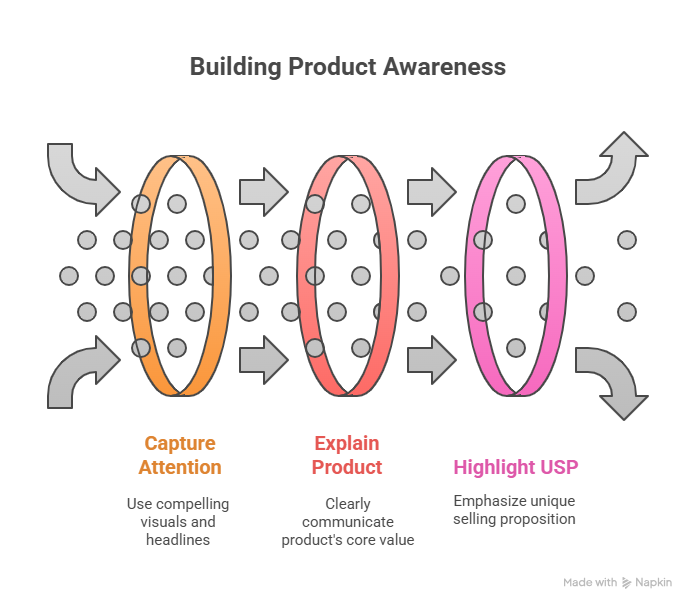
Users might see your ad pop up on a social media feed or a website, hear about it from a friend or colleague, or find it through a search engine when looking for a solution to a problem. Media mentions or influential voices in their industry can also spark awareness.
You need to grab their attention and clearly explain what your product does. This isn't just about features; it's about the core problem your product solves.
Think captivating headlines, compelling visuals, and concise messaging that highlights your unique selling proposition. The first impression is crucial for moving them forward.
Stage 2: Interest – Fueling Curiosity and Exploration
Once users are aware, some will show a deeper curiosity. They're not ready to buy yet, but they're actively seeking more information. This is where they start evaluating if your product could be a fit for them.
They might visit your website to browse product pages, feature lists, and use cases. They'll likely read reviews and testimonials to see what others say, or watch a demo video to see the product in action. Many will also start comparing your offering against competitors to understand their options.
Your job here is to clearly show them the specific benefits your product offers and make it super easy for them to learn more. Provide rich, engaging content that addresses their initial questions and highlights how your product stands out.
This includes:
- Detailed product descriptions
- Compelling case studies
- Easy-to-understand explanations of complex features.
The goal is to deepen their engagement and move them from passive interest to active consideration.
Stage 3: Evaluation – The Deliberate Decision Point
At this stage, users are actively weighing the pros and cons and making a deliberate decision about whether your product truly fits their needs and goals. This often involves a deeper dive into specifics and a comparison of value.
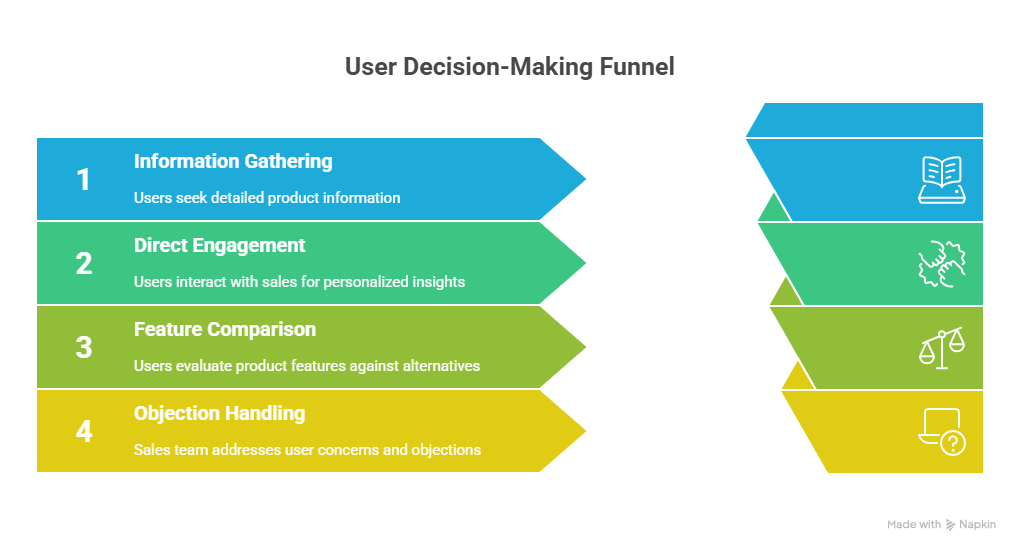
They might read extensive documentation, whitepapers, or FAQs to understand technical details or specific functionalities.
Many will engage directly with your sales team for personalized demos, ask specific questions about their use case, or discuss pricing and implementation. They're meticulously checking feature comparisons, pricing plans, and any security or integration details.
Your job is to remove any roadblocks, address any lingering questions or objections, and make the unique value of your product crystal clear.
This means having a responsive sales team, comprehensive and easily accessible information, and clear answers to common concerns.
Reduce friction in the decision-making process by being transparent and highlighting why your solution is the best choice for their specific challenges.
Stage 4: Trial – The Hands-On Experience and "Aha!" Moment
This is a critically important step because users finally get to experience your product firsthand. Whether it's a free trial, a freemium model, or a guided demo, this is where the theoretical understanding turns into practical application.
Users sign up for a free trial, start using the free version of your product, or participate in a personalized demonstration. They're exploring the interface, trying out features, and attempting to complete their first tasks with the product.
Your absolute priority here is to help users quickly reach that "aha!" moment, that point where they truly understand how your product helps them solve a problem or achieve a goal. This initial success is powerful. You can ensure this through:
- Intuitive Onboarding Flows: Design simple, step-by-step guides that get them started smoothly, highlighting key actions.
- Interactive In-App Checklists: Provide interactive lists within the app that encourage users to explore core features and complete foundational tasks.
- Behavior-Triggered Communication: Send timely, helpful emails or in-app messages based on their actions (or inactions) within the product, guiding them to the next valuable step.
- Helpful Tutorials and Resources: Offer easy-to-follow guides (video or written) for specific tasks, empowering users to self-serve and find immediate solutions.
- Personalized First Experiences: Tailor the initial product experience based on their stated goals or industry, making the product immediately relevant.
Stage 5: Adoption – From Trial to Habit and Advocacy
They've seen the value during the trial, successfully integrated your product into their workflows, and are now active, regular users. They've decided your product is essential for them. This is the ultimate goal, but the work doesn't stop here.
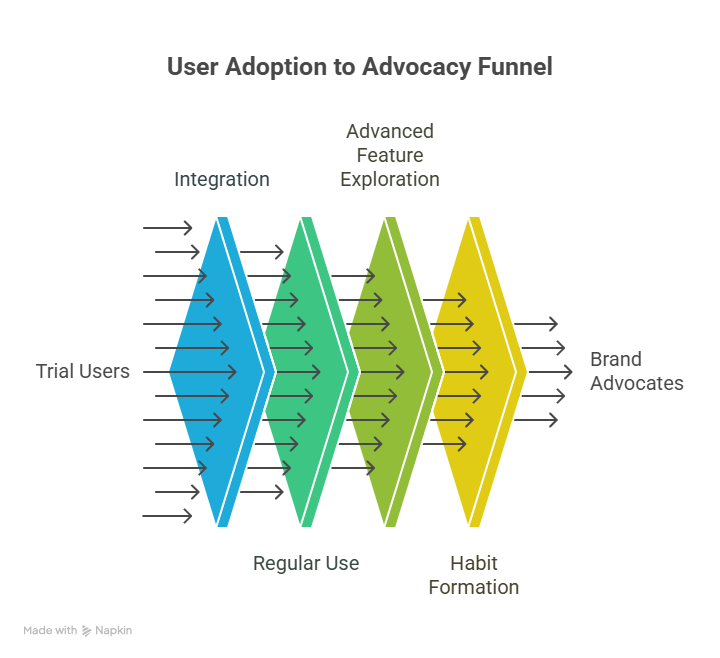
Users consistently log in and use the product to achieve their goals. They might integrate it with other tools they use, depend on it for key tasks, and even start exploring more advanced features independently.
Now, your focus shifts to fostering long-term loyalty and encouraging them to become advocates. This involves:
- Providing Continuous Support: Ensure users can easily find answers to questions and get help when needed, through comprehensive knowledge bases, responsive customer support, or active communities.
- Nudging Towards Advanced Features: As they become comfortable, gently guide them to unlock more powerful functionalities and explore deeper use cases that add even more value.
- Encouraging Habit Formation: Use subtle cues, reminders, and integrations to help them build routines around using your product, making it indispensable.
- Soliciting Feedback and Referrals: Actively ask for their thoughts on how to improve the product and empower them to share their positive experiences with others, turning them into valuable brand advocates.
The Product Adoption Cycle (Who Adopts When)
Beyond the individual user journey, the product adoption cycle gives you a wider view of how different types of people adopt your product across the entire market over time.
It's based on extensive research about how new ideas spread, and it breaks users into five distinct groups based on their willingness to try new things.
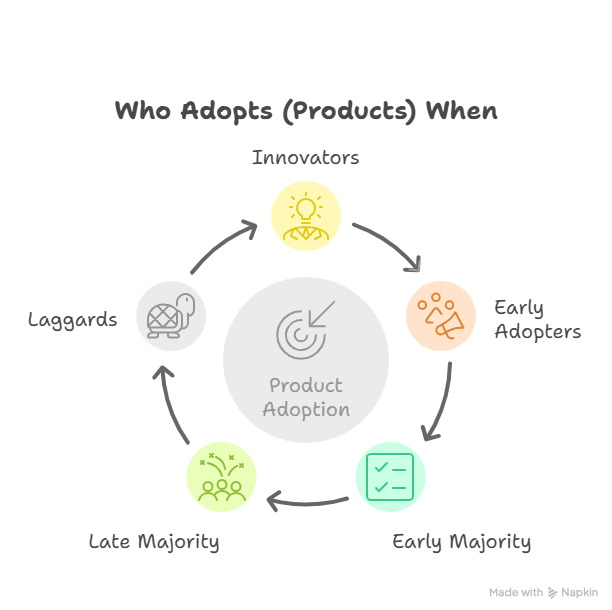
1. Innovators (2.5%)
These are the trailblazers, the very first people to try new technologies and ideas. They are often technology enthusiasts or visionaries who love to experiment.
They actively seek out cutting-edge solutions, love getting early access to new products, and are perfectly fine with bugs or unfinished features because they understand they are at the forefront of innovation.
To reach them, offer beta programs, early access, and engage them in discussions about your product roadmap. They appreciate being part of the creation process.
2. Early Adopters (13.5%)
These are often opinion leaders and visionaries who are open to change. They quickly see the potential of new products and are eager to gain a competitive edge.
They are willing to take calculated risks on new solutions to solve problems more effectively or gain an advantage. They are highly influential and their adoption often drives others, especially through their reviews, testimonials, and public feedback.
The best way to get such buyers to adopt your product is to:
- Provide compelling case studies focusing on innovation and efficiency.
- Highlight how your product gives them a strategic advantage.
- Seek out their feedback and showcase their success stories.
3. Early Majority (34%)
This is the largest group, and they are practical and thoughtful. They won't jump into a new product until they see solid proof that it works.
They need tangible evidence of success and often adopt after seeing early adopters successfully integrate the product. They are risk-averse and prefer proven solutions over experimental ones. They value reliability and ease of use.
Focus on clear success stories, testimonials, and reliable support. Show them how your product has helped others like them achieve measurable results. Emphasize ease of integration and user-friendliness.
4. Late Majority (34%)
Skeptical and cautious, this group adopts only when there's overwhelming evidence of a product's effectiveness and widespread acceptance. They are often pressured to adopt by their peers or market standards.
They need extensive social proof, such as widespread adoption numbers, industry standards, and guarantees. They are highly sensitive to effort and prefer solutions that require minimal learning or change. They often wait for products to become mainstream or for significant price reductions.
To get them, emphasize widespread adoption, security, and proven ROI. Highlight industry standards and offer strong guarantees or extended support. Reduce perceived effort and risk as much as possible.
5. Laggards (16%)
These are the most resistant to change. They are traditionalists who prefer established methods and only adopt new products when absolutely necessary, often when their existing solutions become obsolete or unsustainable.
They are extremely risk-averse and prioritize stability and familiarity above all else. They are often forced into adoption rather than choosing it willingly.
Focus on the absolute necessity of adopting your product (e.g., regulatory compliance, support for old systems ending). Provide extremely simple, foolproof migration paths and extensive, personalized hand-holding.
How the Stages and Cycle Work Together
Understanding both the product adoption stages and the product adoption cycle is crucial for a complete strategy.
- The stages describe the individual user's step-by-step journey through your product, from their first interaction to becoming a loyal user.
- The cycle describes the characteristics of the type of user undertaking that journey at different times across your market.
For instance:
An innovator or early adopter might sprint through all five stages of the adoption process in a matter of days or weeks, driven by their eagerness for new solutions. They require minimal hand-holding.
However, a late majority user might linger at the evaluation stage for many months, needing substantial social proof, guarantees, and strong evidence of widespread adoption before they even commit to a trial.
By understanding these interconnected dynamics, you can craft highly targeted strategies that resonate with each user segment at their respective stages of adoption, optimizing your efforts for maximum impact.
{{templates}}
Why Product Adoption Matters (A Lot!)
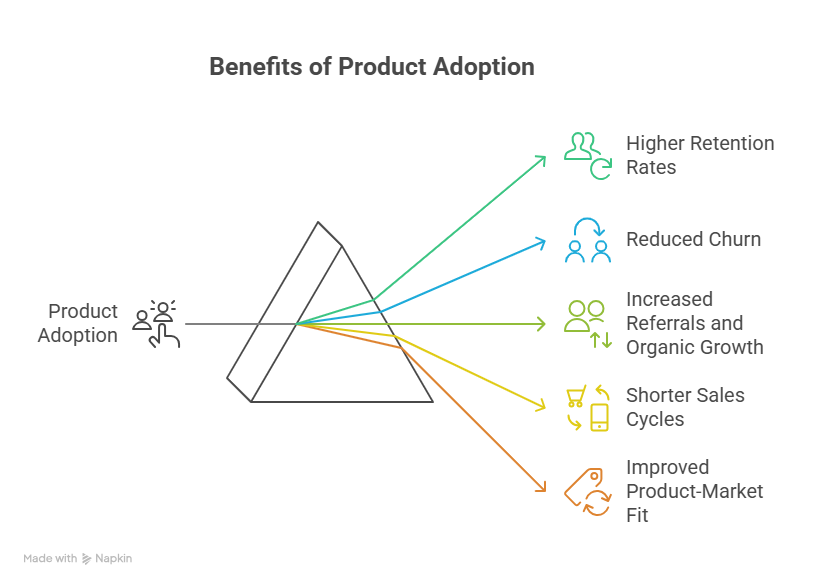
If users don't adopt your product, even the most technologically brilliant or feature-rich offering will ultimately fail to gain traction.
Solid product adoption is a cornerstone of sustainable business growth, leading to powerful outcomes:
- Higher retention rates: Users who truly adopt your product are significantly more likely to continue using it for the long term, reducing customer churn.
- Reduced churn: Active, satisfied users are less likely to abandon your product for a competitor, leading to a more stable customer base.
- Increased referrals and organic growth: Adopted users become your biggest advocates. Their positive word-of-mouth and testimonials drive new customer acquisition without additional marketing spend.
- Shorter sales cycles: When users quickly grasp the value and adopt your product, the path from initial interest to purchase is accelerated, improving sales efficiency.
- Improved product-market fit: High adoption numbers indicate that your product genuinely addresses a significant market need and resonates with your target audience, informing future product development.
How to Increase Product Adoption with AI
Artificial intelligence (AI) offers transformative capabilities for optimizing every single stage of the product adoption journey.
By using AI, you can personalize experiences, predict user behaviors, and automate crucial interventions, leading to significantly higher adoption rates and a more efficient growth strategy.
Step 1: Supercharge Onboarding and First Value with AI
To accelerate users’ "aha!" moments and reduce early-stage friction.
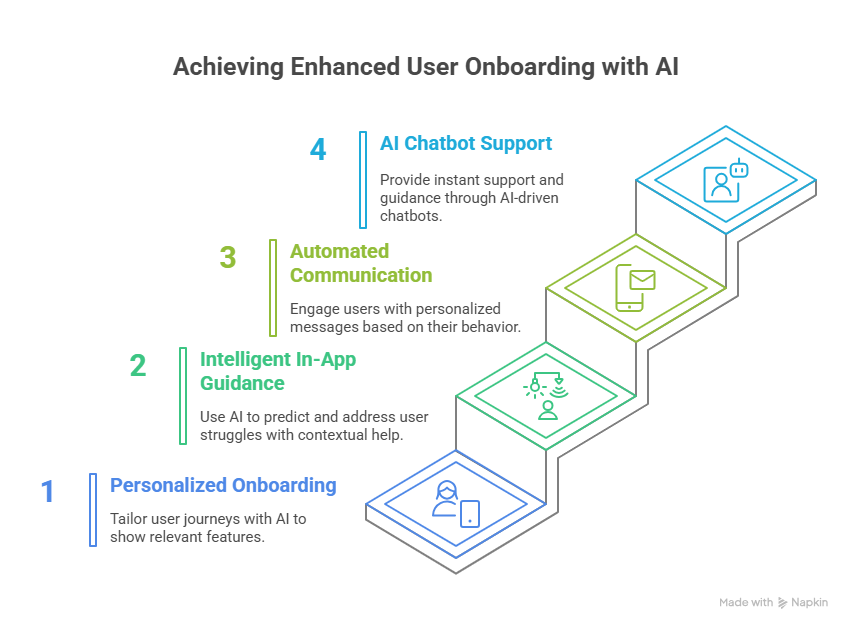
Here’s how to do it:
1. Implement AI-Powered Personalized Onboarding Journeys:
Integrate AI algorithms with your user data (demographics, initial survey responses, acquisition source, behavioral patterns) to dynamically adjust the onboarding flow.
This will immediately present users with the most relevant features and use cases, leading them to their specific "aha!" moment faster (e.g., a marketing professional instantly sees marketing-specific features and templates).
2. Deploy Intelligent In-App Guidance:
Use AI to analyze real-time in-app behavior to predict user struggles. Proactively trigger contextual tooltips, short video tutorials, or mini-guided tours exactly when and where needed.
This reduces user frustration and abandonment at complex features, leading to smoother initial product exploration.
3. Automate Behavior-Driven Communication:
Configure AI-powered marketing automation platforms to analyze user activity (or inactivity) and send highly personalized emails or in-app messages.
This increases user progression through onboarding milestones and proactive re-engagement for users showing signs of dropping off.
4. Integrate AI-Powered Chatbots for Instant Support:
Implement AI-driven chatbots to provide 24/7, instant support during onboarding, handling common questions and guiding initial setup.
As a result, you’ll have lesser support tickets, improved self-service capabilities, and a smoother initial user experience, especially for users preferring immediate answers.
Step 2: Drive Continuous Engagement and Feature Adoption with AI
Encourage deeper product engagement and long-term retention by proactively guiding users to unlock more value.
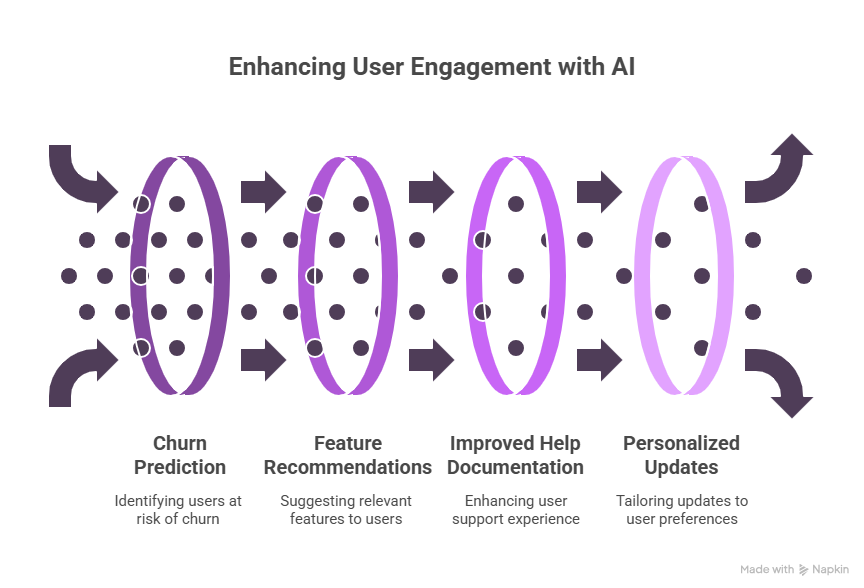
Here’s how:
1. Establish Proactive User Engagement & Churn Prediction:
Implement AI models to monitor granular user engagement metrics and analyze historical data to predict churn risk. Trigger personalized in-app messages, email campaigns, or flag high-risk users for human customer success intervention.
This will help you identify and intervene for at-risk users early on, leading to higher retention rates and reduced churn.
2. Use AI-Powered Feature Recommendations:
Use AI to analyze user roles and usage patterns to identify unexplored, relevant features. Gently nudge users with contextual suggestions, helpful tutorials, or personalized examples of how these features can benefit them.
This helps users discover and adopt more features, leading to increased product stickiness and perceived value.
3. Improve Help Documentation & Search with AI:
Implement AI-powered search within your help documentation, enabling natural language query understanding and highly accurate, relevant answers.
Your users find solutions faster, reducing time spent searching and improving their overall support experience, leading to higher self-sufficiency.
4. Personalize Product Roadmaps & Updates:
Use AI to analyze individual user usage patterns and stated preferences to personalize communication about new features or product updates. Highlight those most relevant to each user.
Then users will be more likely to engage with new features and updates that directly benefit them, driving broader product utilization.
Step 3: Use AI for Strategic Social Proof and Advocacy
Tailor social proof for different adopter segments and identify key advocates to accelerate the adoption cycle.
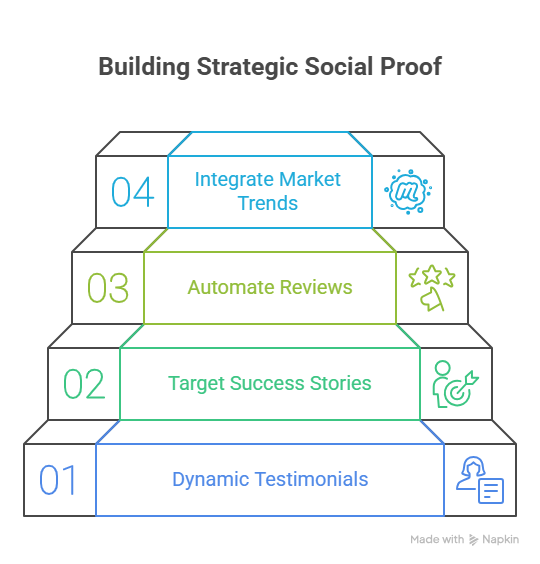
Here’s how to do it:
1. Implement Dynamic Testimonial Display:
Configure AI to analyze a user's profile and perceived stage in the adoption cycle to display testimonials or case studies from similar users or businesses.
Social proof resonates more strongly with potential adopters, addressing their specific concerns and accelerating their trust in the product.
2. Target Success Stories with AI:
Use AI to recommend specific success stories or user interviews that closely align with a potential adopter's industry, company size, or challenges.
This makes success stories more relevant and impactful, leading to higher conversion rates by directly addressing prospect pain points.
3. Automate Review & Referral Solicitation:
Deploy AI to identify happy, highly engaged users at opportune moments (e.g., after completing a key milestone or expressing satisfaction) and automate the process of requesting reviews, testimonials, or referrals.
As a result, you produce a consistent and growing volume of authentic social proof, bolstering credibility and attracting new users through organic advocacy.
4. Integrate Market Trend Analysis for Validation:
Use AI to analyze broader market trends, competitor adoption rates, and industry news. Integrate these data-backed insights into marketing and sales materials.
This helps provide compelling evidence for more cautious adopter types (e.g., late majority), validating the growing acceptance and reliability of your product.
By implementing these actionable steps, you can harness the power of AI to create a more intelligent, personalized, and effective product adoption strategy, driving sustainable growth and maximizing user value.
{{cta}}
Real Product Adoption with AI? Use Lindy
Lindy helps you turn new users into power users, faster and without manual follow-ups.
With Lindy, you can:
- Personalize onboarding flows based on user goals
- Trigger smart, real-time guidance in-app
- Send behavior-based emails and nudges automatically
- Predict churn and intervene before users drop off
- Highlight relevant features to increase engagement
- Automate review requests and referral prompts
Lindy’s AI agents handle the entire adoption journey, so your users get value, and your product sticks.
Start your free demo with Lindy today!
Frequently Asked Questions
1. How can the adoption of a product be improved?
Product adoption can be improved by delivering faster “aha” moments, personalizing onboarding, removing friction in setup, and offering proactive support. Use behavior-based nudges, smart tutorials, and social proof to guide users. Automating this with AI can accelerate adoption and reduce manual intervention.
2. How to drive product adoption?
To drive product adoption, focus on simplifying onboarding, showing value early, and keeping users engaged with relevant features. Use real-time guidance, targeted communication, and feedback loops. Personalization and automation are key, AI tools can help deliver tailored experiences that nudge users toward deeper usage.
3. What is market adoption?
Market adoption refers to how widely and quickly a product is accepted by users across an entire market. It tracks different adopter groups like innovators, early adopters, early majority, late majority, and laggards, and reflects the product’s penetration, credibility, and perceived value within its industry or customer base.
4. How to improve an existing product?
Improving an existing product involves analyzing user feedback, identifying friction points, and enhancing features that deliver the most value. Add missing capabilities, improve usability, and ensure smoother integrations. Use analytics, surveys, and A/B testing to validate changes and guide updates based on real usage data.
5. What’s the difference between product adoption and user onboarding?
User onboarding is the beginning of the user journey, helping people get started and reach their first success. Product adoption goes beyond that. It’s about users continuing to engage, finding value over time, and integrating your product into their daily workflows. Onboarding is just the first phase of product adoption.
6. How long does product adoption usually take?
It depends on your product’s complexity and your user’s intent. For simple tools, adoption can happen in days. For enterprise products, it may take weeks or months. The key is shortening the time to first value and reducing friction at every stage, especially with personalized AI-powered onboarding and support.
7. What metrics should I track to measure product adoption?
Track activation rate, time to first value, feature usage depth, login frequency, retention rate, and expansion behaviors like integrations or referrals. Also monitor drop-off points. AI can help surface hidden trends in this data and trigger actions based on behavior to improve outcomes.
8. What causes users to drop off before adoption?
Most users drop off because they don’t see value fast enough, the setup is confusing, or support is hard to access. Poor onboarding, irrelevant features, and lack of engagement triggers are common culprits. AI can fix this by offering contextual nudges, smart onboarding flows, and instant support.
9. Can AI help improve adoption for complex B2B products?
Yes. AI can personalize onboarding for different roles, offer in-app walkthroughs based on feature complexity, and surface relevant success stories. It also predicts churn risks and prompts human or automated interventions before users disengage. This is especially helpful for complex B2B SaaS platforms with multi-stakeholder usage.
10. What’s an “aha” moment and why does it matter?
An “aha” moment is when a user first experiences the real value of your product. It’s the turning point where curiosity becomes confidence. Helping users reach this moment quickly is critical for adoption — AI can identify when it happens and guide users who haven’t reached it yet.
11. How does AI know what to personalize in onboarding?
AI uses inputs like signup data (role, industry), behavioral signals (clicks, time on feature), and past user journeys to dynamically shape the onboarding flow. It can surface the most relevant features, skip irrelevant ones, and time help messages based on real usage, not guesswork.
12. What role does customer success play in product adoption?
Customer success ensures users get ongoing value after onboarding. Their job is to monitor usage, identify friction, and intervene before churn. With AI, customer success teams can prioritize users who need help, automate outreach, and spend more time on high-impact conversations instead of manual check-ins.
13. How does social proof help with adoption?
Social proof builds trust, especially for the early and late majority. When users see testimonials, case studies, or usage stats from similar people or companies, it reduces perceived risk. AI helps by automatically showing the right proof to the right users at the right time.
14. Is AI worth it for small teams or startups?
Yes. AI doesn’t just save time, iit scales your onboarding, support, and engagement without needing a large team. Even with a small user base, AI helps identify patterns, reduce churn, and increase activation. It’s like having a virtual assistant driving adoption while your team focuses on growth.