What Is Human-In-The-Loop Automation & How Does It Work?
Jack broke down human-in-the-loop automation, explaining how it works, why it matters, and its benefits, plus use cases and top tools versus fully manual workflows.


I tested human-in-the-loop automation for workflows like customer support, compliance, and data analytics to understand the kind of control you get over the edge cases or sensitive decisions. Read this breakdown to understand what it is, how it works, and the top tools to use in 2026.
What is human-in-the-loop automation?
Human-in-the-loop (HITL) automation is a workflow approach where both humans and AI systems collaborate, with humans intervening in tasks where AI lacks confidence or faces edge cases.
AI makes decisions based on data, patterns, and logic it’s trained on. HITL automation adds a safety net by letting humans step in when needed.
Here’s an example: You're using AI to filter job applications. The system might do a great job identifying strong candidates based on keywords and experience, but what if it mistakenly rejects someone with a unique but valuable skill set?
In many advanced recruitment platforms, a human recruiter reviews AI-flagged cases, corrects errors, and ensures that the tool doesn’t reject worthy candidates. Modern hiring workflows already follow this model as a best practice.
Why is having a human in the loop important?
Human-in-the-loop automation is important in use cases where AI moves fast, but shouldn’t act alone. There can be situations where accuracy, judgment, or accountability matter the most. These situations can be:
- High-stakes decisions: In healthcare, AI can surface anomalies in medical scans, but a clinician confirms the diagnosis before any treatment begins.
- Complex or nuanced tasks: Fraud detection systems flag suspicious transactions, but human reviewers decide whether a purchase is fraudulent or simply unusual behavior.
- Customer-facing interactions: AI assistants handle common questions, while sensitive or highly specific requests are routed to a human who can respond with context and empathy.
- Legal and regulatory workflows: In finance, security, or data privacy, automation can enforce rules, but human oversight verifies decisions that meet regulatory and policy requirements.
HITL vs AI vs manual workflows
HITL, automated AI workflows, and manual workflows each make sense in different scenarios. It depends on whether you need complete human judgment, absolute speed, or a combination of both. Here’s how these three differ:
| | Human-in-the-loop automation | AI workflows | Manual workflows |
|---|---|---|---|
| Speed | Fast, with brief pauses for review | Fastest but higher risk of errors | Slow and limited by human capacity |
| Accuracy | High, especially on complex or uncertain cases | High for routine tasks, weaker on edge cases | Depends on individual skill and focus |
| Scalability | Scales well with defined review thresholds | Scales easily with volume | Hard to scale without hiring |
| Risk of errors | Low, since humans validate critical steps | Medium, especially with low-confidence outputs | High due to fatigue or inconsistency |
| Decision quality | Combines judgment with data-driven outputs | Strong pattern recognition, limited context | Strong judgment, limited data processing |
| Cost | Balanced cost with better control | Low marginal cost at scale | Labor-heavy and expensive over time |
| Best use case | High volume with accuracy, compliance, or trust requirements | High volume, predictable tasks | Low volume, highly bespoke work |
How does human-in-the-loop automation work?
Human-in-the-loop automation works by letting AI handle repetitive, simple tasks and routing edge cases to a human for review, approval, or correction. Those escalations happen when AI hits a rule you set, like low confidence, high risk, or an exception case.
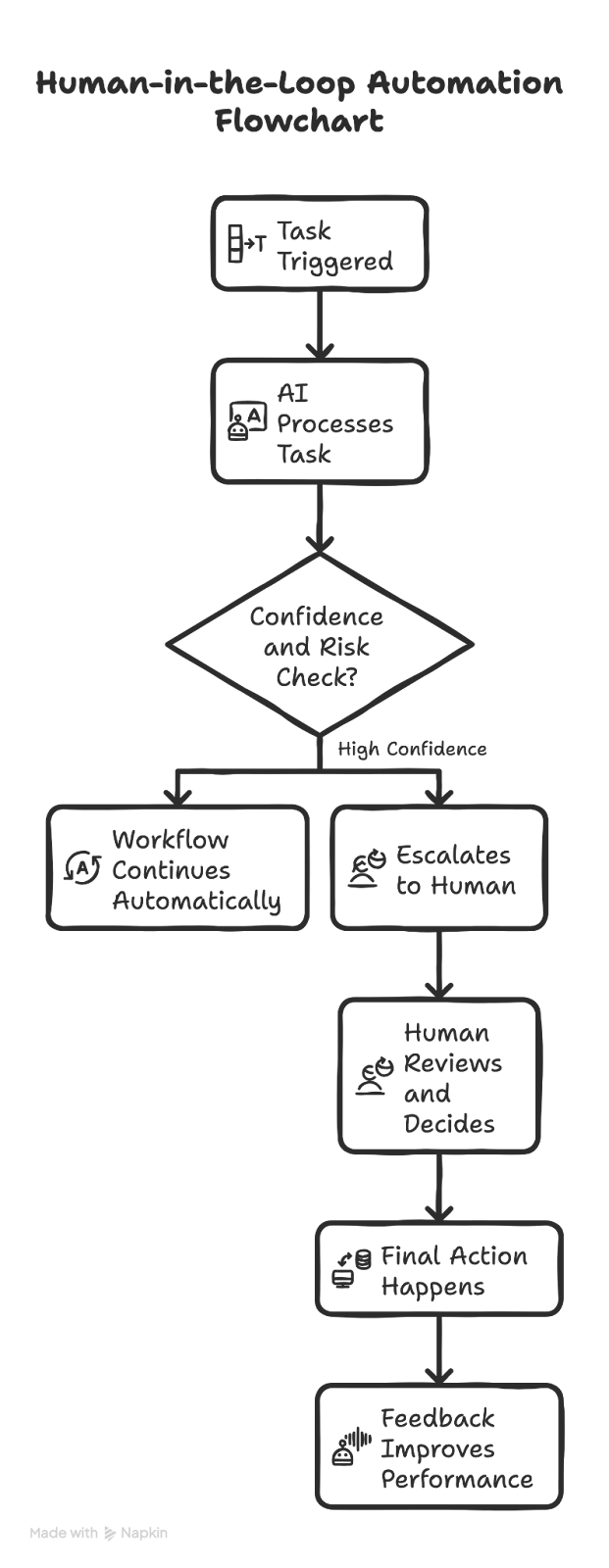
Here’s how it works step-by-step:
- A task gets triggered: A new input comes in (a customer request, a document, a transaction, a support ticket, etc.).
- AI processes the task: The system extracts information, drafts a response, classifies the request, or makes a recommendation.
- The system checks confidence and risk: It evaluates if it’s confident enough to proceed or if it is a high-stakes decision based on thresholds, rules, or policy.
- If confidence is high, the workflow continues automatically: The AI completes the action, logs it, and moves the task forward.
- If confidence is low, it escalates to a human: A person gets the context, the AI’s output, and the reason why it flagged the task.
- The human reviews and decides: They approve, edit, reject, or take over entirely, depending on the workflow.
- The final action happens, and everything is recorded: The system updates the source of truth (CRM, ticketing tool, database) and keeps an audit trail for accountability.
- Feedback improves future performance: The human corrections can be used to refine prompts, rules, or models over time, so fewer tasks need review later.
Imagine a company that uses AI to process customer service inquiries. The AI might be able to handle most inquiries, but there will always be some that it cannot handle. In these cases, a human customer service representative would step in and resolve the issue.
HITL automation is ideal for busy founders juggling sales follow-ups, customer support, and document uploads. It’s perfect for anything where a missed detail means a lost deal, unhappy customer, or compliance headache.
Benefits of human-in-the-loop automation
Human-in-the-loop automation can deliver benefits that fully manual or automated workflows often struggle to match. Here are a few that matter:
Higher accuracy
HITL reduces costly mistakes by adding human review at critical moments. For example, an AI system might extract invoice data at scale, while a human validates only low-confidence fields before payment is released. Accuracy improves without forcing every task through manual review.
Lower operational risk
By involving humans in high-stakes or ambiguous cases, HITL helps prevent errors that could trigger compliance issues, customer churn, or financial losses. This is important in industries like finance and healthcare, where wrong decisions can have major consequences.
Trust and accountability
HITL creates clear ownership over decisions. Humans can review outputs, override AI when needed, and leave an audit trail behind. That transparency builds internal trust in automation and makes it easier to explain decisions to customers, regulators, or stakeholders.
Higher productivity without burnout
AI handles the repetitive, high-volume work. Humans focus only on exceptions, edge cases, and decisions that require context. Support teams, for example, can resolve complex tickets faster without spending their day on routine requests.
Faster iteration and learning over time
Every human correction becomes feedback. Over time, those signals help refine rules, prompts, or models so fewer tasks need review. The system improves continuously instead of staying static.
Better control as workflows change
HITL workflows are easier to adapt when policies, regulations, or business priorities shift. Teams can adjust thresholds, approval steps, or escalation rules without rebuilding the entire system.
Use cases for HITL automation across industries
Many industries use HITL automation to improve the accuracy and effectiveness of their operations. Here are a few examples:
Healthcare
In healthcare, AI can use computer vision to help doctors review X-rays and MRIs to spot potential issues. However, you want HITL in the workflows to send the areas of concern to a trained expert, ensuring accuracy and patient safety.
Finance
AI fraud detection systems analyze financial transactions and flag anomalies. With HITL automation, compliance experts review only high-risk or flagged cases to prevent costly errors and unnecessary account freezes.
Manufacturing
AI can inspect products for defects and flag potential quality issues. HITL in workflows validates these flags, confirming that only actual defects lead to rework, minimizing waste and production delays.
Customer service
AI customer support systems assist in routing customer inquiries and generating automated responses. HITL is there to ensure it escalates the complex or sensitive cases to human agents when needed, improving accuracy and keeping customers happy.
Top 5 human-in-the-loop automation tools: TL;DR
Human-in-the-loop platforms approach the problem in different ways. Some focus on approvals, others on process orchestration, and a few offer AI agents with human oversight. Here’s a quick comparison to help find the right one:
| Tool | Best for | Starting price (billed monthly) | HITL control | Key features |
|---|---|---|---|---|
| Lindy | Automating everyday business tasks with AI agents and human-in-the-loop control | $49.99/month | High | Human approval steps, routing/escalation, audit-friendly task history, email and phone workflows, templates, and 4,000+ integrations |
| UiPath | Enterprise RPA/AI automation with human tasks in the flow | $25/month | High | Orchestrates robots and people, governance controls, and enterprise automation at scale |
| Verint | Real-time human coaching and oversight in contact centers | Custom pricing | Medium–High | In-the-moment agent guidance, CX/EX scoring, supervisor visibility, and call interventions |
| Amazon SageMaker Ground Truth | Data labeling + validation workflows for ML training datasets | Custom pricing | High | Built-in labeling workflows, human review, and managed options |
| Scale | High-volume data annotation for ML/GenAI projects | Custom pricing | High | Data annotation and management, quality workflows, and self-serve + enterprise options |
{{templates}}
Which human-in-the-loop automation tool should you choose?
The right HITL tool depends on where humans need to step in and what kind of work you’re automating. Here’s a quick way to think about each option:
Choose Lindy if
- You want AI agents to handle workflows, but still ask for approval before acting
- Your automation touches email, calls, scheduling, or internal ops
- You need flexible human checkpoints without a complex setup
Choose UiPath if
- You’re automating structured, repetitive business processes at enterprise scale
- Your workflows already rely on RPA and strict governance
- Humans need to validate or intervene in long-running processes
Choose Verint if
- Your main use case is live customer conversations
- Humans need real-time guidance, not post-action review
- You care more about coaching and decision support than workflow automation
Choose Amazon SageMaker Ground Truth if
- Your HITL needs are focused on training or improving ML models
- Humans are labeling, validating, or correcting data
- You’re already deep in the AWS ecosystem
Choose Scale if
- You’re working with large volumes of training data for AI or GenAI
- Accuracy and quality control matter more than workflow orchestration
- You want access to managed human review at scale
{{cta}}
Challenges of HITL automation and their solutions
HITL automation helps AI systems produce more reliable results, but adding human oversight comes with its own set of complications. Here are a few to look out for:
Data quality
For HITL to function properly, you need to train AI on high-quality data. If the data is inaccurate or incomplete, then the results will share the same qualities. The key is keeping your data clean and up to date.
Solution: Use a data validation tool to catch errors early, and make regular updates to ensure your automation is always working with fresh, accurate information.
Human error
To err is human. Even the best-trained employees make mistakes. In workflows using HITL, incorrect inputs or judgments can add up if you feed them back into the system, affecting model training and downstream decision-making.
For example, if you use a mislabeled dataset to refine an AI model, that mistake compounds over time, leading to skewed predictions and reduced accuracy.
Solution: Set your team up for success with clear guidelines and ongoing training. Make it easy to catch and correct mistakes by building in review checkpoints.
This can involve secondary reviews by another expert, AI-assisted confidence scoring to flag uncertain labels, or consensus-based validation for high-stakes decisions. When everyone understands how their input affects the bigger picture, errors become less frequent.
Data security
Security and compliance are a must when dealing with sensitive information like customer details or financial records.
Solution: Use a tool with strong security, like Lindy, that has strong encryption, role-based access controls (RBAC), and audit logs to restrict access to sensitive data. Enable multi-factor authentication (MFA) and limit user permissions to reduce security risks.
Also consider training employees on phishing prevention, password management, and safe data handling. Regularly update security protocols by rotating encryption keys, enforcing least privilege access, and conducting security audits to stay ahead of new threats.
Try Lindy for your human-in-the-loop automation workflows
Lindy lets you create AI agents to automate workflows and add human-in-the-loop review using the visual workflow builder. You can pick from hundreds of prebuilt templates, customize them, and integrate 4,000+ tools to launch quickly.
Here’s how teams use Lindy for human-in-the-loop automation:
- Have a human make the final call: You can require approval before the AI agents take action. For example, if an AI agent drafts an email to a lead, it can generate a summary for human review and request approval before sending.
- Drag-and-drop workflow builder for non-coders: You don’t need any technical skills to build workflows with Lindy. It offers a drag-and-drop visual workflow builder.
- Create AI agents for your use cases: You can give them instructions in everyday language and automate repetitive tasks. For instance, create an assistant to find leads from websites and sources like People Data Labs. Create another agent that sends emails to each lead and schedules meetings with members of your sales team.
- Multi-agent collaboration: Lindy lets you chain multiple AI agents together. One AI agent can manage inboxes, another can draft responses, and a human review step can monitor it before messages go out.
- Stay informed without constant monitoring: Lindy sends updates where you already work, like Slack or email. You don’t have to watch workflows run. You step in only when approval or judgment is needed, which keeps automation helpful instead of distracting.
- Free to start, affordable to scale: Build your first few automations with Lindy’s free version and get up to 40 tasks. With the Pro plan, you can automate up to 1,500 tasks, which offers much more value than Lindy’s competitors.