Gong Review 2026: Features, Pricing, Pro & Cons
Jack tested Gong for sales call recording, coaching, and forecasting, weighing pricing, real-time guidance gaps, and alternatives like Fireflies and Chorus.ai.


I’ve used Gong across multiple sales teams for call recording, coaching, and deal visibility.
It’s packed with features. But after the initial excitement, I started asking:
↳ Is it worth the high price tag?
↳ Do teams actually use all those insights?
↳ And are there tools that offer more flexibility without the bloat?
In this review, I’ll break down what Gong does well, where it struggles, and why I eventually moved to Lindy, which gave me more control, easier automation, and a smoother experience across the sales process.
What Is Gong.io?
Gong is a revenue intelligence platform. It sits across your team’s conversations through Zoom, emails, calls, and extracts insights to improve rep performance, optimize deal management, and forecast more reliably.
.png)
It’s not just a call recorder. It’s more like having an AI-powered manager reviewing everything behind the scenes, flagging what went right, what went wrong, and what needs your attention.
When I connected Gong to our CRM and Zoom accounts, it quickly started capturing and analyzing sales calls, even retroactively. The first few days felt like plugging in a missing layer of visibility across our pipeline.
Gong.io Features That I Liked
1. How Gong’s AI Helped Me Catch Missed Details in Sales Calls
Once Gong starts recording your meetings and sales calls, it goes beyond just transcribing them. It analyzes every minute with AI to pull out key moments that would usually take hours to find manually. To see how Gong compares to top alternatives for automated meeting summaries, explore our guide to the best gong note taker.
You get full transcripts, plus AI-labeled highlights such as:
- Pricing discussions – So you can track how often reps bring up cost and how buyers respond.
- Objections raised – Automatically surfaced so coaches can spot where deals might be getting stuck.
- Next steps committed – Helps managers quickly check if reps are driving deals forward or leaving things vague.
- Competitor mentions – Lets you see how often other vendors are coming up and in what context.
- Talk ratios and silence gaps – Reveals whether reps are listening or dominating conversations.
This single feature helped our managers cut down hours spent reviewing calls. Instead of rewatching entire recordings, they zero in on moments that matter, like when a prospect pushed back or asked about pricing. For a closer look at lighter meeting recording tools, check out our detailed fireflies ai review.
What stood out to me personally is Gong’s "Trackers" feature. You can create custom trackers by entering specific keywords or competitor names, and Gong will automatically flag them in all your call transcripts.
It’s especially valuable for sales leaders who want to monitor how often certain objections, feature requests, or pain points are coming up, without having to search manually.
Trackers also help with trend analysis over time, like spotting if pricing concerns are increasing or if one competitor is being mentioned more frequently than others. It makes your deal reviews and coaching sessions far more data-driven. If you are exploring competitive options for revenue intelligence, check out our guide to the best gong alternatives.
{{templates}}
2. Deal Insights That Show Where to Focus (and What to Drop)
Gong connects every sales interaction, like calls, emails, and meetings to your CRM pipeline and analyzes deal health based on real engagement signals from buyers.
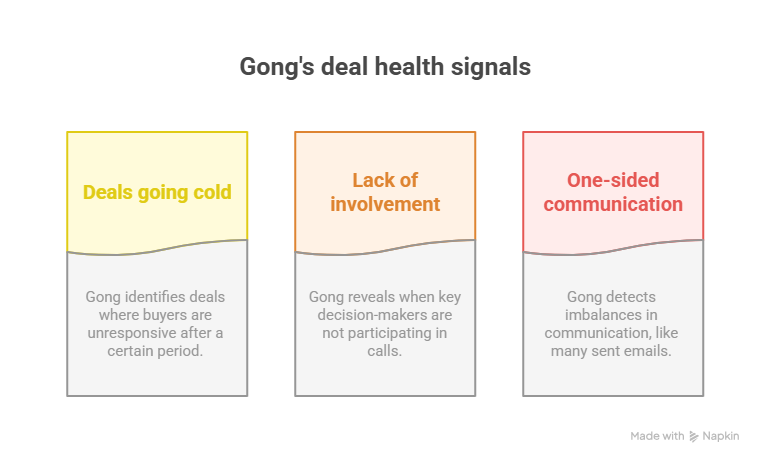
Instead of relying on rep gut feel or outdated CRM notes, Gong flags red and green signals like:
- Deals going cold – No response from the buyer in X days? Gong shows that clearly.
- Lack of executive involvement – If key decision-makers haven’t joined calls or replied, you’ll know.
- One-sided communication – Like when reps have sent 5 emails and only got 1 vague reply back.
These signals helped our team stop wasting time on dead deals. Instead, we focused attention on accounts where buyers were still active and involved.
I personally found the “Engagement Map” feature especially helpful. It visualizes which stakeholders have been involved in each stage of the deal, who’s attending calls, replying to emails, or missing altogether. That means you’re less likely to get blindsided by a hidden approver or an influencer you didn’t know existed.
That said, the accuracy of these insights depends heavily on your CRM hygiene. If reps aren’t logging contacts properly or keeping stages updated, Gong’s deal intelligence will reflect those gaps. It’s powerful, but only if your CRM data is clean. To learn how modern automation tools handle data enrichment for your sales pipeline, check out our best clay review.
3. Forecasting That’s Data-Driven, Not Hope-Driven
Gong Forecast helps you move beyond guesswork by using actual sales behavior, not just rep-reported updates, to generate revenue projections that are grounded in reality.
It pulls from multiple data points like:
- Call behavior – Tracks how often buyers engage and how late-stage conversations unfold.
- Rep activity – Analyzes how frequently your team follows up, sends emails, and holds meetings.
- CRM updates – Weighs pipeline health based on how deals are moving (or stalling) in your CRM.
What stood out to me is how Gong highlights deal risk based on engagement, not just rep confidence. If a deal looks strong on paper but the buyer’s gone silent, Gong adjusts the forecast accordingly.
You also get a real-time, week-by-week visual forecast. It updates as activity happens and gives sales leaders a clearer picture of where they’re headed, what’s solid, what’s slipping, and what’s missing.
Another big value is how it flags pipeline gaps, like low coverage in the final stages or not enough activity to close in time. That kind of visibility helps with both coaching and strategic planning.
That said, the forecasting only works well if your team follows a consistent sales process. If reps aren’t keeping deal stages and CRM notes up to date, you’ll need to clean that up. Gong can’t fix bad inputs, but it does a great job making use of the good ones.
4. Sales Coaching Backed by Data, Not Opinions
Gong transforms coaching from vague feedback sessions into data-driven conversations grounded in actual call behavior.
Instead of watching full-length calls hoping to catch a coaching moment, you can pinpoint patterns like:
- Reps with high talk time but low conversion – Gong shows the numbers, making it easy to identify reps who need to listen more.
- Reps skipping discovery questions – Gong flags when key moments are missed, so you can train reps to stay structured.
- Low performers vs. top performers – You can compare talk tracks, question types, and timing to show what’s working.
What made the biggest difference for us is that reps became more receptive to coaching. It wasn’t just “you talk too much.” It was, “You spoke for 78% of this call, while our top reps average 54%.” That shift from subjective to quantified feedback made coaching more impactful and harder to ignore.
The insights are also visual and trackable over time, so you can measure progress and revisit calls with context. It doesn't just catch mistakes but also builds consistent, repeatable performance across the team.
5. Gong Engage: Smarter Daily Prioritization for Busy Reps
Gong Engage works like a personal assistant for every rep, helping them focus their day around the activities that actually drive revenue.
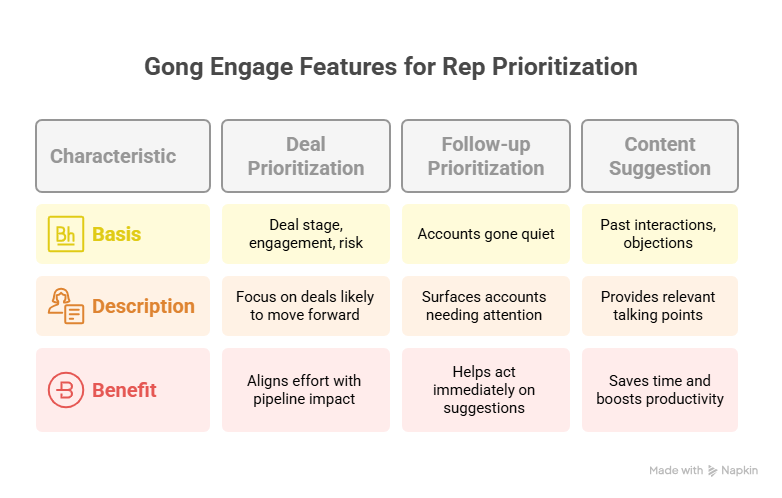
Instead of a generic task list, reps get context-rich prompts that answer:
- Which deals to prioritize – Based on deal stage, engagement signals, and risk indicators.
- Who to follow up with – Gong surfaces accounts that have gone quiet or are waiting on next steps.
- What to say – Suggestions are based on past interactions, recent objections, or topics discussed.
It’s especially useful for high-volume reps managing dozens of accounts. Rather than wasting time deciding where to start, they can act immediately on prioritized, context-aware suggestions.
From what I’ve seen, teams often treat Gong Engage as a revenue-focused to-do list, not just a reminder system, but a smart layer that ties activity to actual pipeline impact. It helps align rep effort with the deals most likely to move forward.
While it's not always perfect and may occasionally surface less relevant tasks, the overall time-saving and prioritization boost make it a solid productivity enhancer.
6. Gong Agents & AI Summaries: Automate the Busywork, Share What Matters
Gong’s latest additions: Gong Agents and AI-powered summaries save you from repetitive sales admin work and keep teams aligned without the noise.
These agents quietly handle tasks like:
- Auto-summarizing calls – You get a quick, structured recap right after the meeting, with key points and action items clearly highlighted.
- Logging next steps to your CRM – No more manual data entry. Gong adds tasks, follow-ups, and commitments directly into the system.
- Triggering Slack alerts – For example, when a deal goes cold or hits a risk threshold, relevant stakeholders are notified instantly.
From my experience, the Slack summaries are especially helpful for cross-functional visibility. Instead of asking product or marketing to sit through long calls, you can keep them in the loop with bite-sized, auto-generated updates.
While this feature is still evolving, it’s already proving useful for aligning teams quickly without extra effort. As Gong continues building out this automation layer, the potential to reduce sales admin overhead and tighten collaboration across teams is huge.
What I Didn’t Love About Gong
Here are a few areas where Gong.io didn’t fully meet my expectations:
1. No Real-Time Coaching or In-Call Guidance
Gong provides excellent post-call insights, but there’s no real-time assistant to guide reps while the call is happening.

If a rep makes the same mistake in back-to-back calls, like skipping discovery questions or overtalking, Gong will flag it after the fact, not during.
For teams that want live coaching or in-call nudges, you’ll need to pair Gong with a real-time assistant tool like Lindy, which can surface reminders, suggest better phrasing, or detect talk-time imbalance while the call is live.
2. Onboarding Is Heavier Than It Looks
Getting Gong fully integrated across tools like Zoom, Slack, Salesforce, and rep workflows took us about 3–4 weeks.
While the documentation is well-structured, the setup isn’t plug-and-play. You’ll likely need a dedicated RevOps lead or strong CS support to configure trackers, CRM mapping, and analytics dashboards correctly.
If your sales process isn’t already standardized, expect some friction during rollout. Gong’s full value depends on clear processes and disciplined usage.
3. Short Calls Aren’t Tracked
Gong doesn’t record or analyze calls under 60 seconds, which can be a problem for teams doing high-velocity sales or quick-touch customer check-ins.
For example, if your SDRs often do 30-45 second connect calls or leave voicemails, those won’t show up in Gong’s system. That means gaps in rep activity data and missed micro-interactions that could still carry important context or trends.
Each of these issues has a workaround, but it’s important to be aware of them, especially if you’re in a fast-moving or high-volume sales environment.
How Much Does Gong.io Cost Realistically?
Gong doesn’t make its pricing public. But based on what I’ve paid and what others report, it’s clear: this is a premium platform built for serious revenue teams.
Here’s a breakdown of typical costs (based on what I pay):
| Component | Estimated Cost |
|---|---|
| Platform Base Fee | ~$5,000/year |
| Per-User License | $1,360 – $1,600 per user/year |
| Support & Training Add-on | ~$7,500 (one-time) |
For example, if you have a 50-person sales team, here’s what you can expect to pay:
- Base fee: $5,000
- Licenses: 50 × $1,520 average = $76,000
- Training/support: ~$7,500
- Total: ~$88,500 per year (approx.)
Is Gong.io Worth the Money?
- For startups or lean teams: This will feel expensive, especially with no free trial and a required demo-to-contract sales process. If your sales motion is still evolving or you don’t have strong RevOps support, it might be premature.
- For mid-market to enterprise orgs: Gong often justifies the cost if you’re scaling a team and need reliable coaching insights, rep visibility, and forecasting discipline. The automation it brings can replace hours of manual review and drive tangible improvements in deal velocity and pipeline accuracy.
Things to Know About Gong Pricing Before You Buy:
- No free trial – You can’t test it on your own. You’ll need to go through a demo and commit based on sales conversations.
- Annual contracts – Gong software generally locks you into yearly deals. Monthly flexibility is rare.
- Support can be extra – Onboarding and analytics alignment usually require help from your CS team or a RevOps lead.
If your reps are doing more than 20+ calls per month, and you’re serious about improving win rates, onboarding speed, or forecasting, the ROI from Gong can start showing up fast, especially with a dedicated manager tracking performance.
But if you're early-stage or experimenting with your sales process, a lighter tool might be more appropriate.
In that case, it’s best to go for Lindy. It’s affordable for smaller teams and scales well.
Learn about Gong’s pricing in detail here.
Who Should Use Gong?
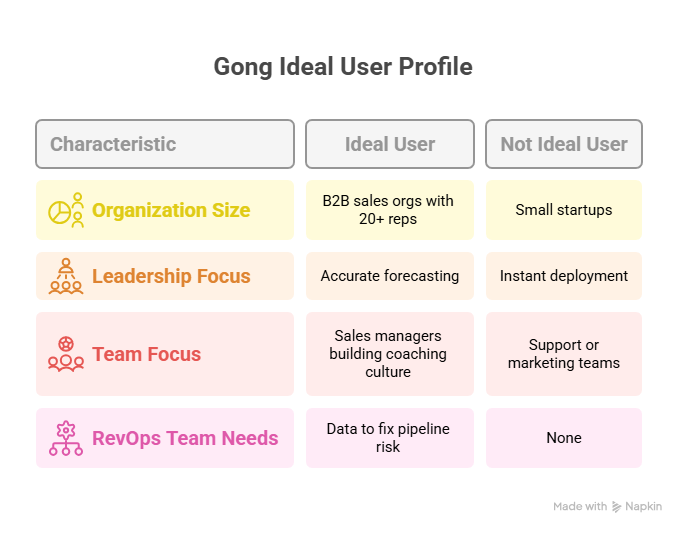
Gong is best-suited for:
- B2B sales orgs with 20+ reps
- Leaders who want accurate forecasting
- Sales managers building a coaching culture
- RevOps teams needing data to fix pipeline risk
It’s not ideal for:
- Small startups or budget-conscious teams
- Businesses looking for instant deployment
- Support or marketing teams (Gong is sales-focused)
Top Gong Alternatives
| Tool | Key Strength | Best For |
|---|---|---|
| Lindy | Real-time voice/email agents + automation | Teams wanting in-call AI |
| Fireflies | Cheap meeting recordings + transcripts | SMBs on a budget |
| Chorus.ai | Coaching tools + analytics | Sales managers |
| MeetRecord | Revenue tracking + deal workflows | Growth-stage B2B teams |
| SalesLoft | Outreach & email cadences | Outbound-focused teams |
{{cta}}
Gong Works Best with Lindy

Gong is excellent at surfacing insights after the call, whether it’s for coaching, forecasting, or understanding deal risk. But it’s not built for real-time execution.
That’s where Lindy fills the gap.
Gong and Lindy work seamlessly together. Gong analyzes what happened. Lindy helps shape what happens next.
With Lindy, you can:
- Jump into live calls and guide reps in real time
- Trigger Gong-like summaries instantly and push them to CRM or Slack
- Use AI agents to follow up automatically, update deals, or remind reps based on Gong insights
- Cover gaps Gong misses, like short calls, email responses, and cross-functional workflows
Together, they give you full-cycle coverage: from real-time support to post-call insight.
Try Lindy for free and bridge the gap between intelligence and execution with Gong integration.
Frequently Asked Questions
1. What is Gong.io?
Gong is a revenue intelligence platform that records and analyzes sales conversations on calls, emails, and meetings. It helps teams improve rep performance, identify deal risks, and forecast pipeline with real buyer data. Think of it as an AI-powered assistant that gives managers insight into what’s really happening in the sales cycle.
2. Does Gong record Zoom meetings?
Yes. Gong AI integrates with Zoom, Google Meet, and Microsoft Teams. Once connected, it automatically joins and records meetings, transcribes conversations, and analyzes the call for keywords, risks, and action items. The recordings are available for review, coaching, and syncing with your CRM for deal tracking.
3. How much does Gong cost?
Gong pricing includes a platform fee of around $5,000 per year, plus $1,360–$1,600 per user annually. Large teams may get discounts. Support and onboarding services can cost ~$7,500 extra. There’s no public pricing page, you’ll need to request a quote during the demo process.
4. Can I get a free trial?
No, Gong doesn’t offer a free trial. You need to request a demo and go through their sales process to access the platform. If you want hands-on testing before buying, consider trying Lindy, which offers a free 7-day trial with real-time sales automation features.
5. Does Gong work in real time?
No. Gong provides post-call analysis only. It records conversations and analyzes them after they end. There’s no in-call guidance or real-time nudges. For live call support, you’ll need to use a tool like Lindy that offers real-time coaching, automation, and feedback during the conversation.
6. Who should avoid Gong?
Gong is not ideal for early-stage startups, small teams with tight budgets, or companies looking for immediate plug-and-play tools. Its setup requires RevOps support, clean CRM data, and a structured sales process. If you’re still figuring out your sales motion, a lighter tool may be better.
7. How does Gong integrate with other tools like CRMs or Slack?
Gong integrates with Salesforce, HubSpot, Slack, Gmail, Outlook, Zoom, Teams, and more. It automatically pulls in conversation data and syncs insights back to your CRM. Slack alerts can be set up for deal risks, summaries, and call updates.
8. Is Gong secure and compliant with industry standards?
Yes, Gong is SOC 2 Type II and ISO 27001 certified. It supports GDPR compliance and offers data encryption in transit and at rest. Admins can also configure access controls and role-based permissions.
9. How long does Gong keep call recordings and transcripts?
By default, Gong retains data for the duration of your contract, but you can configure retention policies based on your compliance needs. Admins can delete or export data on demand.
10. What kind of support does Gong provide after purchase?
Gong offers a dedicated customer success manager, onboarding services, and access to training resources. However, advanced support or custom onboarding may cost extra, especially for teams without in-house RevOps.
11. Can Gong be used outside of sales?
Gong is optimized for sales use cases. While it can technically record calls from success, support, or onboarding teams, the AI models and metrics are tuned for sales conversations. If you need cross-departmental automation, Lindy is a better fit.
12. How does Gong compare to Lindy for day-to-day sales tasks?
Gong helps after the call, analyzing patterns, forecasting pipeline, and coaching reps. In contrast, Lindy helps during the call, guiding reps in real time, sending follow-ups, and automating admin tasks. Most teams benefit from using both together.
13. Can I use Gong for email analysis too?
Yes, Gong can analyze email threads as part of its deal intelligence. It tracks open rates, response delays, and message tone. But it's more limited compared to tools like Lindy, which can draft, personalize, and automate email responses live.
14. How do I get started if I want both Gong and Lindy working together?
Start by integrating Gong with your CRM and meeting tools. Then, deploy Lindy agents to handle live calls, automate summaries, and sync follow-ups. Together, they give you full visibility and execution control across the sales cycle.
15. Does Gong offer any usage analytics or adoption dashboards?
Yes. Gong provides admin dashboards to track rep usage, call coverage, coaching activity, and feature adoption. This helps RevOps teams monitor ROI and identify gaps in adoption early.