Chatbot vs. Conversational AI: Differences & Real-Life Examples
Everett broke down chatbots versus conversational AI, contrasting scripted bots with intent-aware systems and mapping which fits customer support, sales, and internal operations.


I’ve worked with both chatbots and conversational AI across customer support, sales, and internal ops, and they’re not the same thing.
↳ Chatbots follow scripts.
↳ Conversational AI understands intent, context, and adapts on the fly.
One gives answers. The other solves problems.
In this guide, I’ll break down chatbot vs. conversational AI with real-world examples, key differences, and when to use each so you don’t waste time on the wrong solution.
Chatbot vs. Conversational: What’s the Difference?
| Feature | Chatbot | Conversational AI |
|---|---|---|
| Technology | Rule-based, keyword triggers. | NLP + Machine Learning, sometimes speech recognition. |
| Flexibility | Rigid, follows set scripts. | Dynamic, understands context, adapts to conversation flow. |
| Learning Ability | Does not learn or remember. | Improves over time with data from interactions. |
| User Experience | Basic, can feel robotic or limited. | More human-like, contextual, fluid. |
| Use Cases | Answering FAQs, simple forms, basic lead capture. | Full customer support, virtual assistants, complex sales tasks, voice assistants. |
| Integration Ability | Minimal, often standalone. | Deep connections with backend systems and other tools. |
What Is a Chatbot?
A chatbot is a tool that pretends to have a conversation.
It works by following set rules, like using pre-written answers, looking for certain keywords, or following a decision tree (like an “if you say X, then I say Y” path).
For example:
A chatbot on a bank's website might respond to“ lost my card” with a fixed reply like: “Please call our 24/7 helpline at 1800-XXXX-XXX.”
It doesn't really understand “lost,” it just recognizes the phrase “lost my card” and triggers that specific answer. There aren’t many use cases for complex conversations with chatbots, because they follow rules, not language.
Key Features of Chatbots:
- Predefined flows or FAQs: They only know what you program them to know.
- No learning or memory: They don't remember past conversations or learn from new ones.
- Quick to build and deploy: You can set them up fast for simple tasks.
- Limited to the rules you set: They can't do anything outside of their programming.
What Is Conversational AI?

Conversational AI is a much more advanced system. It understands natural language, the context of a conversation, and what a user really means. This is a major difference between chatbots and conversational AI.
It uses smart tech like machine learning (which helps it learn) and Natural Language Processing (NLP), and sometimes even speech recognition for voice interactions.
You can use it to book flights, get recommendations for local restaurants, control smart home devices, summarize meetings, manage your schedule, and so much more.
For example:
A conversational AI agent might respond to “can't find my recent transactions” by actually logging you into your account, showing your transaction history, and even asking if you'd like to download your statement. It understands the intent behind your words, not just keywords.
Core Features of Conversational AI:
- Understands intent and language variations: It grasps what you mean, even if you phrase it differently.
- Learns from past interactions: It gets smarter over time by analyzing conversations.
- Offers personalized responses: It can give answers tailored to you based on your history or information it accesses.
- Can connect with other systems: It can link up with your customer relationship management (CRM) software, enterprise resource planning (ERP) tools, and other business systems to get or put in information.
When to Use a Chatbot
You should consider using a chatbot for your business if you:
- Need something fast and simple to set up
- Are mainly answering frequently asked questions (FAQs) or just collecting basic contact info
- Have a limited budget or the amount of data
- Don't need the system to understand context or complex questions
It’s best for small websites, simple support, or one-step tasks. Understanding typical chatbot pricing can help you determine which option fits your current budget.

{{templates}}
When to Use Conversational AI
You should use conversational AI if you:
- Have users who ask open-ended or complicated questions
- Want your system to get smarter and adapt over time
- Need support across many channels, like chat, voice calls, or email
- Want to connect it with your CRM, ERP, or other custom business tools
It’s best for larger companies, growing startups, automating customer service, sales conversations, or voice assistants.
So, Which One Should You Use: Chatbot or Conversational AI?
It depends on your needs.
Basically, if your goal is to give customers a much better experience, cut down support costs, and automate tasks at a bigger scale, go for conversational AI.
But if you just need a simple tool to answer a few common questions, a basic chatbot will do the job perfectly fine. If you want to evaluate whether automated tools can replace live support agents, explore the best chatbot vs human comparisons.
Real Examples of Chatbots
1. Domino’s: Dom Bot on Facebook Messenger
The Dom Bot helps customers place and track orders through Messenger.
For example, if you type “order pizza,” it shows saved orders or menu options using a fixed script. It can’t understand flexible input like “I’m hungry, what should I get?”
2. H&M: Chatbot on Kik
H&M’s chatbot on Kik recommends outfits based on multiple-choice responses.
You answer questions like your preferred style or colors, and it shows outfit suggestions. You can’t type freely or ask open-ended questions, the flow only works if you follow its structured options.
3. Duolingo: Early Scripted Bots
Duolingo previously used scripted bots for language practice.
Users picked preset replies during mock conversations (e.g., “Yes, I would like some tea.”). The bots couldn’t process free-form text or understand variations, limiting the interaction to pre-written scenarios.
Real Examples of Conversational AI

1. Bank of America: Erica in the Mobile App
Erica is a conversational AI assistant that helps users perform tasks like checking account activity, locking cards, or setting reminders.
For example, if you ask “How much did I spend on groceries last month?”, it interprets the request, analyzes transactions, and gives a breakdown without requiring exact phrasing.
2. Google Assistant
Google Assistant handles everyday tasks across devices, setting reminders, answering questions, or controlling smart home functions.
For example, if you say, “Remind me to water the plants when I get home,” it sets a location-based reminder. It understands the context behind “home” and schedules the task without needing exact commands.
3. Amazon Alexa
Alexa allows voice-based control over smart devices, shopping, schedules, and more.
If you say “Order more paper towels,” it checks your past purchases, confirms the item, and completes the order. It can handle follow-up questions or changes without restarting the conversation flow.
These real examples make it clear that:
- Chatbots follow rigid, rule-based flows.
- Conversational AI adapts, understands context, and responds with useful actions.
How to Integrate Chatbots and Conversational AI into Your Process
Whether you're using a basic chatbot or advanced conversational AI, the goal is the same. Save time, improve customer experience, and reduce manual work.
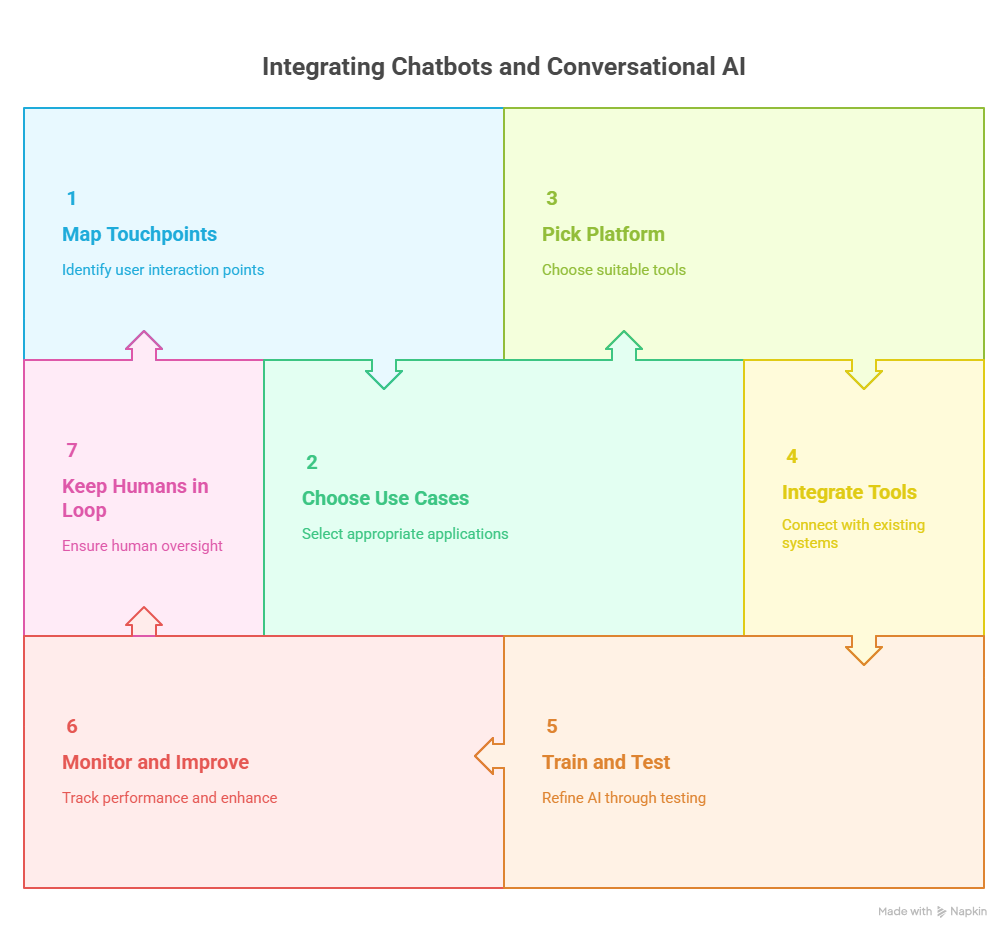
But they fit into your business processes differently. Here’s how to get started:
1. Map Out the Touchpoints
Start by identifying where users interact with your business, like on your website, app, helpdesk, checkout page, WhatsApp, etc.
Use chatbots for predictable tasks (e.g., FAQs, lead capture) and conversational AI where more dynamic conversations are needed (e.g., sales, support, product recommendations).
2. Choose the Right Use Cases
Don’t overcomplicate it from the start. Use a chatbot for:
- Showing store hours or shipping policies
- Booking appointments via a calendar integration
- Collecting lead info with short forms
Use conversational AI for:
- Handling support tickets
- Answering open-ended product questions
- Managing returns or cancellations via CRM integration
3. Pick the Right Platform or Tool
If you want a plug-and-play bot, tools like Tidio, Chatfuel, or Intercom work well. If you need something smarter, use conversational AI platforms like Google Dialogflow, IBM Watson, or a no-code tool like Lindy to build context-aware agents. Always select the platform based on your needs.
4. Integrate with Existing Tools
Make sure your chatbot or AI connects with your CRM, helpdesk, email marketing tools, or e-commerce platform. For example, a conversational AI tool integrated with Shopify can pull order data and provide real-time order updates without human intervention.
5. Train and Test
For chatbots, this means testing flows and making sure the buttons work. For conversational AI, you need to train it on real conversations, define intents and entities, and refine it regularly as it learns from interactions.
6. Monitor and Improve
Use built-in analytics to track drop-off points, unresolved queries, and conversation success rates. Improve your scripts or training data based on where users get stuck or when the AI fails to respond correctly.
7. Keep Humans in the Loop
Even with automation, let users escalate to a human agent when needed. The best setup is hybrid. Chatbots handle routine, AI manages complexity, and humans step in for edge cases.
By combining both, you can automate simple tasks without sacrificing experience on more complex ones. Start small, build on what works, and let the system grow with your business.
{{cta}}
Upgrade to Smarter, Scalable Support with Lindy
Lindy isn't your average chatbot. She's a powerful conversational AI that combines the best of both worlds, delivering the efficiency of a chatbot with the advanced capabilities of conversational AI.
Here’s what Lindy brings to the table:
- Instant inbox support: Lindy handles customer queries directly from your support inbox or her own, cutting response times and improving satisfaction, without human delays.
- Always-on availability: Whether it’s midnight or midday, Lindy responds instantly, 24/7.
- Multilingual coverage: She speaks 13+ languages, helping you connect with a global customer base.
- Easy website integration: Add Lindy to your site in minutes with a lightweight code snippet.
- Connects with 3,000+ tools: From Stripe to Intercom, Lindy plugs into your existing stack without hassle.
- Built to scale: Whether it’s 10 chats or 10,000, Lindy handles it all, solo or in sync with other Lindy agents.
Get started with Lindy for free and see how fast your support and results can scale.
Frequently Asked Questions
1. Can a chatbot be upgraded to conversational AI later?
Yes, but only if the platform supports it. You’ll need access to NLP, training data, and integration capabilities. If your current tool is rule-based only, you may need to switch to a platform like Lindy or Dialogflow for true conversational AI features.
2. What’s the best way to test if my business needs conversational AI or just a chatbot?
Start by analyzing customer queries. If they’re repetitive, a chatbot works. If they involve context, intent, or follow-ups, conversational AI is a better fit. Pilot a small use case and track resolution rates, handoff requests, and engagement to decide.
3. Do I need technical skills to set up conversational AI?
Not necessarily. Tools like Lindy offer no-code setup, pre-built workflows, and native integrations. For more custom solutions, some platforms might require basic understanding of intents, entities, and APIs, but many offer templates to get started quickly.
4. How do I measure the performance of a chatbot or conversational AI?
Key metrics include resolution rate, fallback rate (when it doesn’t understand), average response time, CSAT (Customer Satisfaction Score), and number of escalations to human agents. Conversational AI usually shows better performance over time as it learns from real data.
5. Can I use both chatbot and conversational AI together?
Yes. This hybrid model is common. Use chatbots for simple, predictable queries and deploy conversational AI for tasks that require understanding, personalization, or backend integration. A platform like Lindy supports both approaches in a unified setup. Hybrid models work because user needs are not a standoff between chatbots vs. conversational agents.
6. Is conversational AI only for large enterprises?
No. Startups and mid-sized businesses also use conversational AI to automate support, improve response times, and scale without hiring large teams. Modern platforms make it accessible, cost-effective, and easy to use, even for small teams.
7. What’s a good first step to try conversational AI without risk?
Start with a free plan from a tool like Lindy. Deploy it on a low-volume channel like a support inbox or landing page. Monitor how well it handles queries, and then expand its role based on performance and customer feedback.