What Are Autonomous AI Agents: Types, Benefits, and Uses
Lindy broke down autonomous AI agents, outlining three agent types, six leading platforms, key implementation challenges, and practical use cases for teams.


Unlike traditional automation tools, autonomous AI agents can be setup to complete jobs automatically and understand natural language. They can organize your inbox, find leads, and assist customers by answering questions. These platforms can save businesses time without increasing human resources.
In this article, we’ll cover:
- What are autonomous AI agents and how do they work?
- Types of AI autonomous agents and how to use them in your business
- 6 popular examples of AI agents including, features, and prices
- Implementation challenges and FAQs
- How Lindy can help
Let’s start with an overview.
What are autonomous AI agents?
Autonomous AI agents are applications that can act on their own and execute tasks in response to natural language commands. They use large language models like ChatGPT and Gemini to process human inputs and generate responses.
Website-embedded AI customer service chatbots are classic examples of autonomous AI agents. You teach your AI chatbot about your products and services by feeding it a document called a knowledge base, which it will scan and understand in seconds.
Then, prompt your chatbot on how to respond to inquiries. This will enable your AI chatbot to engage with many customers' questions, troubleshoot common issues, and even pass the customer on to a real person if it detects that the situation is too complex.
You can also create agents that prioritize urgent emails in your inbox and draft responses for your approval. AI agents can retrieve leads from the web, help debug your code, and even handle inbound and outbound calls.
The bottom line is this: Autonomous AI agents can execute various tasks, freeing up precious time.
How do autonomous AI agents differ from traditional software programs?
When it comes to functionalities, autonomous AI agents are light years ahead of traditional software. This is because conventional software programs operate with manual intervention. They require you to input specific commands during each step of a process.
For example, scheduling meetings across multiple time zones with traditional software like Google Calendar or Outlook requires a lot of effort. You’ll need to look up everyone’s time zones and compare available slots, ping team members individually to confirm times, send out calendar invites, and wait for the inevitable, “Can we move it?” response.
Luckily, autonomous AI agents have relegated this clunky traditional software communication to 2019.
Instead of trudging through these tedious tasks with your keyboard and mouse, autonomous AI agents get the job done for you. Just prompt your AI to send an email to everyone on your team to pick a time for a meeting.
Your AI agent will then handle all the grunt work — tracking responses, identifying shared availability, resolving scheduling conflicts, and even sending calendar invites automatically.
Core characteristics of autonomous agents
Let’s now take a look at the critical components and qualities that make up most autonomous AI agents. These traits are baked into most agent platforms, so they feature them right out of the box.
Autonomy
Autonomy is the defining trait of these agents: It’s the ability to operate independently without constant human oversight. Once given an objective as a prompt, an autonomous AI agent can plan, execute, and adjust its actions to pursue that goal.
This independence allows AI autonomous agents to take initiative, solve problems, and complete tasks without constant instruction. They do this using internal feedback mechanisms to understand your commands and sophisticated algorithms to fine-tune their output.
Because of their autonomy, these agents are ideal for tasks that require ongoing attention or real-time adjustments, such as monitoring systems, responding to customer inquiries, or managing workflows across departments.
Reactivity
Reactivity means that AI autonomous agents can respond quickly and effectively to changes. Their algorithms under the hood allow them to perceive real-time inputs — such as user commands and behavior, sensor data, or external events — and adjust their processing accordingly.
AI agents rely on reactivity in cases where situational awareness is crucial. Real-world examples of reactivity-focused agents include autonomous vehicles, customer service bots, and artificial intelligence for financial trading. Predefined rules enable them to handle inputs on the fly.
In our autonomous AI chatbot example, if a customer changes their query mid-conversation, the agent can adjust its response and intent immediately. The agent can also detect the customer’s sentiment through response time and vocabulary, which it will use to create accurate nuanced responses.
Proactive
Autonomous AI agents are programmed to be proactive, meaning they can anticipate needs and take initiative to accomplish their objectives. They can generate tasks, identify opportunities, and address issues before they escalate.
An AI customer service chatbot can detect when a user lingers on an e-commerce site’s returns page. The chatbot can pop up and automatically offer help by asking if the customer needs assistance with a return or refund.
If the user mentions a delayed order, the AI chatbot can create a support ticket, suggest a refund, or even escalate the issue internally, all without being asked. This is just one way of how it works behind the scenes to resolve problems before they become complaints.
This means that autonomous AI agents can act strategically when they don’t need to act reactively. Thus, they can align their behavior with long-term goals or organizational KPIs that they’re prompted to follow.
Social
Autonomous AI agents exhibit a social ability. In other words, they can interact meaningfully with humans and other agents. This means they can converse in everyday speech, understand context and sentiment, and follow conversational cues.
To illustrate this, our customer support chat might escalate a case to a human agent when it determines that the customer is becoming frustrated. It can pick up on the “frustration cues” such as angry word choices and if there are more text in all caps.
Similarly, in multi-agent systems, social ability allows coordination across specialized agents to tackle complex goals. In a team of autonomous AI agents working together in a lead gen, one agent is responsible for lead research by scanning websites and social platforms to identify potential leads.
After qualification, it passes the lead data to a second agent, trained for outreach. This autonomous AI agent crafts personalized messages via email or LinkedIn, adjusting tone and content based on the recipient's profile and past interactions. A third agent steps in to handle meeting scheduling, syncing with calendars, and sending confirmations.
What are the primary benefits that autonomous AI agents bring?
As you’ve probably gathered by now, autonomous AI agents accelerate productivity and decision-making, enabling them to handle complex, multi-step operations with minimal human input.
Here are some of their greatest advantages:
- Task automation without supervision: Autonomous agents can complete complex workflows without constant human input. Once given a goal, they can break it down into steps, make decisions, and adapt as needed — saving you time and freeing you from micromanagement.
- Real-time decision-making: These agents can assess incoming data and adjust their actions instantly. They can also react to customer behavior, track inventory levels in real-time, and follow changing market conditions.
- Scalability across functions: Flawless multitaskers, autonomous AI agents can handle multiple tasks simultaneously, such as managing leads, scheduling meetings, and answering FAQs. Plus, they can be quickly configured to execute an increasing number of functions while your business grows, without adding to headcount.
- 24/7 availability and consistency: Unlike human teams, autonomous AI agents don’t need breaks. They operate around the clock, providing consistent performance and faster responses, regardless of the time zone customers are in.
3 types of autonomous AI agents
Autonomous AI agents vary by their purpose and complexity. Different agents are configured to handle specific tasks, so let's take a look at the 3 main types:
1. Reactive agents
As their name suggests, reactive agents specialize in responding to immediate stimuli using a set of predefined rules. They’re also the most basic type of autonomous AI agents, and they lack memory or internal modeling.
These agents excel in fast-paced environments where immediate decisions are required, such as controlling thermostats when a change in temperature is sensed or triggering alerts. However, their limited context-awareness means they can't learn from past actions, plan ahead, or retain any context or information.
While limited, reactive agents are productive and predictable. They’re helpful for well-scoped, low-risk tasks that don’t require adaptability, foresight, or interaction with customers.
2. Deliberative agents
Deliberative agents, also known as cognitive or reasoning agents, operate by using internal models and goal-based reasoning. They can understand inputs, simulate possible outcomes, and select actions that align with predefined objectives.
These AI autonomous agents can rely on a knowledge base to assess the best course of action across multiple steps or scenarios. They are well-suited for complex tasks such as route planning in autonomous vehicles or conversing with customers as a voice AI or an AI chatbot.
3. Hybrid agents
Hybrid agents are among the most advanced types of autonomous AI systems. They can respond swiftly to immediate events while also making long-term decisions based on internal goals and planning. As a result, they are both versatile and robust.
For example, a hybrid AI system in healthcare might quickly react to reschedule patient appointments during a system outage, while also maintaining continuity in long-term treatment management.
This integration of short-term responsiveness and strategic oversight makes hybrid agents valuable in sectors like finance, logistics, and healthcare, where both agility and foresight are essential.
6 autonomous AI agent platforms
The market is teeming with AI autonomous agents, and not all are created equal. So, we picked 6 that stood out and assessed each one, determining which audience they work best for.
1. Lindy

Lindy is a no-code platform that lets you create autonomous AI agents (called Lindies) with a drag-and-drop interface. The platform offers many pre-built templates that allow you to quickly build and deploy agents for specific tasks, such as lead generation, note-taking, and inbox management.
Features
- Lindy can help you schedule meetings by analyzing calendar availability and sending out invites. It can also send reminders or follow-ups.
- When the meeting time comes, Lindy can join in and record and transcribe the call. Then, it can summarize key insights and propose actionable items that you can share with your team via the Slack integration.
- Build an autonomous AI email agent that can read, sort, and prioritize your inbox. It can also draft replies based on previous interactions and shared knowledge about your company or the topic.
Ideal users
Lindy suits professionals in various industries who want to save time and automate repetitive tasks, such as organizing interviews for HR, handling customer support inquiries, and managing lead follow-ups in sales. The platform provides enough flexibility and cost-effectiveness to build autonomous AI agents for businesses from fresh startups to established enterprises.
Pricing
Lindy’s free plan allows for up to 400 monthly tasks, with Pro pricing starting at $49.99/month for up to 5,000 monthly tasks.
{{templates}}
2. Gumloop

Gumloop is a no-code AI automation platform designed to help businesses streamline routine workflows. It allows non-technical folks the ability to rapidly build AI autonomous agents.
Features
- Gumloop lets you choose the LLM (large language model) that will power your agent. For instance, you can use ChatGPT-4 or Claude 3.5 Sonnet for agents that execute high-level tasks, such as customer communication.
- The platform features built-in integrations with tools like Slack, Salesforce, Semrush, Google Analytics, and HubSpot. This makes it easy to create automations across third-party platforms you use, such as triggering form submissions and emailing receipts when you receive payments.
Ideal users
Gumloop is designed for non-technical teams aiming to reduce operational workload through no-code automation. It’s ideal for startups, small businesses, and lean teams looking for an affordable and easy-to-use platform. It also works for enterprise teams, as it can support high-volume automations.
Pricing
Gumloop pricing starts at $97/month, allowing for one user and providing up to 30,000 monthly automation credits. The next plan, at $297/month, lets you onboard 10 users and provides 75,000 automation credits per month.
3. Voiceflow
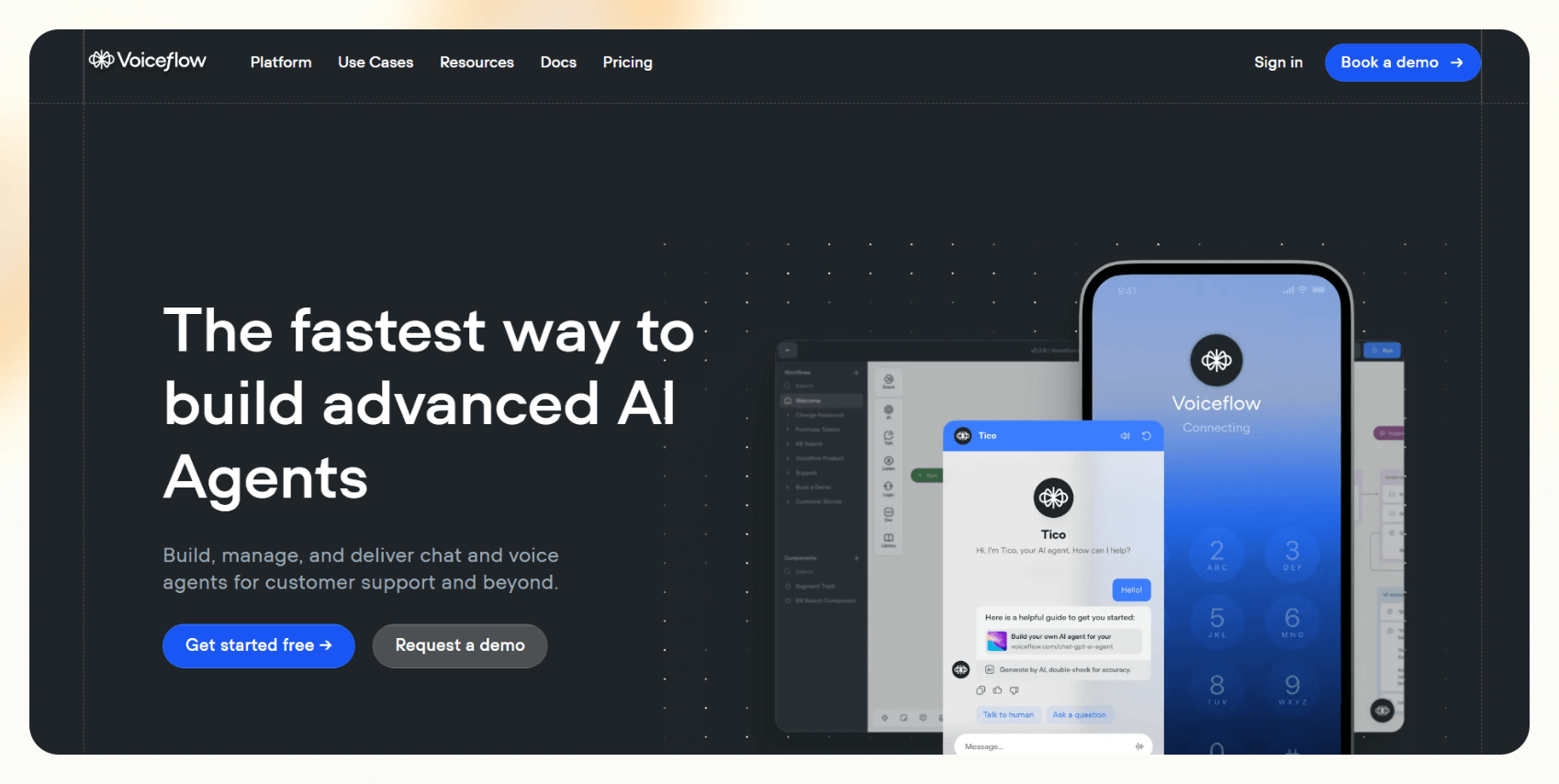
Voiceflow is a no-code platform for building autonomous AI voice agents. It was originally developed for Alexa voice apps, but the platform now supports making agents for websites, mobile apps, and other smart speakers.
Features
- The platform lets your team build agents together by supporting real-time collaboration. It includes features like in-line commenting, version history tracking, and shared workspaces.
- Before deploying your agents, you can use Voiceflow’s built-in testing suite. This helps you pinpoint issues and refine your agents. You’ll also get a post-launch analytics dashboard that offers detailed insights into user interactions and engagement.
Ideal users
Voiceflow appeals to solo entrepreneurs, large enterprises, and everything in between. It’s suitable for automating tasks in customer support, education, e-commerce, SaaS, and fintech, or other roles seeking conversational automation.
Pricing
The $60/month per user version allows up to 2 editors and building of up to 20 agents. Voiceflow’s $125/month per user version is more suited for teams, as you can have up to 5 editors while creating an unlimited number of autonomous AI voice agents.
4. Relay.app
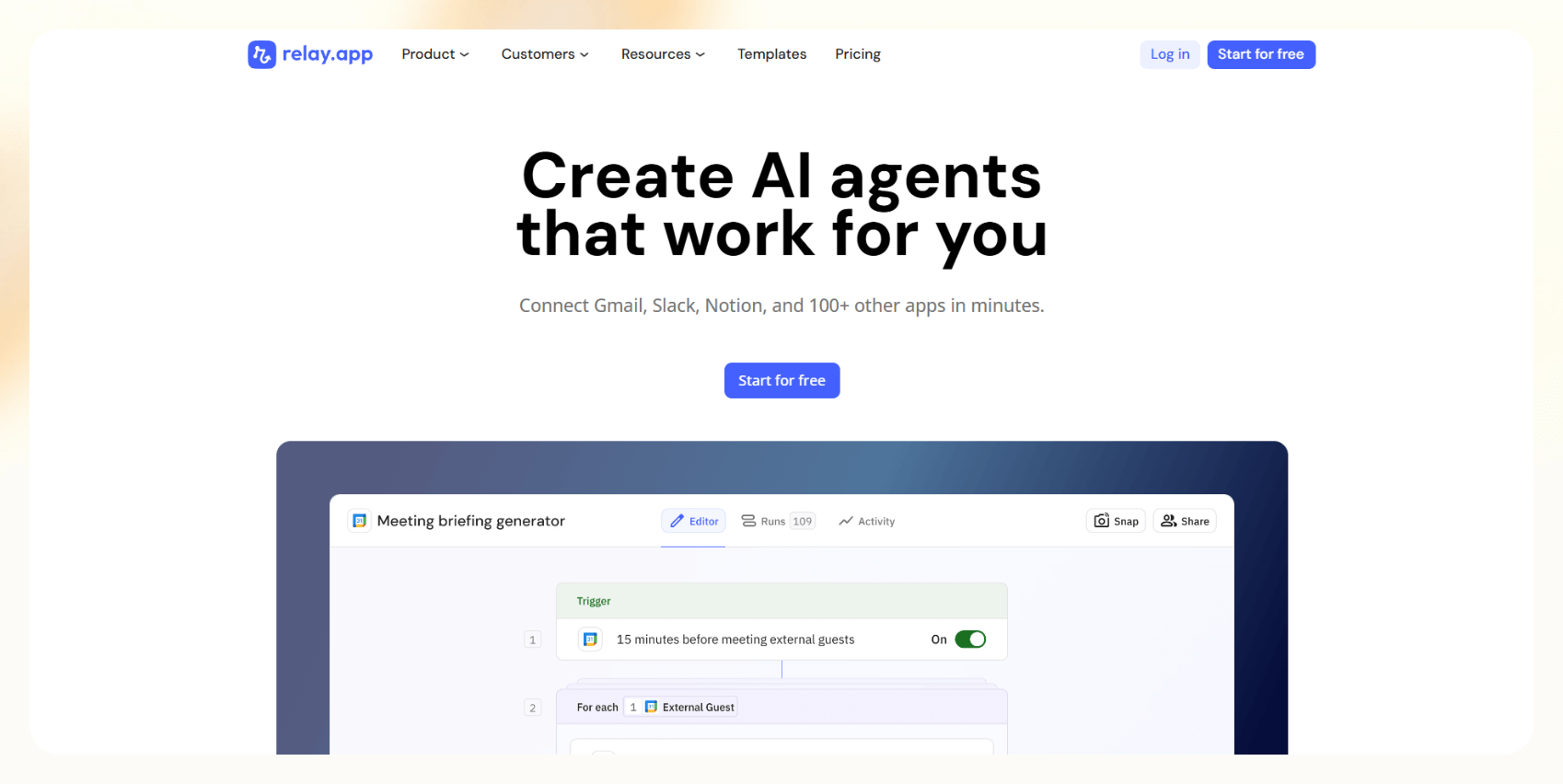
Relay.app is a no-code platform that lets you build autonomous AI agents that can summarize information, translate several languages, and extract data. You can create workflows step by step and automate complex processes, as well as streamline repetitive tasks.
Features
- The platform features Steps, which are structured, step-by-step sequences blending automation with optional human input. These begin with a trigger event followed by data input and integration with connected apps like Slack, HubSpot, or Google Sheets.
- Relay provides various team features. These include shared workspaces, the ability to set granular permissions and assign roles, and tracking workflow activity with detailed logs and edit histories. Notifications can be customized and delivered via Slack or email.
Ideal users
Relay.app is ideal for teams that automate workflows across multiple apps, especially when occasional human input is required. It works for sales, marketing, HR, and support teams. Relay.app serves startups, SaaS companies, and agencies of all sizes.
Pricing
For $23.75/month, one user can create up to 750 Steps. The $86.25/month version allows for unlimited users and up to 2,000 Steps.
5. Salesforce Agentforce
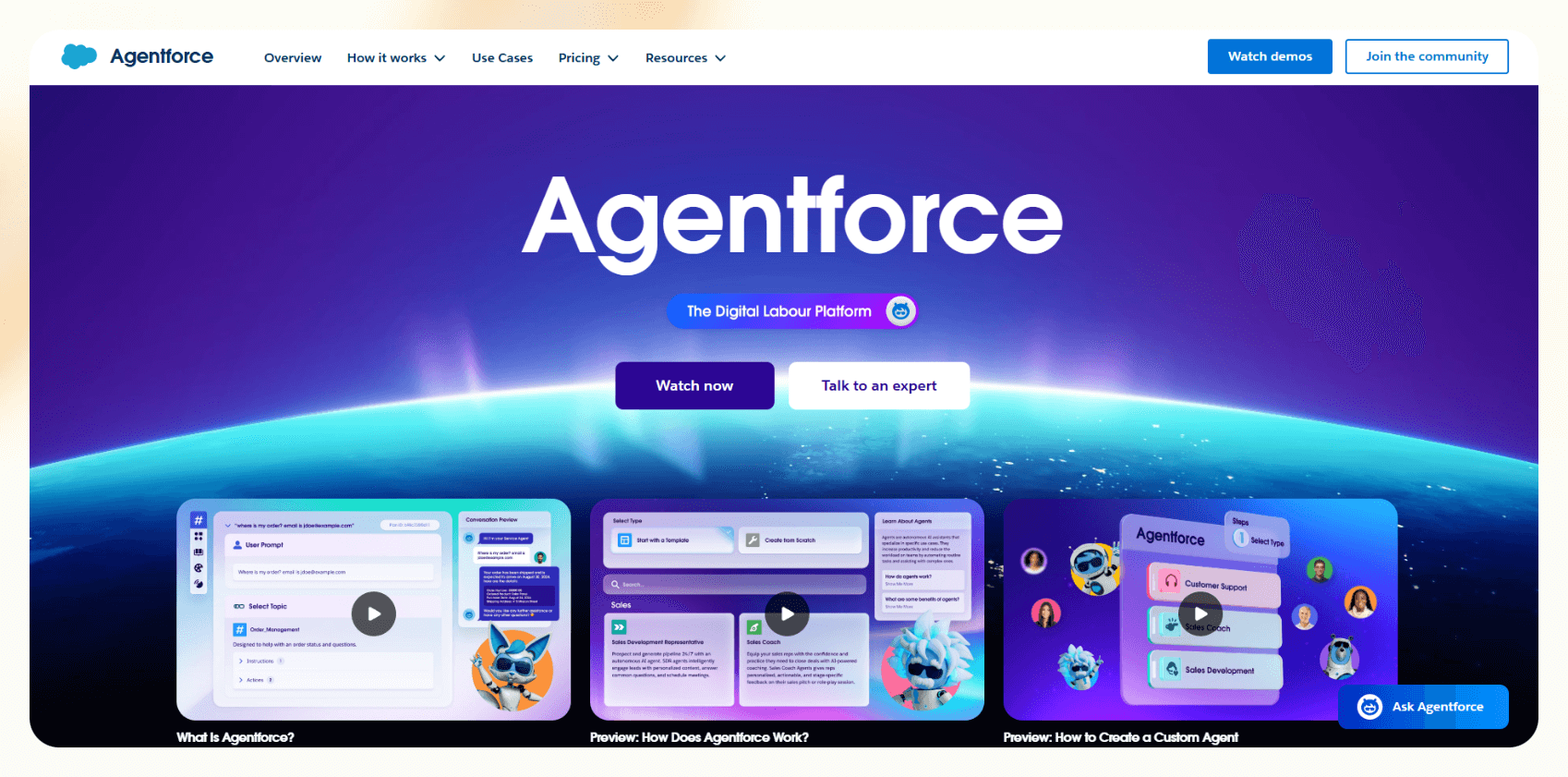
Agentforce is an autonomous AI agent platform designed to work within the Salesforce system. It acts as a customer service chatbot while also providing support to your team.
Features
- Agentforce uses a low-code building interface, which requires some technical skills, such as understanding the logic behind coding and being able to write a few JavaScript or Python commands. This allows techies to add a high degree of customization to their agents.
- The platform lets you build and deploy AI agents that can handle a wide array of tasks across multiple channels, including web, mobile, Slack, and CRM platforms. They can autonomously resolve inquiries, engage prospects, and provide personalized recommendations to your team.
Ideal users
Agentforce is purpose-built for businesses of all sizes operating within the Salesforce ecosystem — it integrates deeply with Salesforce, making it ideal for sales, marketing, and support teams looking to scale without adding staff.
Pricing
Salesforce has a unique pricing plan: You’ll pay $2 per conversation. This means that if your customer service AI chatbot speaks with an average of 5 customers a day, you’ll pay around $150/month.
6. OpenAI’s Operator

Operator, introduced by OpenAI (the makers of ChatGPT), is a preview of an AI autonomous agent capable of performing web-based tasks on your behalf using its own browser.
Features
- The platform combines ChatGPT-4’s vision and advanced reasoning to interact with webpages, documents, images, and more. It can “see” webpages through screenshots and perform actions like as filling out forms, making purchases, and navigating websites, just as a human would.
- You can customize Operator with specific instructions for all sites or individual ones, tailoring how it approaches tasks like booking flights or shopping online. Save prompts for repeated use and run multiple tasks simultaneously by opening new conversations, similar to using browser tabs.
Ideal users
You’ll need to be a ChatGPT Pro user to access Operator. It offers unlimited access to OpenAI's most advanced models, including o1 and GPT-4o, and is tailored for heavy users with high computational demands. This makes it more suitable for larger teams or enterprises that require extensive AI capabilities.
Pricing
Since the platform is still in beta testing mode, it is only available to folks on the ChatGPT Pro Plan, which costs $200/month.
{{callouts}}
Key challenges when implementing AI agents
Just like onboarding a new employee, implementing AI agents comes with its own unique set of challenges. But if you know of these hurdles in advance, clearing them can be less painful and time-consuming.
Learning curve and deployment
Most no-code AI platforms are indeed easy to use, but that’s after you get the hang of it. Even with intuitive drag-and-drop builders, understanding how to define triggers, map conditional logic, and create scenarios takes time to become fluent in using them.
If you’re building agents that can handle several nuanced tasks, the learning curve can become even steeper.
After you learn the building interface and are creating agents, you’ll need to understand how they’ll operate within the broader workflow of your business. This means you’ll likely go through a trial-and-error period as you try to integrate your autonomous AI agent into workflows.
Quality
Ensuring quality in AI agent interactions is a recurring challenge. Sometimes AI agents’ outputs can vary, due to their underlying architecture and the knowledge you feed them. One poorly phrased customer message or misinterpreted intent could result in a lost lead, a frustrated customer, or a miscommunication.
The key to maintaining quality is setting clear expectations during the setup phase. Do this by crafting your prompts carefully and having a clear and concise knowledge base. Regular audits and stress tests, coupled with real-time monitoring, can help ensure problems are caught before they arise.
Another quality concern is knowledge accuracy. If an AI agent pulls information from outdated documents, incomplete databases, or misaligned sources, its output will reflect it. It's also important to periodically review and update your base sources as priorities, products, and policies evolve.
Compliance
AI systems often process sensitive data, so your platform must provide the proper safeguards. This means you should ensure you’re aware of your chosen platform’s security policy before testing its free version.
A good rule of thumb is to go with a platform that’s transparent about its data encryption methods, cloud infrastructure, and access control systems. Bad actors can manipulate these protocols if they’re not accounted for and locked down.
Additionally, if you have a medical agent that handles sensitive patient info or an automation that deals with customer data, you’ll need to have a HIPAA and SOC 2-compliant system, respectively. Failure to meet these standards could result in financial penalties or worse.
{{cta}}
Frequently Asked Questions
What is autonomous AI?
Autonomous AI acts independently, managing tasks, making decisions, and communicating naturally without constant input. It’s like having a smart teammate who adapts, learns, and gets things done for you.
What distinguishes autonomous AI agents from traditional AI systems?
Autonomous AI agents differ from traditional systems in that they operate independently after receiving a goal or prompt. Unlike conventional software that requires step-by-step human input, autonomous agents plan, execute, and adapt their actions with minimal oversight.
How do autonomous AI agents learn and improve their performance?
Autonomous AI agents don’t "learn" in the traditional sense — they rely on predefined rules, prompts, and knowledge bases to carry out tasks. They don’t evolve unless you modify their instructions or update their data sources. Their performance can improve through prompt refinement, a clear and precise knowledge base, and consistent reviews.
Can autonomous AI agents collaborate with human workers?
Yes, autonomous AI agents are actually designed to work alongside humans by handling repetitive or structured tasks. For instance, a customer service chatbot can answer basic queries and transfer more nuanced concerns to a human agent. They can also assist teams by organizing information, scheduling meetings, or generating content.
Try Lindy: Your new autonomous AI agent
Are you ready to create customized autonomous AI agents that you can build and deploy in a snap? Go with Lindy. Here’s how Lindy can transform you and your team’s workflows and free up time to focus on deep work:
- Your own customer service rep: Build a customer-service chatbot on your own knowledge base that can engage customers, answer questions, and resolve problems. It can even detect if an issue gets too complex, and it will then pass the case off to a real human service rep.
- Heaps of integrations: Through a partnership with Pipedream, Lindy connects with over 2,500 third-party platforms and can natively automate tasks across tools like Slack, Salesforce, and Notion.
- Affordable automations: Automate up to 400 tasks with Lindy’s free plan. Then, try out the Pro plan and automate up to 5,000 monthly tasks — more than many competitors at this price point.
Ready to start building autonomous AI agents that can do more? Try Lindy for free.