5 AI In Healthcare Examples That Will BLOW Your Mind
Everett researched real-world AI healthcare tools like Aidoc, Tempus, and Olive AI, examining medical imaging, personalized treatment, and admin automation for accuracy, efficiency, and cost.


I spent hours researching the developments of AI in healthcare. From faster diagnoses to personalized treatments, here are 5 real world examples of AI in healthcare you should know.
What is AI in Healthcare?
AI in healthcare refers to the application of artificial intelligence technologies, like machine learning, to improve patient care, hospital operations, and research in the medical field. Beyond medical facilities, teams in other capital-intensive sectors can learn how to best use ai construction workflows to streamline physical infrastructure projects.
Using AI, you can analyze patient data for more accurate diagnoses, personalize treatment plans, and streamline administrative tasks. To reduce administrative burdens, many clinics rely on specialized ai medical charting software to generate clinical notes automatically.
Some common examples include analyzing X-rays and MRIs, virtual health assistants that chat with patients, and predictive models that warn hospitals before a patient’s condition worsens. To learn how these digital assistants handle complex clinical workflows, explore the growing role of ai agents in healthcare.
But here’s the thing: AI isn’t replacing doctors, at least not anytime soon.
It’s more like a sidekick. It helps medical professionals be faster, catch things they might miss, and focus on what they do best: caring for people.
5 Examples of Artificial Intelligence in Healthcare
1. Medical Imaging & Diagnostics
Doctors often have to manually review X-rays, MRIs, and CT scans, which is a slow, error-prone process.
This is where AI comes to the rescue.
With the help of machine learning, computer vision, and deep learning models, AI can scan thousands of images in minutes, flagging anything that looks abnormal.
These tools are getting better at spotting issues like tumors, fractures, and infections early, often even before obvious symptoms appear.
AI doesn't replace the doctor’s final judgment, but it acts like a second set of expert eyes.
It highlights areas of concern so that doctors can focus their attention faster, diagnose more accurately, and, in some cases, start treatments earlier.
From cancer screenings to spotting rare diseases, medical imaging automation is saving lives, and it’s only getting better with time.
Best AI Tools to Automate Medical Imaging & Diagnostics
- Aidoc: Analyzes CT scans in real-time to detect issues like brain bleeds, strokes, and fractures. Helps radiologists prioritize urgent cases faster.
- Zebra Medical Vision: Uses deep learning to scan medical images for signs of conditions like osteoporosis, cardiovascular disease, and cancers.
- PathAI: Assists pathologists by analyzing biopsy slides with AI, improving the speed and accuracy of diagnosing diseases like cancer.
- Google Health AI: Focuses on early disease detection through advanced image analysis — especially in ophthalmology and breast cancer screenings.
- Lindy: Supports the medical imaging workflow by transcribing clinician dictations, organizing imaging reports, and generating EMR-ready notes through its Medical Scribe feature.
2. Predictive Patient Monitoring
Imagine if doctors could get a heads-up before a patient’s condition starts to decline. That’s exactly what predictive patient monitoring with AI aims to do.
In many hospitals, nurses and physicians manually monitor patient vitals like heart rate, blood pressure, oxygen levels, and so on. But changes can sometimes be subtle and easy to miss until things get serious.
AI tools constantly analyze real-time patient data, spotting patterns that might signal trouble ahead.
For example, AI systems can predict the risk of cardiac arrest hours before it happens, based on minor shifts in a patient’s vitals that aren’t always obvious to humans. It can also detect early signs of sepsis, respiratory failure, or even sudden deterioration in post-surgery patients.
This means doctors can intervene earlier, improving outcomes and often saving lives.
Beyond the ICU, predictive monitoring is starting to be used for at-home patients too. Helping caregivers or doctors when a remote patient’s condition needs attention.
Best AI Tools to Automate Predictive Patient Monitoring
- Current Health: Monitors patients remotely through wearable devices, using AI to detect early warning signs and trigger interventions.
- Clew Medical: Focuses on ICU patient monitoring with AI that predicts deterioration events, helping clinical teams prioritize patients who need urgent care.
- Health Catalyst: Uses predictive analytics to flag high-risk patients and supports care teams with data-driven insights to intervene earlier.
- Biofourmis: Offers AI-based remote monitoring platforms that predict changes in chronic condition patients, helping providers manage heart failure, COPD, and more.
3. Personalized Treatment & Genomics
With advances in genomics (the study of your DNA) and patient data analysis, AI helps doctors create personalized treatment plans based on a person’s unique genetic makeup, lifestyle, and medical history.
Here’s how it works:
AI can sift through a range of genetic data to identify mutations or risk factors that might make someone more likely to develop certain diseases. It can also predict how a patient might respond to different medications
This makes it easier to find the right drug and dosage without months of trial and error.
In cancer treatment, especially, AI-powered genomics tools help doctors design therapies targeted to the specific genetic mutations driving a patient's tumor.
Beyond genetics, AI also looks at clinical records, lab results, and even wearable device data to offer a fuller picture of what treatments might work best for an individual.
Best AI Tools to Automate Personalized Treatment & Genomics
- Tempus: Uses AI to analyze clinical and genomic data, helping doctors personalize cancer treatments based on a patient’s unique tumor profile.
- Foundation Medicine: Offers genomic profiling services that identify actionable mutations, guiding more targeted therapy choices for cancer patients.
- PathAI: Supports personalized medicine by analyzing pathology data with AI, helping clinicians understand the best treatment path based on cellular-level insights.
- Deep Genomics: Focuses on drug discovery using AI to predict how genetic mutations affect disease and how new treatments could intervene.
{{templates}}
4. Admin Workflows
From scheduling appointments and sending reminders to billing patients and updating insurance information, administrative work often eats up hours that could otherwise be spent on actual patient care.
That’s where AI-powered automation comes in.
Today, automation tools can handle appointment scheduling based on doctor availability, send payment reminders, verify insurance details, and even fill out forms.
Some even manage patient intake by collecting information before a visit, saving staff the hassle of manual data entry.
By automating these routine but necessary tasks, healthcare providers can improve patient experience (shorter wait times, fewer errors) and free up valuable time for clinicians and office staff.
Best AI Tools to Automate Admin Workflows
- Olive AI: Focuses on healthcare operations by automating insurance verification, prior authorizations, and claims management.
- Notable Health: Uses AI to automate intake forms, appointment scheduling, and documentation across the patient journey.
- Spruce Health: Helps clinics with secure messaging, telemedicine, scheduling, and billing—all automated through one platform.
- Luma Health: AI-driven scheduling and communication tool that fills appointment gaps and improves patient outreach automatically.
- Lindy: Focuses on automating appointment scheduling, sending reminders, managing rescheduling requests, and handling insurance verification workflows. Lindy also helps with coding, billing documentation, and secure patient communications, while maintaining HIPAA and PIPEDA compliance.
5. Drug Discovery
Bringing a new drug to market can take over a decade and cost billions.
AI is speeding up the most critical early stages, like spotting potential compounds, predicting how they’ll interact with the body, and narrowing down the best candidates for testing.
Instead of running endless lab experiments, researchers can now simulate drug behavior with AI, spotting patterns humans might miss. Some platforms even repurpose existing drugs for new diseases, cutting development time even further.
Best AI Tools to Automate Drug Discovery
- Atomwise: Uses deep learning to predict how molecules will bind to disease targets, helping researchers discover promising compounds faster.
- BenevolentAI: Combines biomedical data mining with machine learning to suggest new drug candidates and optimize research pipelines.
- Insilico Medicine: Focuses on AI-driven drug design, biomarker discovery, and aging research, helping accelerate the drug development process.
- Exscientia: Designs novel drug candidates using AI-driven molecular discovery platforms, with a strong track record of speeding early research stages.
- Lindy: While not directly involved in molecule discovery, Lindy supports research teams by automating research documentation, managing study notes, tracking project milestones, and ensuring sensitive data is stored securely across healthcare and biotech organizations.
Healthcare Benefits From Artificial Intelligence?
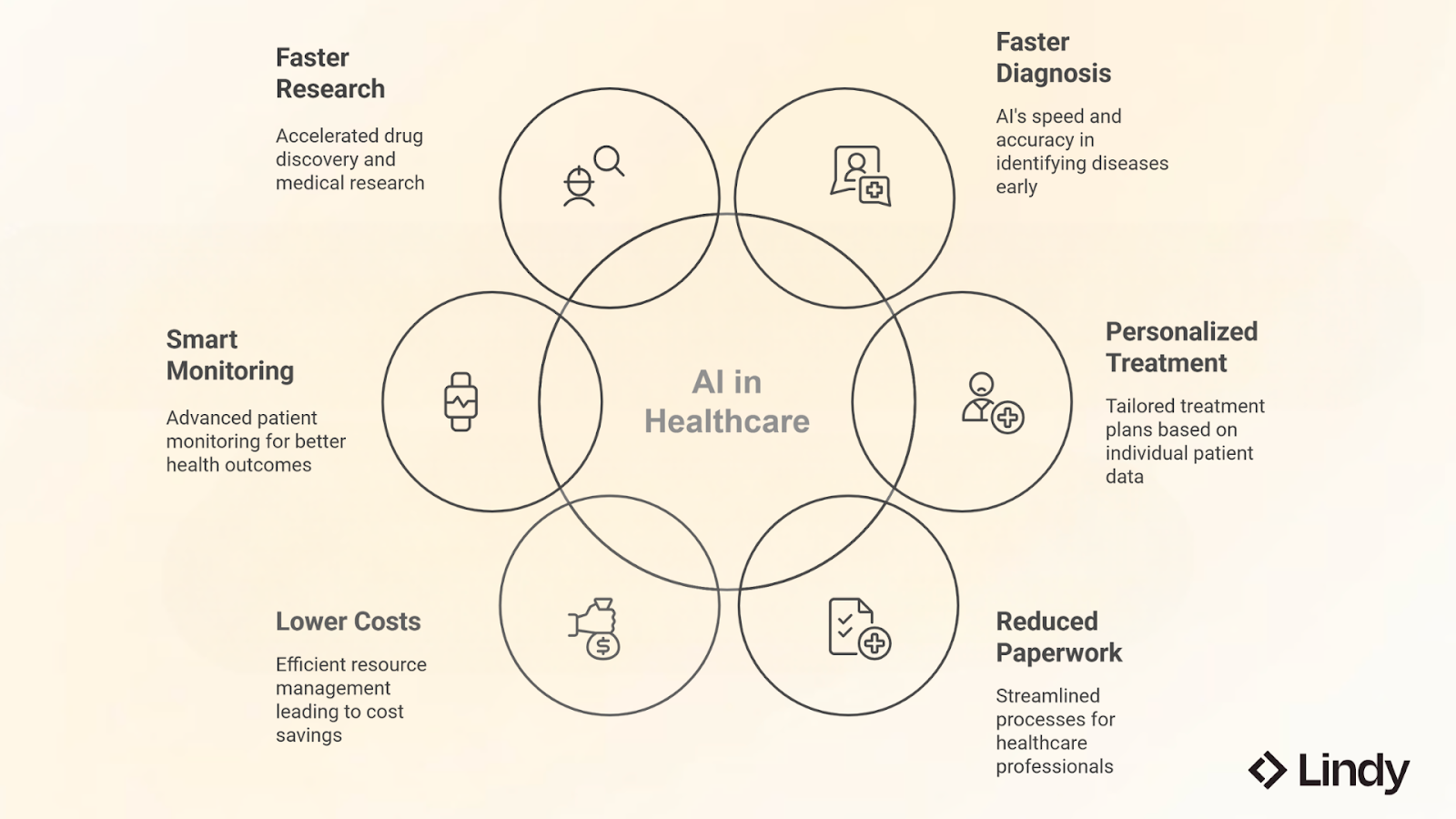
AI in healthcare offers numerous benefits, including improved patient outcomes, enhanced efficiency, reduced costs, and personalized care.
- Faster, earlier diagnosis: AI models can catch subtle signs of diseases in medical images and patient data, often before symptoms become obvious. This leads to faster treatment and better outcomes.
- More personalized care: By analyzing genetic data, medical histories, and real-time health information, AI helps doctors create treatment plans tailored to individual patients rather than relying on a standard approach.
- Administrative relief: AI tools automate scheduling, intake forms, transcriptions, and billing workflows. This frees up valuable time for clinicians and reduces burnout among healthcare staff.
- Cost savings: Early detection, efficient workflows, and faster research translate into lower operational costs for healthcare providers and more affordable care for patients.
- Better patient monitoring: AI-powered monitoring systems can alert doctors to early signs of deterioration in both hospital and home settings, allowing for quicker interventions.
- Accelerated research and innovation: AI helps researchers discover new drugs, find patterns in large datasets, and bring new treatments to patients faster than traditional methods allow.
{{cta}}
How can Lindy help?
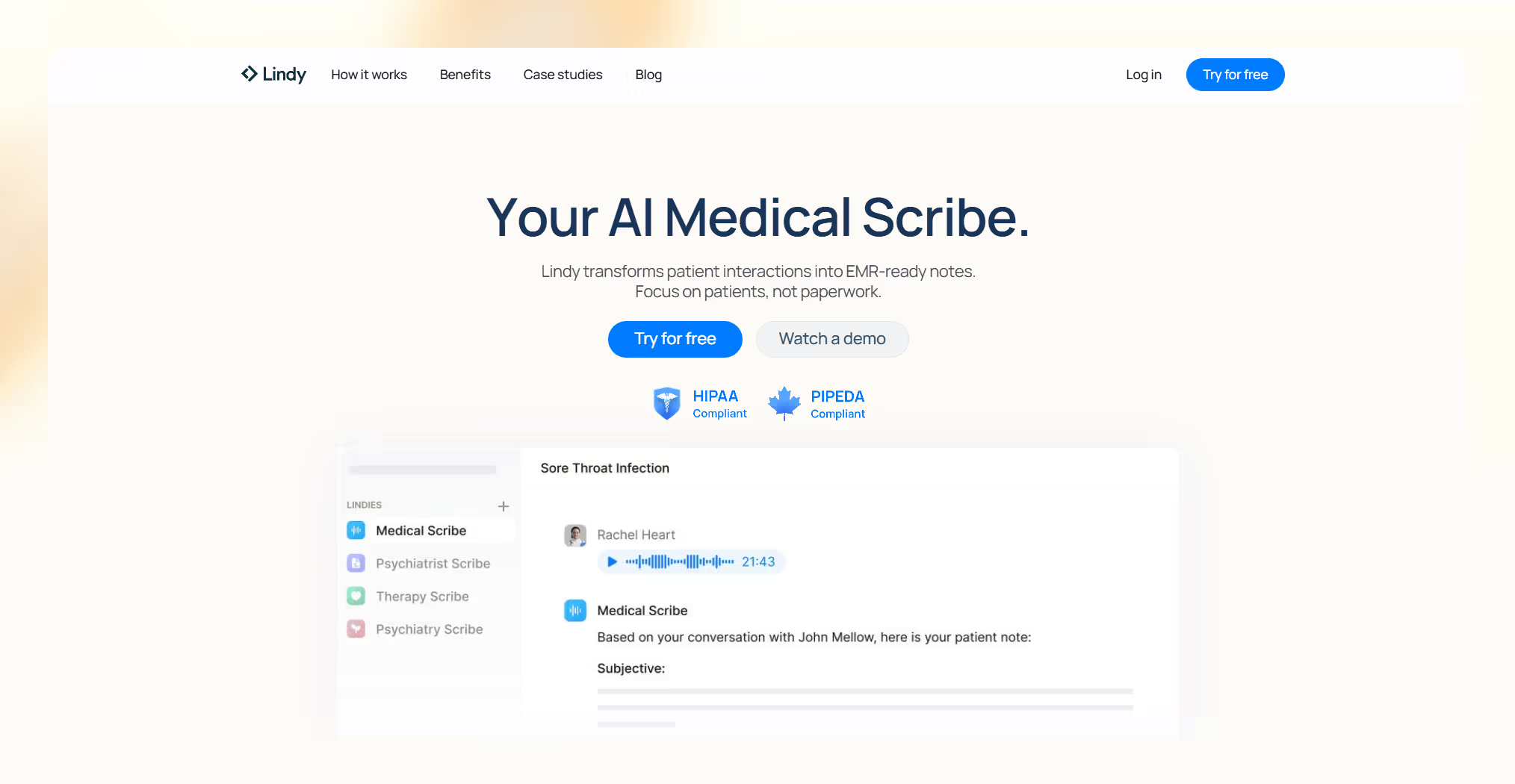
Lindy helps healthcare teams save time by automating all the admin and documentation work that usually eats up hours.
Instead of drowning in paperwork, clinicians can focus more on patient care, while Lindy keeps things organized, accurate, and running smoothly in the background.
Key ways Lindy helps in healthcare:
- Organizes and categorizes medical records
- Automates appointment scheduling and reminders
- Handles patient intake forms and administrative emails
- Assists with billing, insurance, and compliance documentation
- Transcribes patient interactions into EMR-ready notes (Medical Scribe)
- Saves up to 2 hours per day on admin work and increases note accuracy
- Generates clinical documentation (progress notes, referral letters, billing codes)
Frequently Asked Questions
1. What is An Example of Medical AI?
An example of medical AI is Lindy, which helps make healthcare tasks easier.
It organizes medical records, schedules appointments, and handles patient intake forms and emails.
Lindy also helps with billing, insurance, and compliance paperwork, and can transcribe patient conversations into notes for doctors.
Using Lindy you can save hours on admin work, makes notes more accurate, and even creates clinical documents like progress notes, referral letters, and billing codes, helping healthcare professionals work more efficiently.
2. How AI Will Change Healthcare?
AI will transform healthcare by improving diagnostics, enabling personalized medicine, and enhancing operational efficiency.
It will automate routine tasks such as scheduling, billing, and managing patient records, freeing up time for healthcare workers.
Additionally, AI will assist in creating personalized treatment plans by predicting patient outcomes based on data, ultimately improving patient care and reducing costs.
3. How Many Hospitals Use AI?
While a precise number is difficult to pinpoint due to ongoing adoption and varied definitions of AI usage, a significant portion of hospitals are leveraging artificial intelligence (AI) in various aspects of healthcare.
Surveys indicate that a substantial percentage, often exceeding 40% and reaching into the 70% range in some areas, are already using AI for tasks like revenue cycle management, patient monitoring, and predictive analytics.
4. Can AI completely replace doctors in the future?
No, AI won’t completely replace doctors in the future. AI is designed to assist, not replace, healthcare professionals.
While AI can analyze data faster, detect patterns, and suggest possible diagnoses, it lacks essential human qualities like empathy, ethical judgment, and nuanced decision-making based on complex patient contexts.
In real-world settings, AI acts more like an extra pair of expert eyes, helping doctors catch things earlier, reduce human error, and speed up certain tasks.
But final diagnosis, patient communication, and treatment planning still rely heavily on the experience and emotional intelligence of trained medical professionals.
5. Is AI in healthcare safe and secure?
Yes, when implemented responsibly, AI in healthcare is generally safe. Most reputable tools follow strict data privacy laws like HIPAA (in the U.S.) and PIPEDA (in Canada).
However, the security of any AI system ultimately depends on how it's set up and maintained.
Key best practices for safe AI use in healthcare include:
- Training staff on data privacy protocols
- Regularly auditing systems for vulnerabilities
- Encrypting patient data during storage and transfer
- Choosing vendors with strong security track records
- Using HIPAA-compliant and PIPEDA-compliant platforms
Healthcare organizations should view AI as a shared responsibility. The technology itself can be secure, but human oversight is critical.
6. How expensive is it to implement AI in healthcare?
Implementing AI in healthcare can range from $20,000 to over $1 million, depending on the complexity and type of AI solution.
- Affordable options: Tools like AI scribes, appointment schedulers, and billing assistants are relatively inexpensive and easy for small clinics to adopt.
- Moderate to high-cost options: Advanced imaging diagnostics, genomics-based AI platforms, and hospital-wide predictive analytics systems tend to require a larger investment, often needing customized integration and specialist support.
Many healthcare providers start with smaller automation tasks to test the waters before committing to more complex, system-wide AI projects.