How to Use AI to Take Meeting Notes: Top 6 Tools in 2026
Lindy walked through using AI for meeting notes, comparing Otter, Fireflies.ai, and Fathom on transcription accuracy, integrations, and pricing for teams.


Taking notes during meetings often means missing half the conversation or spending hours writing messy recaps. If you’ve been wondering how to use AI to take meeting notes, this guide is for you.
AI note takers handle transcription in real time, highlight action items, and create structured summaries you can share instantly. These tools save time and improve accuracy compared to manual note-taking.
In this article, we’ll cover:
- How to use AI to take meeting notes
- Choosing the right AI note-taking tool
- Top 5 AI meeting note taker platforms
- Benefits and limitations
- Steps to make AI meeting notes reliable
- Tips for using Lindy effectively
How to use AI to take meeting notes
An AI meeting note taker can record, transcribe, and summarize discussions automatically, saving time in meetings.
Here’s a clear five-step process you can follow:
1. Select a tool that fits your workflow
Options include Otter, Fireflies.ai, Jamie, Fathom, Lindy, and more. Each covers Zoom, Google Meet, or Teams, but the capture style differs. For instance, Jamie records directly from your desktop without adding a bot, while Lindy joins calls automatically and sends structured recaps.
2. Connect your calendar and conferencing apps
Link your Google or Outlook calendar and the meetings apps that you use. Once you connect your apps, the bot can auto-join the meetings on your schedule.
3. Run the note taker during the meeting
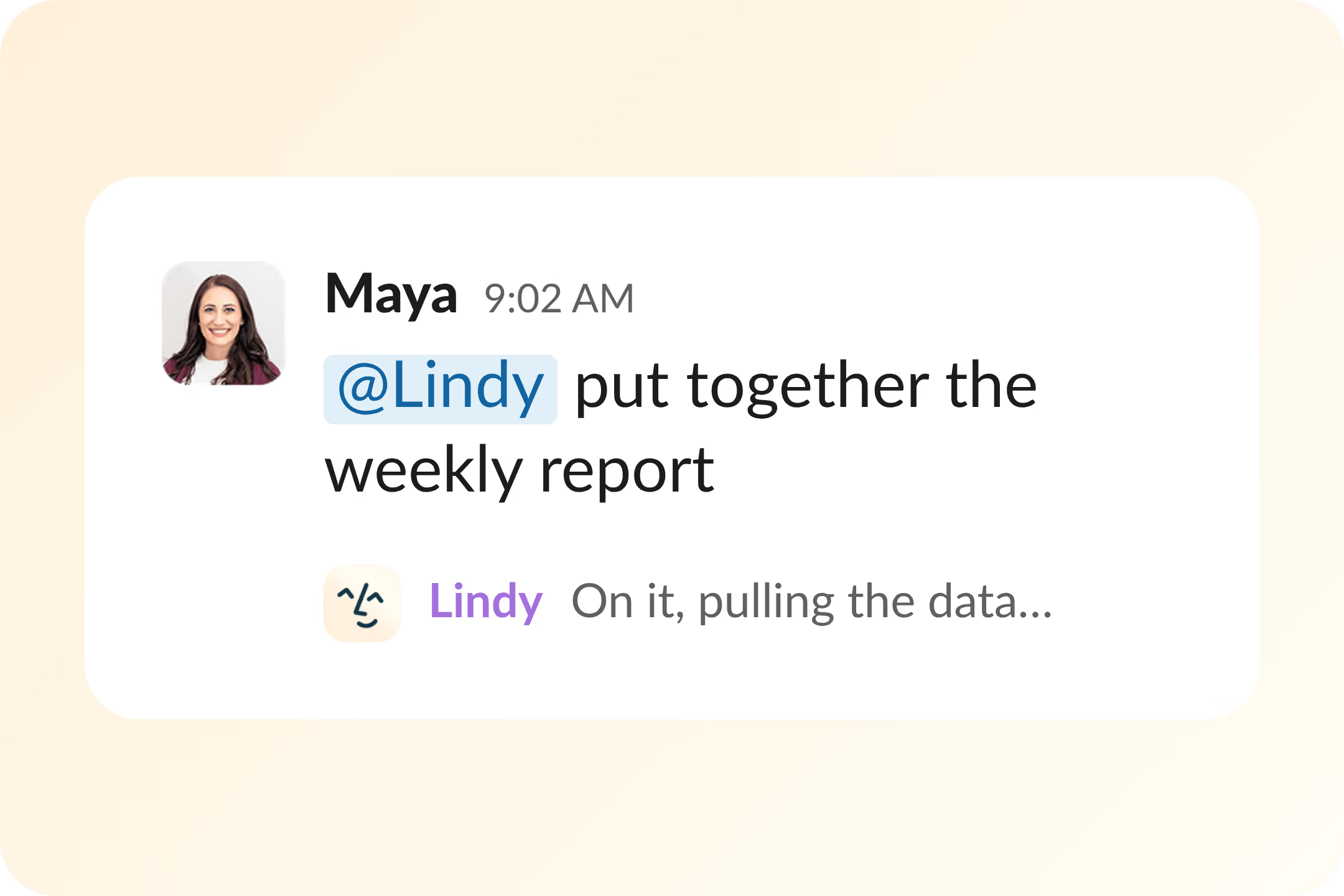
The AI note taker either joins the call as a bot, like Otter or Fireflies, or records locally, like Jamie. Lindy can also push highlights to Slack in real time, keeping teammates in the loop without waiting for a recap.
4. Review and edit key points
AI meeting notes usually include action items and decisions, but they’re not perfect. Skim the summary for errors, especially with industry-specific terms, and make quick edits before sharing.
5. Distribute and store the notes
Send a recap to the team and archive a full transcript in Google Drive or your CRM. A meeting recap should list decisions, owners, and deadlines so your team doesn’t lose anything.
So, how do you choose the right tool?
Choosing the right AI meeting note-taker
Now that you know how to use AI to take meeting notes, the next step is finding the right tool for your team. Factors like accuracy, integrations, ease of use, data security, and cost play a role in the final decision. Here’s what to consider:
Accuracy
Different note‑taking AI tools handle accent, cross-talk, and technical terms with mixed results. Test in your own environment before deciding. Tools like Otter offer custom vocabulary to improve precision.
Check integrations
Good tools don’t stop at transcription. They connect with Slack, Google Docs, CRMs, or project tools to make distribution simple. Fireflies.ai syncs notes into HubSpot, while Lindy can automatically send summaries to Slack or Google Sheets for faster follow-up.
Ease of use
One-click calendar integration and clear sharing options reduce friction. Fathom has a simple desktop app, while Jamie’s bot-free model avoids adding another attendee to external calls.
Security and compliance
Most vendors claim SOC 2 or HIPAA compliance, but standards vary. Review security pages to confirm whether storage and data retention match your policies.
Cost
Free AI meeting note taker plans are common, but may have fewer features. Fathom’s free plan offers unlimited recordings, while others cap monthly minutes. Paid plans usually add advanced summaries and team features.
Choosing the right tool saves editing time and makes your AI meeting notes useful. Next, let’s look at specific tools worth considering in 2026.
{{templates}}
Top 5 AI meeting note-takers in 2026
Many AI note‑taker options exist, but few stand out for specific use cases. Here are five of the best tools in 2026, with a quick look at why each is worth considering:
| Tool | Best for | Why it stands out |
|---|---|---|
| Lindy | Automating meeting notes, summaries, recaps and post-meeting workflows | Offers a Meeting Notetaker template that records, summarizes, delivers notes to Slack or Google Sheets, and chains follow‑up actions |
| Otter | Real-time captions and collaboration | Auto-joins Zoom, Meet, or Teams, and provides searchable transcripts and collaborative highlights |
| Jamie | Bot-free recording | Runs locally on your computer, works even if you’re offline, and avoids adding a bot, which many external guests prefer for privacy |
| Fireflies.ai | Sales and customer success teams | Transcribes calls and pushes summaries directly into CRMs like HubSpot & comes with AskFred, an AI assistant that answers questions about past calls |
| Fathom | Teams and individuals who want a free AI meeting note taker | Offers unlimited recordings on its free plan, paid tiers add AI summaries, action items, and CRM integrations |
All five tools support Zoom, Google Meet, and Microsoft Teams, with each using different methods to capture audio and deliver notes. Some tools, like Jamie, prioritize privacy and simplicity. Others, like Fireflies, go deeper into CRM sync and conversation intelligence.
Lindy combines AI meeting notes with automated distribution and follow-up. Each of these platforms can save you time, but the right choice depends on whether you care more about collaboration, compliance, or workflow automation.
That’s why it helps to look beyond features and consider the benefits you’ll see day to day.
Benefits of using AI for meeting notes
An AI meeting note taker helps teams save time, capture more detail, and share information faster than manual notes. Here are the main benefits to expect:
Save time on every call
Manual note-taking pulls attention away from the discussion. An AI note taker handles transcription and summarization in the background, so participants can focus on the conversation.
Reduce errors and missed details
Handwritten notes often miss context or exact wording. AI meeting notes provide a transcript with summaries of decisions and action items. Reviewing a meeting later is easier when the full record is searchable.
Share notes to different apps
Good tools distribute recaps directly to Slack, email, or Google Docs. For example, Lindy’s AI note taker can send a concise summary to a Slack channel right after the call, keeping everyone aligned without extra effort.
Build a searchable meeting history
Storing transcripts creates a reference library for your team. Tools like Fathom and Fireflies let users search across past meetings to pull up commitments or action items. This helps fast-growing teams that need to track decisions over time.
AI note takers capture words and provide continuity, so people remember the outcomes after the meeting ends.
Next, let’s cover some best practices to make sure your notetaking AI produces useful and reliable results.
Best practices for AI meeting note-taking
Using an AI meeting note taker is straightforward, but a few practices make the results more reliable and valuable. These are worth following:
Test transcription early
Every tool handles accents, jargon, and audio quality differently. Run a few meetings during a trial period to see how well the notetaking AI performs with your setup. Make edits where needed so you can trust the summaries.
Add role-specific prompts
Some tools let you choose what to highlight. Otter, for example, supports custom vocabulary. In Lindy, you can frame summaries around “decisions,” “risks,” or “next steps,” which helps produce more structured AI meeting notes.
Plan how to distribute notes
AI notes are useful when they reach the right people without delay. Fireflies can push transcripts into HubSpot, while Lindy can send a summary to Slack and archive the full transcript in Google Sheets. Decide which destinations work best for your team before rolling out a tool.
Keep sensitive data in mind
AI transcription means conversations leave the meeting room. Review each vendor’s security page and follow your company’s policy on where to store notes. Academic and enterprise guidelines recommend storing notes in official repositories instead of personal drives.
Human-in-the-loop
AI summaries speed things up, but the final distribution should include a quick review. Assign one person per meeting to skim the recap for accuracy before sharing. This review keeps the process accurate while the AI note taker shares notes where your team works.
Following these practices helps teams trust their notes and focus more on what was decided, not on whether something got lost.
Next, we’ll look at the limitations you should expect with most AI note-taking tools.
{{cta}}
Drawbacks and limitations of most AI note takers
An AI meeting note taker saves time, but there are trade-offs worth keeping in mind before relying on one fully. Below are a few to keep an eye on:
- Privacy and security risks: These tools record and process sensitive conversations. Most vendors highlight compliance like SOC 2 or HIPAA, but not all offer the same level of control. Always confirm where transcripts are stored and who has access. Some teams may prefer a bot-free model like Jamie for privacy reasons.
- Accuracy challenges: Even the best note-taking AI struggles with overlapping voices, strong accents, or industry-specific jargon. Missed words or misattributed speakers can cause confusion if you share notes without a review. Do a quick human check before you share AI meeting notes with a wider group.
- Risk of over-reliance: AI tools can create a false sense of security. If no one checks the recap, small errors in action items may snowball into bigger miscommunications. AI should reduce effort, not replace human accountability.
- Integration gaps: Not all platforms connect easily with CRMs, project tools, or knowledge bases. If your workflow depends on downstream syncs, you’ll want to test this during trials. Otherwise, notes may pile up in storage instead of driving action.
Understanding these drawbacks helps teams choose tools wisely and plan around their limits. Next, let’s focus on how to get more value when using Lindy for meeting notes.
Tips for using Lindy as your AI note taker
Lindy can do more than record conversations. It turns meeting discussions into actionable workflows, making it a strong option if you want AI meeting notes tied directly to follow-ups. Here are ways to set it up:
Integrate with your existing tools
Start with Lindy’s meeting recorder template. It records, summarizes, and sends recaps straight to Slack or Google Sheets. You can also configure it to generate a Google Doc for long-form notes. It helps the AI note taker support collaboration without spreading errors.
Test accuracy in your own environment
Audio quality and jargon vary across teams. Run a few meetings and compare the transcript with the summary. Adjust Lindy’s prompts so the summary highlights decisions, risks, and deadlines correctly.
Train it with a relevant term
If your team uses product acronyms, customer names, or technical phrases, add them to the instructions inside the notetaking AI. Doing this helps the summaries reflect your team’s language and reduces the time spent editing.
Standardize how notes are stored
Choose a consistent destination for archiving. Many teams use Slack for highlights and Google Sheets for a searchable record. With Lindy, you can set both up in the same workflow. This makes it easier to trace past commitments when questions come up later.
Keep a human in the loop
AI notes speed things up, but a final check prevents errors from spreading. Assign someone to skim the recap before you share it with external stakeholders. This practice balances speed with accuracy and makes the AI meeting note taker more reliable.
Using Lindy in this way moves you from simple transcription to a repeatable process. As the meeting ends, you’ll have polished notes and clear action items.
Try Lindy to take meeting notes and trigger automation workflows
Lindy is an AI automation platform that lets you build your own AI agents. You don’t need any technical skills to build workflows with Lindy. It offers a drag-and-drop visual workflow builder. These agents can join meetings, take notes, trigger workflows, and automate tasks.
You can get started with pre-built templates and 4,000+ integrations.
Lindy helps automate your workflows with features like:
- AI Meeting Note Taker: Lindy joins meetings from Google Calendar. It records the conversation, creates transcripts, and writes structured notes in Google Docs. After the meeting, Lindy can send Slack or email summaries with action items and can even trigger follow-up workflows across apps like HubSpot and Gmail.
- Create AI agents for your use cases: You can give them instructions in everyday language and automate repetitive tasks. For instance, create an assistant to find leads from websites and sources like People Data Labs. Create another agent that sends emails to each lead and schedules meetings with members of your sales team.
- Update CRM fields without manual entry: Instead of just logging a transcript, you can set up Lindy to update CRM fields and fill in missing data in Salesforce and HubSpot without manual input.
- Send follow-up emails and keep everyone in sync: Lindy agents can send follow-up emails, schedule meetings, and keep everyone in the loop by triggering notifications in Slack, letting you build a Slackbot.
- Supports tasks across different workflows: Lindy handles website chat, lead generation, and content creation. You can create AI agents that help reduce manual work in training, content, and CRM updates.
- Cost-effective: Automate up to 40 monthly tasks with Lindy’s free version. The paid version lets you automate up to 1,500 tasks per month, which is a more affordable price per automation compared to many other platforms.
Try Lindy free and automate up to 40 tasks with your first workflow.
Frequently asked questions
Is there a free AI meeting note taker?
Yes, Fathom, Fireflies, Otter, and Jamie are some of the free AI meeting note takers. Fathom offers unlimited recordings, Fireflies has a free tier, and Otter provides a basic plan. Jamie also includes a free option for a set number of meetings.
What’s the most accurate AI note-taking tool?
Otter and Lindy are two of the most accurate AI note-taking tools. Otter supports custom vocabulary to handle specific jargon, while Lindy lets you frame summaries around categories that matter to your team. The best way to find accuracy is to test each AI note taker on your own calls.
Can AI note-takers work with Zoom and Google Meet?
Yes, AI note‑takers work with Zoom and Google Meet. Lindy, Otter, Fireflies, and Fathom support both, plus Teams. Jamie works across these platforms without adding a bot.
How do I integrate AI notes with my CRM?
You can integrate AI meeting notes directly into your CRM using tools like Fireflies, Fathom, or Lindy. These platforms connect with popular CRMs and automatically push or update notes, so your records stay accurate without manual copying.
Is Lindy better than Otter for team meetings?
Lindy is better if you need automated follow-ups and note distribution, while Otter is stronger for real-time captions and live collaboration. However, Lindy stands out if you want meeting notes tied to automated follow-ups and distribution.
Are AI meeting notes secure?
AI meeting notes are secure when vendors comply with standards like SOC 2 and HIPAA. Always verify each platform’s security features against your requirements.
Can AI note-takers work offline?
Yes, some AI note‑takers work offline. Jamie records locally on your device.