Freed AI vs. Lindy: Which Is Best for Medical Documentation?
Everett compared Freed AI and Lindy for medical documentation, weighing transcription accuracy, template customization, EHR integration, and pricing across real clinical workflows.


I’ve used both Freed AI and Lindy for medical documentation, and while Freed AI is solid for basic transcripts, Lindy outperforms it in real-world workflows.
Lindy doesn’t just take notes; it summarizes, organizes, and adapts to your exact needs. Whether you're a solo practitioner or running a clinic, it fits seamlessly into your workflow without locking you into rigid templates.
In this guide, I’ll break down Freed AI vs. Lindy across usability, accuracy, customization, and real-time performance, and show you why Lindy is the smarter choice in 2025.
Freed vs. Lindy: Key Differences
Here’s how these two stack up against each other:
| Feature | Lindy | Freed |
|---|---|---|
| Customization | Fully customizable templates tailored to your specialty | Stuck with standard SOAP notes |
| Accuracy | Over 99% transcription accuracy, super precise | 95% accuracy, good, but not perfect |
| Speed | Live, instant transcription while you speak | Slower post-consultation transcription |
| Language support | 13+ languages (including French) ready to go | English only |
| Compliance | HIPAA & PIPEDA compliant (great for Canada, too!) | HIPAA compliant, no PIPEDA |
| Support | Hands-on, personal setup and onboarding | Basic, no-frills support |
| Pricing | $49 to $199 per month, depending on the plan type | $99+ per month |
Now let’s review each tool in detail.
1. Lindy AI: Customizable Clinical Scribing
What does it do?
Lindy is an AI-powered medical scribe that automates clinical documentation using real-time transcription and customizable note templates across multiple specialties.
Who is it for?
Lindy is built for healthcare professionals who need structured, compliant, and multilingual documentation, including clinicians, therapists, veterinarians, and physiotherapists.
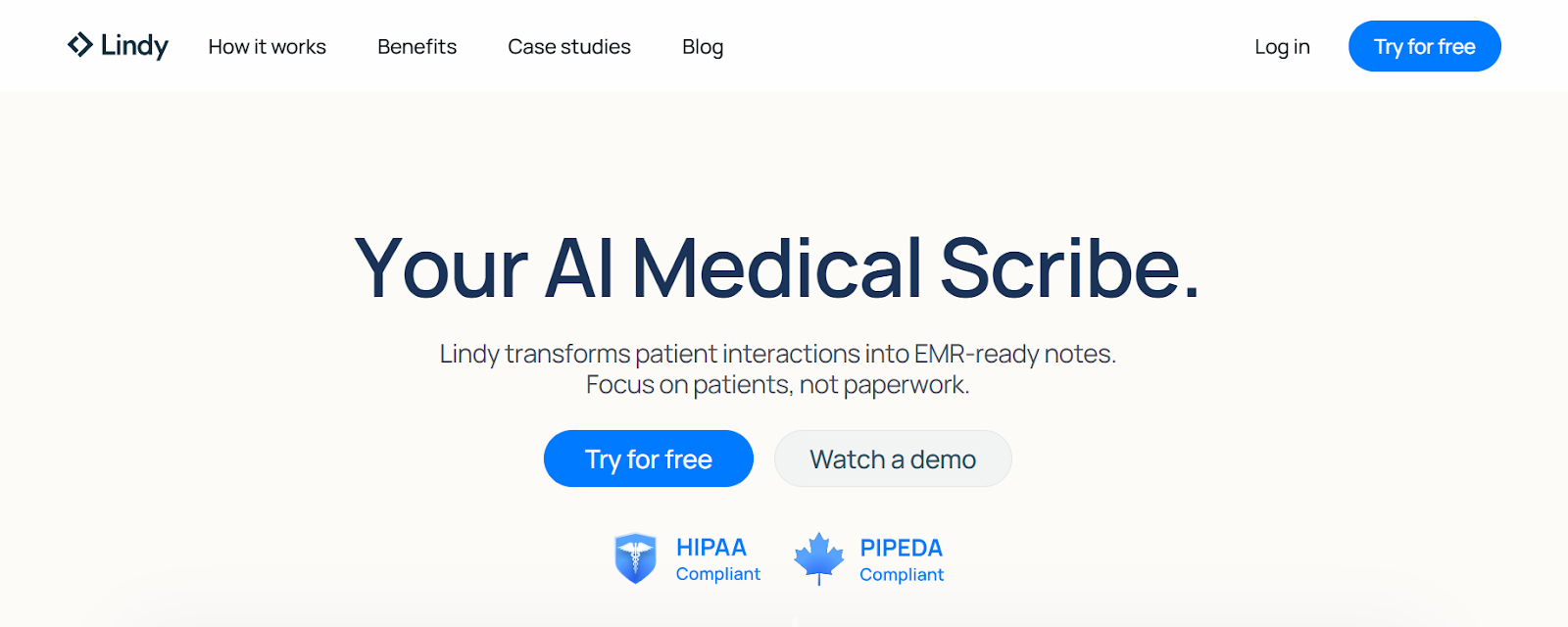
Lindy excels in multi-specialty support, making it a strong option for practices with varied documentation needs. It goes beyond standard SOAP notes, generating progress notes, DAP notes, referral letters, and even billing codes or medico-legal reports.
Its real-time transcription works in 13 languages, which is a major advantage in diverse clinical settings.
Plus, Lindy offers over 50 pre-built templates but also allows deep customization. This flexibility, however, means there’s a learning curve if you want to go beyond defaults.
Once set up, though, Lindy can completely transform your documentation process by saving time and increasing consistency in how records are created.
It also integrates smoothly with existing EHRs, and its HIPAA and PIPEDA compliance keeps your patient data protected.
Pricing is credit-based, which offers flexibility but may be restrictive for high-volume users who document frequently or run large practices.
Pros
- High transcription accuracy
- Templates for over 50 specialties
- Multi-language support
Cons
- Takes time to configure complex setups
- Relies on strong internet connection
- Credit model may not suit high-volume clinics
- $49/month (Students, ~30–50 notes)
- $99/month (Standard, ~1,000–3,000 notes)
- $199/month (Pro, ~3,000+ notes with customization support)
Overall, Lindy is ideal for specialists who need deep customization, multilingual transcription, and flexibility across medical disciplines, all in a HIPAA-compliant setup.
2. Freed AI: Effortless Medical Note-Taking
What does it do?
Freed AI automates note-taking during patient visits, generating real-time, guideline-compliant SOAP notes and summaries based on clinician speech.
Who is it for?
Freed is ideal for individual physicians or clinics seeking fast, accurate, and adaptive note-taking without needing technical setup or training.
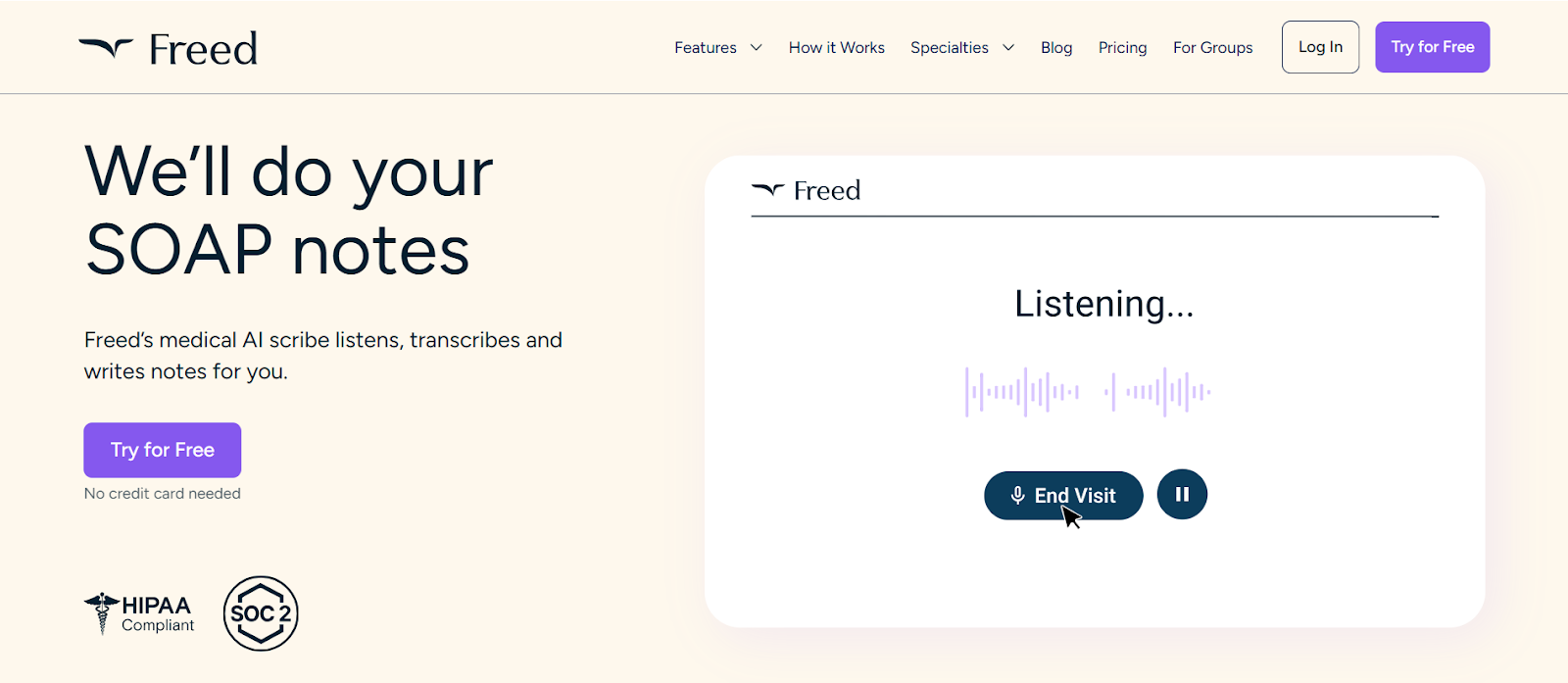
Freed stands out for its ease of use and rapid implementation. You don’t need to build templates or define structures. Just speak, and the AI listens, transcribes, and turns your patient interaction into notes. It generates SOAP notes and after-visit summaries in real time, letting you focus more on patients than paperwork.
The self-learning engine improves over time by adapting to your preferred style and tone, which makes it smarter with each use. Unlike credit-based tools, Freed offers unlimited usage under a flat plan — ideal for high-frequency practices and fast-paced clinics.
Its voice-activated controls mean you can issue commands on the fly without interrupting patient flow. Plus, the after-visit summary feature is a nice touch for clinics offering follow-up documentation to patients or assistants.
EHR integration is seamless, and it’s fully HIPAA compliant. However, because the AI adapts over time, it may take a few sessions to deliver optimal accuracy. Still, the experience becomes smoother and smarter with continued use.
Pros
- No setup; starts working instantly
- Adapts to personal style
- Unlimited notes under one plan
Cons
- Learning curve during initial use
- Limited template flexibility
- Dependent on tech reliability
- Free trial: 7-day unlimited visits
- $99/month (Unlimited individual use)
- Custom pricing (Group plans)
Freed is perfect for clinicians who want plug-and-play simplicity with unlimited documentation. It offers speed, adaptability, and ease in one clean package.
{{templates}}
4 Reasons to Choose Lindy over Freed
At first glance, both Lindy and Freed seem like perfectly matched offerings.
Yes, Freed has earned its reputation for medical charting. However, its focus on the traditional SOAP note format can make it feel generic, especially for practices with specialized needs. There is also no customization.
But that’s the case with Lindy. Here’s why it is superior to Freed AI:
1. Lindy understands that every practice is different
That's why we put customization at the forefront. Need a note template tailored to your niche specialty? Easy as pie. Want to include ICD-10 codes, differential diagnoses, and treatment plans? It takes seconds. With Lindy, your charting system adapts to you (and your chosen EMR), not the other way around.
Plus, Lindy offers ready-made templates for a variety of practices, from general medicine to our veterinarian heroes.
2. Dictate, transcribe, and create notes in actual real time
Need to summarize a patient visit lightning-fast? Lindy's top-tier, instant voice-to-text transcription and seamless formatting will turn your spoken words into organized documents that read like you, but faster.
So, forget about recording a consultation on your phone and sending it to a transcriptionist.
With Lindy, you get a fully customized SOAP note with nearly non-existent processing times.
And patient summaries? Lindy makes them thorough and professional. Plus, with 13+ languages supported, it’s ready to handle your multilingual charting needs.
3. Time is precious, and Lindy helps you save it
We, at Lindy, believe your focus should only be on patient care, not wrestling with software. Lindy offers an intuitive setup that takes minutes, not weeks. Lindy’s transcription and note processing are so efficient you'll gain 2+ hours of precious time back into your schedule every single day.
4. Real support for real doctors
Stuff like “onboarding" and "custom integrations" can feel unnecessarily complicated and time-consuming. Lindy can help with that, too.
Whether it's Zoom calls, emails, or patient explanations, Lindy’s team will guide you until you're a charting pro.
When Should You Use Lindy vs. Freed AI?
We get it, it’s a tough choice. And don’t you hate those completely bogus lists that are so tilted in one direction that they might as well be an ad?
Yes, we’re biased, but we’re not reality-averse. And there’s plenty to like about Freed, too!
So, when should you use Lindy vs Freed? Let’s take a look:
Lindy is for you if:
- You’re all about speed. When you’ve got patients to see, you don’t have time to wait around for AI to think. With Lindy, your notes are translated live as you speak. Zero awkward pauses. Notes are converted instantly into EHR-ready, natural-sounding SOAP notes.
- You’re not a fan of “one size fits all.” Lindy lets you customize everything to your needs. Do you want a specific layout or terminology for your notes? No problem. Lindy’s got you covered.
- You need to transcribe every detail. With its advanced natural language processing features, Lindy has a uniquely high accuracy rate of over 99%, far higher than other similar offerings.
- You appreciate the “above-and-beyond” school of customer service. The team at Lindy actually cares about your experience and success. They’ll do whatever it takes to get you up and running, from answering questions to hopping on a call to walk you through setup.
- You’re in the U.S. or Canada. Lindy’s dual compliance has your back.
Go with Freed if:
- You can get by with 95. At 95% accuracy, Freed’s transcription is nothing to scoff at. Suppose you’re not going to be losing sleep over that 4% (and above) differential. That may not sound like much, but when scaled up to 1000 words, that’s 50 mistakes.
- You want a standard SOAP note that follows a one-size-fits-all format.
- You don’t need a ton of customization. Freed offers solid generic notes, so if you’re looking for basic functionality without a lot of fuss, Freed fits the bill.
- You don’t care about PIPEDA. Freed meets HIPAA compliance for practices in the US. For our friends up north or overseas, you’ll definitely want to go with Lindy.
You can’t go wrong either way. But if a customized, speedy solution with amazing support is what you’re after, Lindy just might be the perfect match for you and your practice.
Lindy vs. Freed AI Scribe Pricing
The million-dollar question is, “What’s more expensive, Lindy or Freed?”
When it comes down to the almighty dollar, the two are pretty comparable, but not equal.
With Lindy, you have three package options:
- The Student plan gives you 30 to 50 notes and costs $49/month.
- The Standard plan is perfect for small clinics just dipping their toe in the AI waters. You get an estimated 500-1500 SOAP notes and storage for one provider for $99/month.
- The Pro plan offers all the standard features for up to five providers for $199/month. It also includes a dedicated account manager and 1:1 note-tailoring.
- The Clinic plans for 5, 15, and 30 physicians.
Plus, Lindy also offers a 7-day unlimited-use trial to get the ball rolling.
Freed also offers three tiers:
- Free to check things out with 3 visits.
- The Freed plan is also $99/month.
- The Group plan has organization-wide BAA and license management, though you’ll have to get in touch with Freed to learn more.
As you can see, if you’re a small clinic or solo practitioner, the prices are pretty comparable.
Now, for mid-sized practices and big players, it’s another story.
We’d say that the added customization and scale-as-you-go features make this a definite win for Lindy.
Lindy vs. Freed: Pros and Cons
Lindy: Trustworthy, customizable, endlessly flexible
- Lindy’s fast transcription adapts to your practice. Whether you run an acupuncture clinic or a pediatrics practice, Lindy customizes itself to your specialty and terminology. It supports over 13+ languages, too (with English and French being its forte), so you’ll never be at a loss for words with your international patients.
- But you can also have too much of a good thing. Lindy has so many options to play with, but you may find yourself tinkering a bit before you get started, especially if you’re making your template from scratch.
Freed: The basic workhorse
- Freed AI is the type of tool that sits back and does its job without complaint. It has a solid, generic clinic note game and delivers letters within a few minutes. It isn’t flashy, but it gets the job done for basic documentation needs.
- The trade-off? Freed lacks personality. Plus, it only supports English notes and has limited customization. So, don’t expect Freed to spice up your notes or make helpful suggestions.
Freed AI vs. Lindy: Our Verdict
When it comes to customizable and solid real-time transcriptions, nothing beats Lindy.
But for basic medical documentation, Freed is good, too.
So, that’s all cards on the table.
If you're still not sure, try Lindy for free.
{{cta}}
Frequently Asked Questions
1. What is the best AI for medical documentation?
Lindy is the best AI for medical documentation. It offers over 99% transcription accuracy, supports 50+ medical specialties, allows full template customization, integrates with most EHRs, and complies with both HIPAA and PIPEDA. Its flexibility, multilingual support, and automation capabilities make it the top choice for clinics, hospitals, and solo practitioners.
2. Which AI produces more accurate notes?
Lindy consistently delivers more accurate notes in transcription, making it more reliable for clinical documentation. Freed performs fine, coming close to Lindy, but its sensitivity to background noise can affect precision in busy or shared environments.
3. How much does Lindy cost compared to Freed?
Both platforms offer standard plans at $99/month. However, Lindy provides a more flexible credit-based model and a $49/month plan for students or low-volume users, which makes it more affordable for trainees and solo practitioners.
4. Can I customize the note templates?
Yes. Lindy supports full customization for over 50 specialties, including layout, formatting, and clinical phrasing. Freed allows basic edits in standard SOAP templates but lacks flexibility and specialty-specific depth.
5. What about security and privacy?
Lindy is HIPAA and PIPEDA compliant, making it suitable for U.S. and Canadian users. Freed complies with HIPAA but does not meet PIPEDA standards, which may be a concern for clinics operating in or with Canada.
6. Which AI tool for medical documentation is easier to use?
Lindy is more intuitive out of the box, with a clean UI and minimal setup for fast documentation. Freed has a steeper learning curve, especially if you want to tailor templates or workflows.
7. Can Lindy or Freed AI integrate with my existing EHR system?
Both support EHR integration. Lindy offers more advanced syncing, with custom field mapping and flexible configuration. Freed connects with standard EHRs but lacks deep customization options.
8. What kind of specialties do Lindy’s templates support?
Lindy supports 50+ specialties including psychiatry, dermatology, pediatrics, orthopedics, and even veterinary care. Each template is deeply customizable to match your clinical language and workflow.
9. Which AI tool is better for group practices or multi-provider clinics?
Lindy scales better for teams, offering collaborative features, multi-user access, and dedicated account support. Freed has group plans but fewer customization and collaboration tools, which may limit use in larger clinics.
10. Is there a free trial for Lindy and Freed?
Yes. Lindy offers a 7-day free trial with full access to premium features. Freed allows documentation for three patient visits before requiring payment, giving users a basic feel of the product.