20 AI Business Ideas for 2026: From Side Hustles to SaaS
Jack compiled 20 AI business ideas across six categories, from content agencies to voice receptionists and niche SaaS tools, covering startup steps, tools, and limitations.


Two years ago, I started a running blog. Not because I had some grand business plan, but because I liked running and figured, why not write about it? A few months in, I was making consistent money from it. Affiliate links, a couple of sponsored posts, nothing crazy, but real income from something I built alone.
A lot of people are now building an AI business idea with just a laptop and tools that handle work that used to take a whole team. So which idea do you pick? That is what this guide is for. Many of these tailored business models leverage the best vertical ai agents to automate industry-specific tasks efficiently.
One thing you will notice across most of these ideas is that once you are running, the operational layer (client follow-ups, scheduling, CRM updates, inbox management) is what eats your time. That is where Lindy helps. Text Lindy what you need handled, and it handles it. Finding the right ai tool for business operations can help streamline these routine tasks before they overwhelm you.
20 AI business ideas: At a glance
| # | Business idea | Best for | Starting point |
|---|---|---|---|
| 1 | AI content agency | Writers and marketers who want retainer income | Offer a free sample post to two local businesses |
| 2 | AI social media management | Anyone with a feel for content on a specific platform | Pick one platform, niche down, and land your first client |
| 3 | AI resume and LinkedIn optimization | HR or writing backgrounds, looking for quick wins | Start on Fiverr, collect five reviews, then go direct |
| 4 | AI research and briefing service | Curious, organized people who write well under pressure | Send a sample report to five professionals in one niche |
| 5 | AI-native video and UGC ads | People with a feel for short-form video performance | Produce five sample ads speculatively, use as a portfolio |
| 6 | Voice AI receptionist | People comfortable with local sales and client relationships | Show one business their missed call data, and offer to fix it |
| 7 | Niche AI educational content | Subject-matter curious people with editorial discipline | Launch one format, publish for 90 days before judging |
| 8 | Agentic AI tool | Domain experts who know where friction hides in their industry | Talk to ten people, find one repeatable task, build fast |
| 9 | AI email outreach tool | Sales or growth backgrounds who understand cold email | Build for one seller type, charge per qualified lead |
| 10 | Niche AI writing tool | Deep experts in law, healthcare, or procurement | Build one narrow task, test with five real professionals |
| 11 | AI-powered marketing agency | Marketers with strategy chops and media buying knowledge | Lead with one service, find two clients in a known niche |
| 12 | AI recruiting and talent agency | Recruiters or HR pros comfortable with relationship selling | Specialize in one function, target companies with repeat postings |
| 13 | AI financial analysis service | Finance or accounting backgrounds with client-facing experience | Offer a paid audit first, document results publicly |
| 14 | AI customer support outsourcing | Ops or customer service pros who understand quality control | Start with one predictable client, run draft mode for two weeks |
| 15 | AI for healthcare documentation | Clinical or health tech backgrounds with compliance knowledge | Start with a wellness product before touching clinical tools |
| 16 | AI for real estate | Real estate or proptech pros who understand transaction flow | Pilot with one agent for 60 days, document the results |
| 17 | AI for legal document automation | People with legal training or deep law firm experience | Offer a $5,000 audit to identify where AI saves the most time |
| 18 | AI prompt libraries and templates | Deep domain experts who have mastered prompting for their field | Build 15 prompts, test every one, sell on Gumroad first |
| 19 | AI newsletter or research product | Curious writers who can filter signal from noise consistently | Start free, publish weekly, build to 500 engaged subscribers |
| 20 | AI-powered e-commerce store | People with a feel for consumer products and short-form video | Pick a niche, build a Shopify store, test five AI video ads with $100 |
Services you can sell this week
If you want to make your first dollar from AI, this is where you start. These are all service businesses, meaning you find a client, deliver the work, and get paid. There is no building a product for six months or waiting for app store approvals.
AI handles the production side, so you can take on more clients than any traditional freelancer could, at a fraction of the usual overhead. Most people in this category land their first client within two weeks of trying. If you decide to transition from services to creating custom tools, using ai app builder software can help you launch quickly.

1. AI content agency
Think about every small business owner you know. They all know they need to be posting content somewhere, a blog, LinkedIn, a weekly email, something. But between running the actual business and everything else on their plate, it never happens. That is where you come in. You handle all of it for them, and AI handles most of the production work.
How it works: A client tells you their topics, audience, and tone. You use AI to generate drafts, edit them to match the client's voice, and deliver on a set schedule. The AI handles roughly 70% of the production work, and you handle the quality, consistency, and client communication. Once you have a system down for one client, replicating it for the next one takes a fraction of the time.
How to get started: Pick one content type, either blog posts or LinkedIn, not both at once. Find two or three small businesses in a niche you already understand and offer them a free sample piece to show what you can do. Land them on a monthly retainer from there and build from that base.
Tools to use:
- ChatGPT or Claude: Both are solid for generating first drafts and rewriting content in a specific tone. Claude tends to produce cleaner long-form writing, while ChatGPT is faster for shorter social copy.
- Surfer SEO or Frase: If you are doing blog content, these tools help you optimize posts for search so your clients get traffic from what you write.
- Lindy: Client follow-ups, approval chasers, and calendar invites are the parts of this business that eat your week before you notice. Tell Lindy what needs to go out, and it drafts everything and shows it to you before anything is sent.
Who this is for: Writers, marketers, or anyone with a decent grasp of English who wants a scalable service business without trading hours for money alone. Prior content experience helps, but what matters more is your ability to understand a client's voice and maintain consistency across a lot of output.
Limitations: Clients will constantly ask for revisions at the beginning while you figure out their voice and preferences, which is normal but time-consuming if you are not prepared for it. The work also gets repetitive once you have a solid system. Building out clear processes and templates early is what separates people who scale this to $10K a month from people who burn out at two clients.
2. AI-powered social media management
Every local business owner knows they should be posting on social media. The problem is they are also managing staff, handling customers, chasing invoices, and doing about forty other things before noon. Posting on Instagram is the last thing on their mind. You take that off their plate entirely.
You run their accounts, AI generates the content, you give it a quick edit to make sure it sounds like them, and they never have to think about it again.
How it works: You take a content brief from the client at the start of the month, feed it into AI to generate a full batch of posts, lightly edit everything to match their voice, and schedule it all in advance. On a well-built system, managing three or four clients takes around ten hours a week total. Your hourly rate starts looking very good from there.
How to get started: Niche down before you pitch anyone because it makes everything easier, from finding clients to delivering results. Something like "I manage LinkedIn for B2B SaaS founders" will land clients. Start with one platform, get good at it, and then expand once you have a repeatable process.
Tools to use:
- ChatGPT or Claude: Use these to generate post captions, hooks, and copy variations based on the client's brief. The more context you give about their audience and tone, the less editing you have to do afterward.
- Buffer or Hypefury: These handle scheduling and publishing across platforms so nothing ever goes out late, even if you are not at your desk.
- Canva: Lets you create clean, on-brand visuals for every post without needing any design background, and their AI features have made the whole process faster.
Who this is for: Anyone who spends time on social media and has a genuine feel for what good content looks like on a given platform. Prior marketing experience gives you a head start, but what clients care about is whether their accounts look active and professional.
Limitations: Clients often want to approve every single post, which sounds reasonable until you realize it turns a ten-hour-a-week business into a constant back-and-forth that eats your time. Setting up a clear approval process at the start of every client relationship is not optional if you want this to stay efficient.
3. AI resume and LinkedIn optimization service
The job market right now is brutal. People are sending out dozens of applications and hearing nothing back, not because they are underqualified, but because their resume never made it past the automated screening software in the first place. You fix that. Using AI, you rewrite their resume and LinkedIn profile to get seen, and then it is up to them to land the interview.
How it works: A client sends you their current resume and the job descriptions they are targeting. You feed both into AI, generate an optimized version tailored to those specific roles, edit it to sound like a human wrote it, and deliver it with a short explanation of what changed and why. Most clients also want their LinkedIn headline and about section rewritten at the same time, which you can bundle into a package.
How to get started: Start on Fiverr or LinkedIn to get your first few clients and build up reviews quickly. Once you have five solid testimonials and a clear sense of what you are doing, move off the platform and charge your own rates directly. The difference in margins is significant.
Tools to use:
- Claude: Claude is good at rewriting resume bullet points to make them more specific and achievement-focused rather than generic. That is exactly what ATS systems and hiring managers are looking for.
- Teal or Kickresume: These handle the formatting side so your deliverable looks polished and professional without you spending an hour in Word fighting with margins.
- Lindy: Ask Lindy to manage intake and it routes new requests straight to your queue. When a draft is ready, Lindy sends it. When a client goes quiet, Lindy follows up.
Who this is for: People with HR, recruiting, or writing backgrounds will ramp up fastest because they already know what hiring managers look for. That said, anyone who can read a job description carefully and understand which skills are prioritized can grasp the core of this quickly.
Limitations: AI can optimize the presentation of someone's experience, but it cannot invent qualifications that are not there. Clients will sometimes have unrealistic expectations about what a better resume can do for them, and managing that conversation early saves a lot of difficult exchanges later.
4. AI research and briefing service
Lawyers, consultants, and investors all have one thing in common: they constantly need information that they do not have time to find themselves. A consultant needs a competitive landscape of the industry they are entering next week. An investor needs a quick breakdown of a market before a call. You become the person who gets them that information, fast and clean, without them having to dig through fifty tabs to find it themselves.
How it works: A client gives you a topic or a specific question they need answered. You use AI to gather information from multiple sources, synthesize the key findings, and deliver a clean, structured report that they can read in 10 minutes. The AI does complex tasks like research and organization. You handle the framing, fact-checking, and making sure the final product is useful rather than just long.
How to get started: Pick one professional category to serve first, rather than trying to work with everyone. Investors, strategy consultants, or boutique law firms are good starting points because they have a clear, recurring need for this kind of work. Reach out directly with a sample report on something relevant to their specific industry to show rather than tell.
Tools to use:
- Perplexity: The best tool available right now for quickly pulling live, sourced information from across the web, which is essential when clients need current data rather than something from two years ago.
- Claude: Excellent for taking a pile of research and turning it into a coherent, well-structured report that reads like a human wrote it rather than an AI assembled it.
- Notion: Lets you deliver reports in a clean, shareable format that looks professional and is easy for clients to navigate and reference later.
Who this is for: People who are naturally curious, comfortable organizing large amounts of information, and able to write clearly under a deadline. Academic, journalism, or consulting backgrounds translate particularly well into this kind of work.
Limitations: AI still occasionally produces inaccurate information, so every report needs a human fact-check before it goes to the client. One wrong statistic sent to a lawyer or an investor can end the relationship permanently. The quality control step is not something you can skip to save time.
5. AI-native video and UGC ad service
E-commerce brands need a constant supply of video ads, the kind that look like a real person picked up the product and started talking about it, rather than a polished studio production. Until recently, producing that content meant hiring creators, coordinating shoots, and waiting weeks for deliverables. Now you can produce that same content with AI tools in an afternoon.
How it works: A client gives you their product details and target audience. You use AI video tools to generate UGC-style clips, add captions and voiceover, and deliver a batch of ad variations ready to run across TikTok, Instagram, or Meta. Because you are producing variations rather than single videos, clients can test different hooks and formats without commissioning an entirely new shoot each time.
How to get started: Pick one product category you understand, skincare, supplements, or kitchen gadgets are good starting points, and produce three to five sample ads speculatively before you pitch anyone. Use those as your portfolio to approach brands directly or through TikTok Shop's affiliate program, where strong-performing videos can earn commission on top of your production fee.
Tools to use:
- Veo 3 or Kling: These generate realistic AI product videos from static images or text prompts, which is the core of the whole operation and the part that used to require an actual film setup.
- CapCut: Handles editing, captions, and pacing fast enough to turn around multiple variations in a single session without it becoming a full production job.
- ElevenLabs: Produces natural-sounding AI voiceovers that hold up well against real human narration. That matters a lot on platforms where audio is on by default.
Who this is for: People with a genuine eye for what performs on short-form video. You do not need to be on camera or have any film background, but you do need to understand what makes someone stop scrolling, because that instinct is what separates good creative from wasted ad spend.
Limitations: Platform policies around AI-generated content are still evolving and vary between TikTok, Meta, and YouTube. What works today may get flagged or demonetized tomorrow, so staying current on each platform's specific rules around AI disclosure is something you have to treat as an ongoing part of the job rather than a one-time check.
AI tools and SaaS products
This is the category for people who want to build something once and get paid for it repeatedly. The difference between this and the previous category is that you are not selling your time; you are selling a product. That shift is what makes this exciting and also harder to start.
You will need a few months before your first paying customer, and you will need to get comfortable with no-code tools like Lovable or Replit. But once it clicks, the math is completely different. One product, hundreds of customers, same amount of work.

6. Voice AI receptionist for local businesses
Think about how many calls a dentist's office misses during lunch, or how many leads a plumber loses because nobody picks up on a Saturday morning. Every missed call is a potential customer who just called the next person on Google.
You build them a voice AI that answers calls 24/7, qualifies callers, and books appointments directly into their calendar. They stop losing business to missed calls, and you collect a monthly retainer for something you built once.
How it works: You set up a voice agent trained on the business's specific scripts, services, and FAQs. When a call comes in, the agent handles it like a real receptionist, answers questions, gathers information, and books appointments without any human involvement. The business owner gets a summary of every call and only steps in when something needs them.
How to get started: Pick one industry to focus on first. Dentists and HVAC companies are great starting points because their call patterns are predictable and the cost of a missed appointment is obvious and quantifiable. Walk into a business, show them how many calls they missed last week using their own missed call data, and offer to fix it for $500 a month.
Tools to use:
- ElevenLabs: Produces natural-sounding voice clones that make the agent sound like an actual receptionist rather than a robot, which is the difference between a client keeping it and canceling after a week.
- Vapi: Handles all the phone infrastructure, so you do not have to build anything from scratch. It connects your voice agent to a real phone number and manages call routing.
- Replit or Lovable: Let you build and manage the logic behind the agent by describing what you want in plain English, no coding background required.
Who this is for: People who are comfortable with local sales and can walk into a business and have a straightforward conversation. The tech side is manageable with the tools available now, so the bigger skill you need is finding and closing clients.
Limitations: The voice AI space is getting crowded fast, and the tech alone is no longer a differentiator. Your ability to handle local marketing, onboarding, and ongoing client relationships is what determines whether this becomes a real business. The tech alone will not get you there.
7. Niche AI educational content platform
There is a version of this that looks like a YouTube channel and a version that looks like a subscription tutoring app, and both can make serious money if you pick the right niche.
Educational content on YouTube tends to earn in the mid-single-digit RPM range, with language learning and exam prep often outperforming other niches, though rates vary by audience and topic. The smarter long-term play is to pair the content with a paid subscription product, so you have two revenue streams running simultaneously.
How it works: You pick a subject with clear demand and underserved supply, language learning, exam prep, or a technical topic that people struggle to find good explanations for. AI generates the scripts, audio, and visuals. You review, refine, and publish consistently. The platform handles distribution and monetization, and your job over time is more editorial than creative.
How to get started: Start with one format, either a YouTube channel or a podcast, not both at once. Pick a niche specific enough that you can own a corner of it, something like "TOEFL prep for Spanish speakers" rather than "English learning." Publish consistently for 90 days before you judge whether it is working.
Tools to use:
- Wondercraft: Generates full podcast-style scripts and audio per episode at a cost that makes producing daily content economically viable in a way that was not possible two years ago.
- CapCut or Clipchamp: Handles video editing, captions, and pacing quickly enough that you can turn around multiple episodes in a single session without it becoming a production job.
- Claude: Best used for scripting and making sure the educational content is accurate, well-structured, and teaches something rather than just filling time.
Who this is for: People who understand a subject well enough to know what good content looks like, even if they are not experts themselves. An eye for what makes educational content engaging matters more here than deep subject-matter credentials.
Limitations: YouTube has started burying generic AI content that does not provide genuine value, so the quality bar is higher than it looks from the outside. You also need a human review process for factual accuracy. One confidently wrong explanation in a tutoring product can do real damage to your reputation in a niche community.
8. Agentic AI tool for a specific business function
Most AI tools people build are too broad. A general-purpose chatbot for businesses will not stand out. Every company already has ChatGPT. An agentic AI tool is one that takes action on its own rather than just answering questions. The real opportunity is building something narrow and specific, a tool that does one job inside one industry better than anything else.
How it works: You pick a business function, resume screening for HR teams, proposal generation for sales, or automated follow-ups for real estate agents, and build an AI tool that handles that one job end-to-end. The tool connects to the platforms the customer already uses and executes multi-step tasks. Anything that needs human judgment gets routed to the right person for approval before it goes out.
How to get started: Talk to ten people in your target industry before you build anything. Find the one task they do repeatedly that they hate doing, and that follows a predictable pattern. That is your product. Use Lovable or a similar no-code platform to build a first version in a week and put it in front of real users as fast as possible.
Tools to use:
- Lovable or Replit: Let you build functional, AI-powered apps by describing what you want rather than writing code so that you can go from idea to working prototype in days, not months.
- Claude or ChatGPT: Serve as the reasoning layer inside your tool, handling the complex judgment calls that pure rule-based logic cannot manage on its own.
- Zapier or Make: Connect your tool to the apps your clients already use, Gmail, Slack, and CRMs, so the actions your tool triggers execute across their existing stack without building custom integrations.
Who this is for: People who have worked inside a specific industry and understand where the friction is. Domain expertise is your competitive advantage here because someone who has never worked in real estate will struggle to build a better real estate tool than someone who spent five years doing it.
Limitations: Agentic tools that touch critical business data carry real risk if they make a mistake. A hallucinated clause in a legal document or an incorrect number in a financial report can cause serious problems for your customer and significant liability for you. Building in human approval steps for anything high-stakes is not optional.
9. AI email outreach tool
Sales teams and solo founders have the same problem: they need a constant pipeline of qualified leads, but finding, researching, and writing personalized outreach to each one takes more time than they have. You build a tool that handles the entire prospecting cycle, finding leads, qualifying them based on real data, and writing outreach emails that sound like a person wrote them rather than a robot.
How it works: The tool pulls lead data from a source such as Clay, qualifies each lead against criteria the user sets, and generates a personalized email, trained on the user's past successful messages. The result is outreach that references something specific and relevant about each prospect, which performs better than generic templates. Users review and send, or let the tool send automatically, once they trust it.
How to get started: Build a simple version for one specific type of seller first. B2B SaaS founders doing cold outreach is a well-defined starting point with clear demand. Charge per qualified lead delivered rather than a flat monthly fee in the early stages, because it ties your revenue directly to results and makes the value easy for clients to justify.
Tools to use:
- Clay: The best tool available for finding, enriching, and qualifying lead data at scale without manual research, which is the foundation that the rest of the system runs on.
- Claude: Trained on a user's past emails, it generates new outreach that matches their voice and references specific details about each prospect in a way that generic prompting cannot replicate.
- Instantly or Smartlead: Handle the actual sending, inbox warm-up, and delivery tracking so your emails land in inboxes rather than spam folders.
Who this is for: People with a sales or growth background who understand what good outreach looks like and why most of it fails. The technical build is manageable, but knowing what makes a cold email work is what determines whether your tool delivers results or just sends a lot of ignored messages.
Limitations: Generic AI copywriting is increasingly being filtered as spam by both email providers and recipients who have seen enough AI-generated outreach to recognize it immediately. Without a specific niche focus and high-quality personalization data, this product risks becoming just another ignored email generator in an already saturated market.
10. Niche AI writing tool for a specific vertical
There is a meaningful difference between asking ChatGPT to write a legal clause and using a tool specifically trained on legal language, contract structures, and the kinds of risks that matter in that context. Professionals in high-stakes fields like law, healthcare, and procurement already know that general AI falls short for their work. You build the version that does not, and you charge accordingly.
How it works: You take an AI model and wrap it with highly specialized prompts, domain-specific data, and a custom interface designed around how professionals in that field work. A lawyer gets clause detection and risk flagging. A doctor gets clinical note templates that match their specialty. A procurement manager gets contract language that holds up under scrutiny.
The underlying AI is not doing anything a user could not prompt themselves to do, but they would never know how to prompt it that well, and that is the product.
How to get started: Pick one vertical where you have real knowledge or access to someone who does. Spend time understanding exactly what writing tasks consume the most time in that field and what makes a good output versus a bad one. Build a narrow first version around one specific task and get it in front of five real professionals before you expand it.
Tools to use:
- Claude: Particularly strong for professional writing tasks that require nuance, precision, and the ability to maintain a consistent standard across long documents without drifting.
- Grammarly: Adds a grammar and style-checking layer on top of the AI output, which matters in professional contexts where a single error undermines credibility with the people paying for it.
- Notion or a custom Webflow build: Works well for delivering the tool in a clean, professional interface that feels appropriate for the high-stakes context your users are operating in.
Who this is for: People with genuine expertise in a specific professional field, or a strong ability to learn one deeply enough to build something useful for it. The value of this product lies entirely in the specialized knowledge baked into it, so a surface-level understanding will yield a surface-level tool that users abandon quickly.
Limitations: If the specialization is shallow, a professional user will get the same results from ChatGPT for free within a few minutes of trying. The entire business model depends on the depth and accuracy of your domain-specific customization. This takes more upfront research and validation than most other ideas on this list before it becomes something worth paying for.
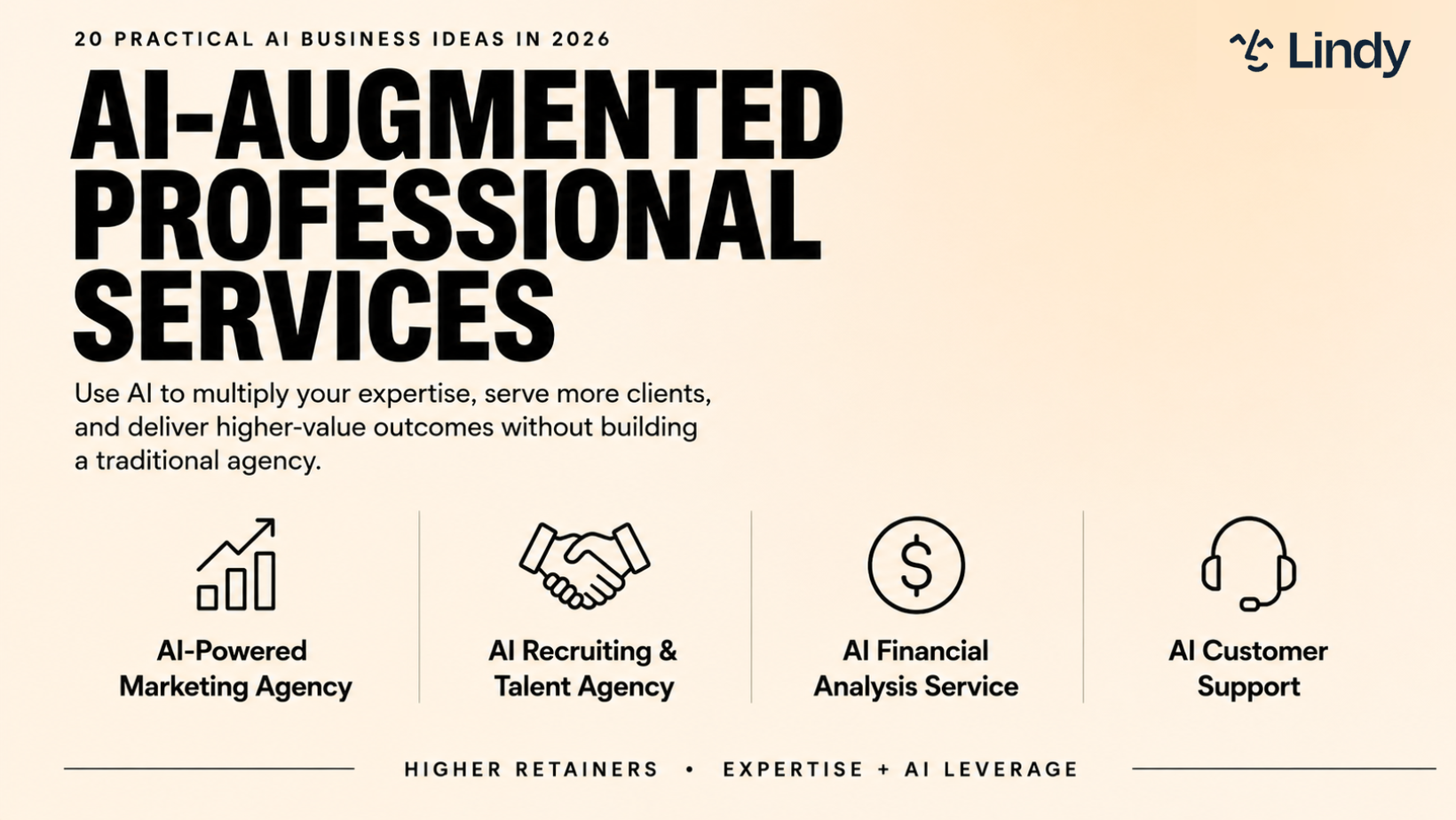
AI-augmented professional services
This category is for people who already have a skill and want to multiply what they can do with it. The idea is to use it to take on more clients, deliver faster, and charge for output rather than hours. A solo marketing consultant running an AI-augmented operation can realistically do the work of a small team.
The clients are bigger, the retainers are higher, and the work is more interesting because AI handles the parts that used to eat your day.
11. AI-powered marketing agency
Most small businesses need serious marketing help, but cannot justify paying a traditional agency $10,000 a month for it. That is the gap. You run a lean, AI-native operation that produces the volume of a full team at a fraction of the cost, and you charge somewhere in between.
AI handles the production side, generating ad variations, writing copy, monitoring performance data, and adjusting SEO strategy based on what is working. You handle the strategy, the client relationship, and the judgment calls that AI cannot make on its own.
How it works: You take a client's brief and use AI to generate high volumes of content and ad variations fast. Instead of spending three weeks producing five ad concepts, you produce fifty variations in a few days, test them, and optimize based on real performance data. The AI also monitors search trends and flags opportunities your clients would otherwise miss entirely.
How to get started: Pick one service to lead with, either paid social ads or SEO content, not both. Find your first two clients in a niche you already understand. Local service businesses, such as dental clinics or med spas, are a reliable starting point because their needs are predictable and their budgets are reasonable.
Tools to use:
- Claude or ChatGPT: Generating copy, ad variations, and content briefs at the volume this model requires without burning through your own time.
- Surfer SEO or Frase: Monitoring search trends and optimizing content so clients see real organic growth, not just a pile of published posts.
- Lindy: Pull performance data and send client updates without opening your inbox. Tell Lindy when reports are due, and it drafts and delivers them on schedule.
Who this is for: People with a genuine marketing background who understand what a good strategy looks like. The AI handles production, but someone still needs to make the calls that determine whether a campaign works or wastes the client's budget.
Limitations: The creative bar is higher than it looks. Generic AI content is everywhere now, and clients can tell the difference between a thoughtful campaign and something that was just generated and shipped. Deep knowledge of media buying and creative strategy is what separates this from a glorified content mill.
12. AI recruiting and talent agency
Recruiting has always been split into two very different kinds of work. The top of the funnel, finding candidates, screening resumes, and scheduling interviews, is repetitive and time-consuming. The close, building relationships, making the right match, negotiating the offer, is where the real judgment lives.
AI handles the first part, and you focus entirely on the second. The result is that one person can run the volume that a traditional agency would need a team of five to manage.
How it works: AI screens resumes against job requirements, handles initial outreach, schedules interviews, and highlights the strongest candidates. You focus on the relationship-driven conversations that reveal whether someone is the right fit beyond what's on their resume. This model typically charges a per-hire fee, often a percentage of the candidate's first-year salary.
How to get started: Specialize in one function or industry before you try to serve everyone. Tech recruiting, finance, or healthcare is a viable starting point with strong demand. Reach out directly to mid-size companies that post roles repeatedly on LinkedIn, because repeated postings signal a hiring process that is not working.
Tools to use:
- Gem or Ashby: Manage the candidate pipeline and automate repetitive communication steps without losing track of where each candidate is in the process.
- Claude: Screening resumes and generating candidate summaries that give you a clear picture of each person before you spend time on a conversation.
- Lindy: Tell Lindy to handle interview scheduling, candidate follow-ups, and client status updates. It keeps the pipeline moving while you stay focused on the conversations that close.
Who this is for: People with backgrounds in recruiting, HR, or sales who are comfortable building relationships over the phone and via email. The AI reduces administrative workload, but the human side of matching people to roles is still where the value lies.
Limitations: AI screening can introduce bias if the criteria it is filtering against reflect historical hiring patterns that were themselves biased. This is a real ethical and legal risk, not a theoretical one, and building in human review of the shortlist is not something you can skip to save time.
13. AI financial analysis service
Small business owners and early-stage founders make financial decisions constantly, and most of them do so without real analytical support. They cannot afford a full-time CFO, and a big firm is not interested in their account.
You fill that gap by offering fractional financial analysis powered by AI, the kind of real-time insight that used to require a team of analysts. Solo operators in this space typically charge $500 to $3,000 a month, depending on the client's size and complexity.
How it works: AI pulls data from the client's bank accounts, accounting software, and financial tools to produce dashboards and forecasts they can act on in real time. You interpret what the numbers mean, flag the decisions that need attention, and give the client a clear picture of where they stand financially without them needing to dig through spreadsheets themselves.
How to get started: The fastest path is to offer a paid initial audit, a thorough review of a client's financial position with clear recommendations. That audit builds trust and almost always leads to ongoing work. Post case studies publicly once you have results to show, because in a high-stakes field like finance, demonstrated proof matters more than any pitch.
Tools to use:
- QuickBooks or Xero: The accounting platform most small business clients already use, so you work with their existing data rather than asking them to change anything.
- Perplexity: Monitoring relevant financial news, market trends, and industry data to inform the analysis you provide.
- Claude: Synthesizing financial data into clear, plain-English summaries and recommendations that clients can act on rather than stare at in confusion.
Who this is for: People with a background in finance, accounting, or investment who can do more than read a spreadsheet. Clients in this space are trusting you with decisions that affect their business, so the credibility of your background matters in a way it does not in less high-stakes categories.
Limitations: Building trust is the hardest part of this business, and it takes time. Clients who have always worked with a human advisor are often reluctant to rely on AI-generated analysis, even when the output is accurate. Proving your methodology through documented case studies and transparent processes is the only thing that moves that needle.
14. AI customer support outsourcing
Customer support is one of those business functions that every company needs, most companies handle badly, and almost nobody enjoys running. Tickets pile up, response times slip, customers get frustrated, and the whole thing becomes a drain on the team.
You take that problem off their hands entirely. You build an AI-first support operation that handles the high volume of routine questions and escalates anything complex to a human, which is either you or a small team, depending on the client's size.
How it works: The AI handles incoming tickets, drafts responses from the client's knowledge base, and routes anything uncertain to a human for review. This human-in-the-loop approach keeps quality high, preserves the client's brand voice, and prevents customers from feeling like they're talking to a robot.
How to get started: Start with one e-commerce client or SaaS company with high support volume and mostly predictable questions. Train the AI on their product documentation and past ticket history, run it in draft mode for two weeks, with everything subject to human review, and then start loosening the reins on the categories where it is performing well.
Tools to use:
- Intercom or Zendesk: The ticketing infrastructure most clients already use, so you slot into their existing system rather than asking them to switch platforms.
- Claude: Drafting support responses that match the client's tone and pull accurate answers from their documentation without inventing anything.
- Lindy: Lindy watches the inbox around the clock, flags anything urgent for your review, and sends a daily rundown of what came in so you can see the full picture at a glance.
Who this is for: People with backgrounds in customer service, operations, or account management who understand what good support looks like from the customer's perspective. The technical setup is manageable, but running a support operation well requires genuine judgment about what deserves a human touch.
Limitations: The biggest risk is allowing the AI to run without sufficient oversight early on. One bad response to an angry customer, especially if it contains wrong information or the wrong tone, can damage a client relationship. Some of those take a very long time to recover from. Quality control is the job, not an afterthought.
{{templates}}
AI for high-value industries
The ideas in the previous categories work for almost anyone. This one is different. These are businesses built for specific industries where the problems are complex, the stakes are high, and the people paying for solutions have real budgets.
The tradeoff is that you need genuine domain knowledge to pull any of these off. A shallow understanding of healthcare or legal work will produce a shallow product, and professionals in those fields will see through it immediately. If you have spent time inside one of these industries, though, the opportunity is real, and the competition is thinner than in the general AI tools space.

15. AI for healthcare documentation
Anyone who has spent time around doctors knows the joke: they went to medical school to help patients and ended up spending half their day on paperwork. Clinical notes, insurance documentation, appointment scheduling, patient follow-ups, it never ends.
AI is starting to eat through that backlog in ways that change how practices operate, and the people building those solutions for clinics are finding a market that is both large and underserved.
How it works: AI transcribes patient visits, generates clinical notes, flags patterns in health records, and manages appointment communications. The physician focuses on the patient while the AI handles the paperwork.
For solo operators without a clinical background, wellness is often the safer starting point. Think nutrition tracking bots, symptom triage tools, or health coaching platforms that avoid regulated medical territory.
How to get started: Start with a non-medical wellness product to avoid the immediate weight of healthcare regulation while you build your understanding of the space.
A Telegram or WhatsApp bot for nutrition tracking, or a simple symptom checker that routes users to the right kind of care, is a viable first product. Once you have traction and a clearer picture of where the real pain is, you move toward clinical tools with the credibility of a working product behind you.
Tools to use:
- ElevenLabs: Natural-sounding voice for patient-facing interactions, which matters more than most people expect because patients judge the quality of a tool partly by how it sounds.
- Claude: Writing clinical notes and patient communications in language that is accurate, clear, and appropriate for a medical context without sounding like it came from a generic AI.
Who this is for: People with clinical, health tech, or medical administration backgrounds who understand both practitioners' needs and regulatory requirements. This is not a space where you can learn as you go on the compliance side.
Limitations: Healthcare AI is one of the most regulated spaces you can enter. Data privacy laws are strict and the consequences of errors are serious. Systems must also be explainable, meaning you need to be able to trace why the AI reached a specific conclusion. Anyone building here without proper legal and compliance guidance is taking on a risk that can end the business before it starts.
16. AI for real estate
Real estate agents lose deals when leads wait too long for a response. A prospect reaches out at 9 p.m., nobody follows up until morning, and they've already booked a showing with someone else. AI helps by responding instantly, qualifying leads, scheduling appointments, and keeping conversations moving around the clock. For agents and brokerages, the value is easy to see.
How it works: A voice AI agent handles inbound calls around the clock, answers questions about listings, qualifies leads against the agent's criteria, and books showings directly on the agent's calendar. Predictive analytics run in the background, tracking market trends and flagging properties likely to move before the broader market catches on.
Document workflows, like DocuSign routing, are handled automatically. The agent focuses on relationships and negotiations, which are where deals are won.
How to get started: Find one agent or small brokerage willing to pilot the system and document exactly what it changes for them over 60 days. A before-and-after story with real numbers, leads responded to, showings booked, deals closed, is worth more than any marketing material when you go to sign your next client.
Tools to use:
- Vapi: Handles the phone infrastructure for the voice AI receptionist, ensuring inbound calls are answered and routed without manual intervention.
- Replit or Lovable: Build the custom logic and dashboards that connect the AI to the agent's calendar, CRM, and document tools without requiring a developer.
- Lindy: Every new lead gets a response within minutes. Tell Lindy the agent's criteria and it qualifies, responds, and logs the interaction in the CRM before the agent ever has to touch it.
Who this is for: People with real estate, sales, or proptech backgrounds who understand the buying and selling process well enough to configure AI that handles it correctly. The tech setup is manageable, but the product only works if the underlying logic reflects how real estate transactions move.
Limitations: AI hallucinations in client communication are a real risk in this industry, and a confidently wrong answer about a property price, a contract term, or a showing availability can damage an agent's reputation with a client who was ready to buy. A human-in-the-loop approval step for anything going directly to clients is not optional in the early stages.
17. AI for legal document automation
Lawyers spend a significant portion of their working hours on documents that follow patterns: NDAs, service agreements, contract redlines, and compliance checklists. The judgment-heavy work, strategy, negotiation, and court is what they went to law school for.
AI can handle most of the production layer, and firms and solo practitioners who adopt it can either take on more clients or charge the same rates while working a fraction of the time.
How it works: The AI generates contracts based on the user's input, performs clause detection to flag unusual or risky language, tracks version history side by side, and sends alerts when renewal or compliance deadlines are approaching.
For B2B work, it automatically redlines contracts against standard positions, turning a multi-hour task into a ten-minute review. Claude is the model of choice here because its writing quality and its ability to maintain precise, consistent language across long documents is stronger than most alternatives.
How to get started: The cleanest entry point for a solo operator is a high-ticket audit model: charge $5,000 for an initial AI legal-tech audit of a firm's document processes, identify the biggest time savings, and implement the tools to capture them. That initial engagement almost always leads to an ongoing relationship because the firm has now seen what is possible.
Tools to use:
- Claude: The strongest available model for legal writing tasks, clause analysis, and maintaining the kind of precise, consistent language that legal documents require.
- Perplexity: A research tool for pulling current case law, regulatory updates, and compliance requirements that inform the documents being generated.
- Spellbook or Harvey: Purpose-built for legal document work and clause analysis, which makes them useful for validating output and supporting the audit process.
Who this is for: People with legal training or deep experience working inside law firms who understand what good contract language looks like and where the real risks hide. The value of this product is entirely in the quality of the legal knowledge behind it, so a surface-level understanding of how contracts work will produce a surface-level tool.
Limitations: The legal industry has strict rules around AI, and the cost of getting something wrong can be high. Systems need safeguards against biased outputs, and anything involving legal advice requires proper oversight. Before starting, make sure you understand the line between automating legal documents and practicing law.
Digital products and productized AI
Build something once, sell it forever, wake up to Stripe notifications. That version of it is real, but it takes longer to get there than most people expect, and the graveyard of generic AI products that never found an audience is enormous.
The ones that work have one thing in common: they are built around specific expertise, not just AI output. If your product gives someone something they cannot get by opening ChatGPT themselves, you have a business. If it does not, you have a side project that makes $200 a month.

18. AI prompt libraries and templates
Most people who use AI tools professionally know the frustration of spending twenty minutes trying to get a decent output from a vague prompt. The people who have figured out exactly how to prompt an AI for a specific task, a legal brief, a performance review, or a product description have something valuable.
You package that expertise into a library of tested, ready-to-use prompts and sell access to it. The businesses and creators who buy it are paying for the hours of trial and error you already did, so they do not have to.
How it works: You build a collection of prompts organized around a specific use case or industry. A buyer purchases access, drops a prompt into their AI tool of choice, and gets a better output than they would have produced on their own.
The best versions go beyond a simple document and wrap the prompts in a custom interface that handles the input and output automatically. That is where the real scale lives.
How to get started: Pick one professional context you understand well and build ten to fifteen prompts that solve real problems in that context. Test every single one yourself, document the outputs, and only sell what you would use. Start on Gumroad or a simple Notion page before you build anything more complex. Validation before infrastructure, always.
Tools to use:
- Claude or ChatGPT: Both for building and testing your prompts, because a prompt library that has not been rigorously tested across different inputs is not a product; it is a guess.
- Gumroad or Lemon Squeezy: The fastest way to start selling digital products without building a full e-commerce setup before you know anyone wants what you are selling.
- Notion or a lightweight Webflow build: Delivers the library in a clean, navigable format that feels like a real product rather than a shared Google Doc.
Who this is for: People with deep expertise in a specific professional field who have spent enough time with AI tools to know exactly what makes a prompt work. The more niche your expertise, the more valuable your prompts, because the people who need them have fewer alternatives.
Limitations: Generic prompts are worthless. Anyone can Google "best ChatGPT prompts for marketing" and get ten thousand free options. The only thing that justifies someone paying for your library is the depth and specificity of what it contains. If you are not bringing genuine expertise to the prompts themselves, the product has no real floor beneath it.
19. AI newsletter or research product
There is more information published every day than any professional can meaningfully process. The people who cut through that noise for a specific audience, filtering, synthesizing, and delivering only what actually matters, have always had an audience.
AI makes it possible to do that at a pace and consistency that was not realistic for a solo operator before. A focused newsletter for the right professional niche can generate strong recurring revenue through subscriptions. In high-value niches, the best newsletters can build meaningful recurring income that grows as the audience expands.
How it works: You pick a professional audience with a real information problem, whether that is founders, HR leaders, finance professionals, or anyone overwhelmed by noise, and publish a product that helps them stay informed. AI handles the research, aggregation, and first drafts.
You provide the editorial judgment like what matters, what the data means, and what readers should do next. That human insight is what makes the product valuable and helps it stand out from fully automated content.
How to get started: Start with a free version to build an audience before you ask anyone to pay. Commit to a publishing schedule you can actually maintain. Weekly is more sustainable than daily for a solo operator, and stick to it long enough to see whether the audience grows. Once you have 500 engaged subscribers, you know whether there is something worth building a paid tier around.
Tools to use:
- Perplexity: Research and aggregation across live sources, which means your newsletter reflects what is happening now rather than what was indexed six months ago.
- Claude: Synthesizing research into clear, readable summaries that sound as if a knowledgeable person wrote them, rather than a model asked to meet a word count.
- Beehiiv or Substack: Both handle publishing, subscriber management, and paid tiers without requiring any technical setup, which means you can focus entirely on the content.
Who this is for: People who are curious about a specific domain, good at distinguishing what matters from noise, and able to write clearly under a deadline. Prior journalism, research, or analyst experience translates well here, but what matters most is whether you can consistently produce something your audience finds worth opening.
Limitations: Fully automated AI newsletters get buried. Platforms have gotten better at identifying content that lacks a genuine human perspective. Readers have gotten better at sensing when they are reading something nobody actually thought about. The human editorial layer is not a nice addition. It is the entire value proposition, and cutting it to save time will eventually kill the product.
20. AI-powered e-commerce store
Traditional dropshipping required finding products, setting up a store, writing listings, running ads, and hoping the margins survived platform fees. AI speeds up much of that work, allowing someone who moves quickly and chooses the right niche to launch and start generating revenue far faster than a traditional operator.
How it works: AI handles product research, store copy, ad creative generation, and customer communication. You focus on the strategic decisions: which niche, which products, which platform, and how to read what the data is telling you about what is working. UGC-style AI video ads drive traffic from TikTok Shop or Meta, and the store converts that traffic into sales.
The margin comes from the spread between what you pay for the product and what the customer pays you. If you run a TikTok Shop affiliate model, you earn commissions instead of holding inventory.
How to get started: Pick a niche where people buy to solve a real problem, not just because a product looks appealing. Skincare, supplements, and pet products often work well because customers buy them repeatedly.
Build a simple Shopify store, create five to ten AI-generated video ads, and put $100 behind the best performer. Then use the results to decide whether the niche is worth investing in further.
Tools to use:
- Midjourney or Kling: Generate realistic product videos from static images that perform like genuine UGC content rather than obvious AI productions.
- Build Your Store AI or Shopify: Set up the store quickly with AI-generated product descriptions, pricing, and layout without spending a week on setup before you have validated demand.
- CapCut: Edit, caption, and format the video ads for each platform to match the native content styles of TikTok, Instagram, and Meta, respectively.
Who this is for: People with a feel for consumer products and an understanding of what drives purchase decisions on short-form video platforms. You do not need a background in e-commerce, but you do need to be interested in understanding why people buy things, because that instinct is what separates stores that scale from stores that generate a few hundred dollars and stall.
Limitations: The biggest mistake in this space is building around a product that is a nice-to-have rather than something people feel they need. Seasonal products spike and disappear, and trend-chasing without a repeatable niche to back it up means you are starting from scratch every few months.
Data quality also matters. If the AI is making product or ad recommendations based on poor inputs, the results will reflect that, and customer trust is difficult to rebuild once it is gone.
{{cta}}
What to know before you start an AI business
Starting an AI business sounds straightforward until you are three months in and nobody is paying you. You built something before validating it, chose a regulated industry without consulting a lawyer, and spent more time perfecting the product than selling it.
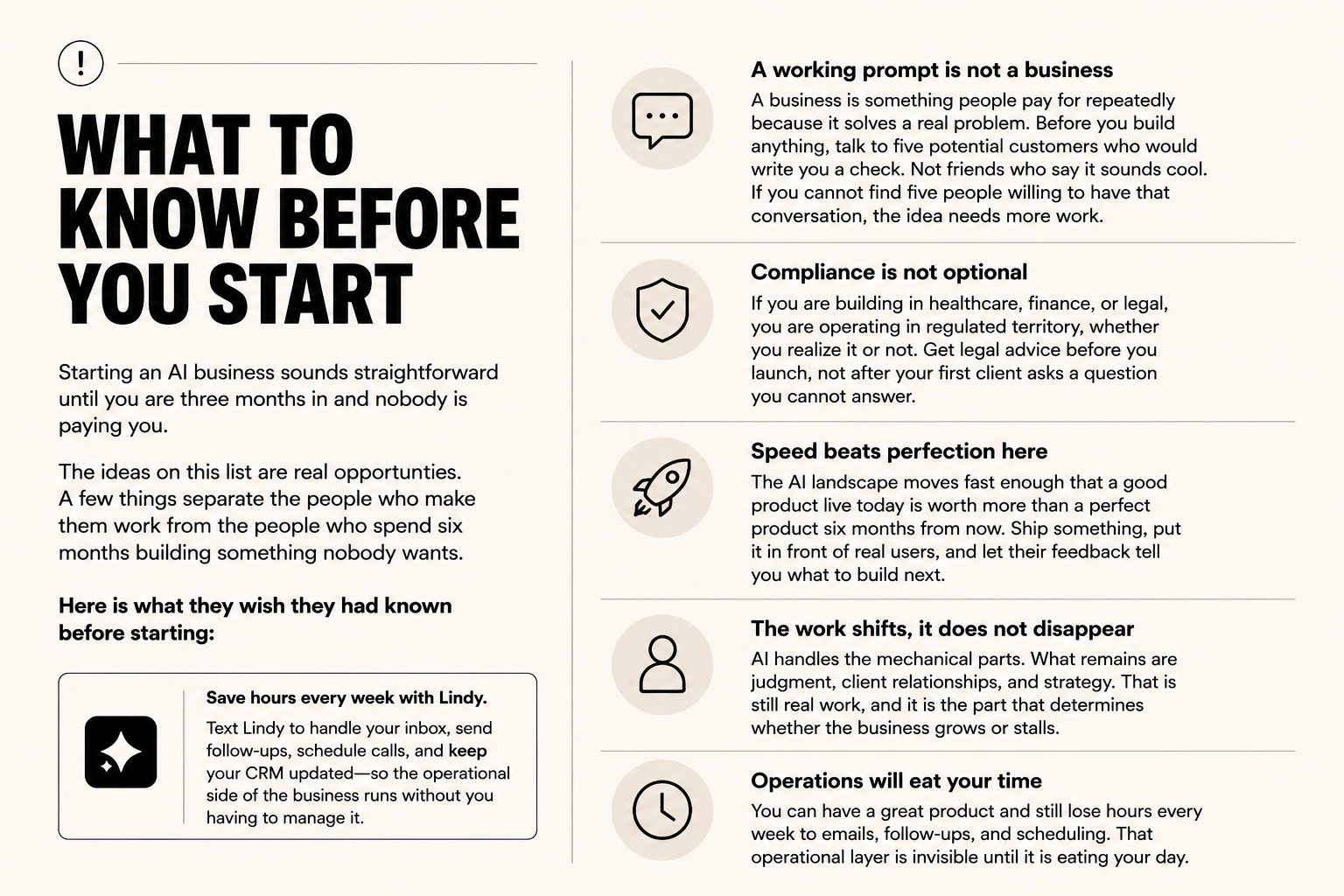
The ideas on this list are real opportunities. A few things separate the people who make them work from the people who spend six months building something nobody wants.
Here is what people wish they had known before starting:
- A working prompt is not a business: A business is something people pay for repeatedly because it solves a real problem. Before you build anything, talk to five potential customers who would write you a check. Not friends who say it sounds cool. If you cannot find five people willing to have that conversation, the idea needs more work.
- Compliance is not optional: If you are building in healthcare, finance, or legal, you are operating in regulated territory, whether you realize it or not. Get legal advice before you launch, not after your first client asks a question you cannot answer.
- Speed beats perfection here: The AI landscape moves fast enough that a good product live today is worth more than a perfect product six months from now. Ship something, put it in front of real users, and let their feedback tell you what to build next.
- The work shifts, it does not disappear: AI handles the mechanical parts. What remains are judgment, client relationships, and strategy. That is still real work, and it is the part that determines whether the business grows or stalls.
I learned the last one the hard way. You can have a great product and still lose hours every week to emails, follow-ups, and scheduling. That operational layer is invisible until it is eating your day.
Try Lindy: The AI assistant you can text to get work done
I have seen this across every business on this list. The work itself is manageable. What gets people is the operational side, like follow-ups that slip, a CRM that never gets updated, an inbox that fills up while you are heads-down on a client.
Lindy is the AI assistant you text in plain English to get work done. I use it to handle the admin layer so I can stay focused on the work that moves the business forward.
Here is what that looks like when you are running one of these:
- Chase approvals without the inbox chase: Tell Lindy who has not replied, and it drafts a follow-up for you to review before anything goes out.
- Send outreach without writing every email: Ask Lindy to draft and send personalized messages from your lead list. It tracks replies and flags the ones that need your attention.
- Log every call without touching your CRM: Tell Lindy what happened. It records the interaction and sends the follow-up automatically.
- Never miss what matters in a meeting: Lindy joins meetings, writes structured notes, and sends action items to everyone afterward.
- Work across the tools you already use: Lindy connects with Gmail, HubSpot, Slack, and hundreds of other apps, so nothing needs to move to a new platform.
FAQs
What's the easiest AI business to start with no experience?
An AI content agency is the easiest AI business to start with no experience. You use tools like ChatGPT or Claude to produce blog posts and social media content for small businesses, edit the output, and charge a monthly retainer fee. No technical background required.
How much can you realistically make with an AI business in year one?
Realistically, an AI service business in year one can generate anywhere from $2,000 to $15,000 a month, depending on how fast you land clients and how well you systematize delivery. Product businesses take longer but have higher ceilings once they find traction.
Do you need to know how to code to start an AI business?
No, you do not need to know how to code to start an AI business. Tools like Lovable, Replit, and Bubble let you build functional products by describing what you want in plain English. Most service businesses on this list require no technical skills at all.
What's the difference between an AI service business and an AI product business?
An AI service business trades deliverables for money; you do the work, and the client pays you. An AI product business sells something you built once to many customers. Services generate income faster. Products scale better over time.
Is it too late to start an AI business in 2026?
No, it is not too late to start an AI business in 2026. Most industries have barely scratched the surface of AI adoption, and the tools available now make it easier than ever to build something real without a technical background or outside funding.
How long does it take to get your first paying client for an AI service business?
Most people land their first paying client for an AI service business within two to four weeks of actively pitching. The fastest path is to pick one niche, offer a free sample, and convert that into a retainer conversation.
What is the biggest mistake people make when starting an AI business?
The biggest mistake people make when starting an AI business is building before validating. A working prompt or a polished Notion template is not a product until someone pays for it. Talk to five potential customers before you write a single line of code or spend a week on setup.









